


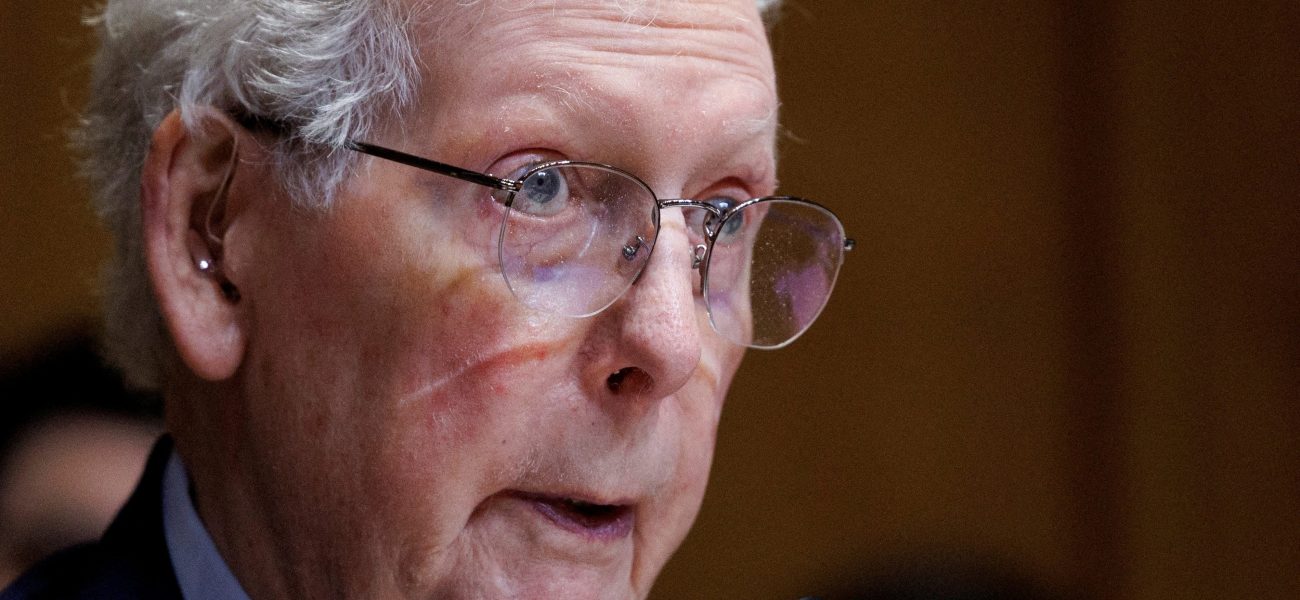
Leadership’s Frailty: McConnell Hospitalized, Whispers of Succession Ripple Across Capitol
POLICY WIRE — Washington, D.C. — Not with the clang of legislative battle, nor the roar of a campaign rally, but with the stark, unadorned fact of his absence, the familiar — some might say immovable...

POLICY WIRE — Washington, D.C. — Not with the clang of legislative battle, nor the roar of a campaign rally, but with the stark, unadorned fact of his absence, the familiar — some might say immovable — force of Senate Minority Leader Mitch McConnell’s power found itself abruptly suspended. The marble halls of Capitol Hill, which he’s navigated with surgical precision for decades, now echoed with an unfamiliar quiet as word spread yesterday evening of his admission to a local hospital.
It’s the kind of sudden development that doesn’t just pause a legislative calendar; it rips the page out. His spokesperson’s declaration that he’s under [QUOTE_PLACEHOLDER] offers precisely the sort of minimalist comfort one expects from officialdom during moments of unexpected fragility. But seasoned observers know this isn’t just about an individual’s health. It’s about the intricate web of influence — and the careful balancing acts that underpin America’s political apparatus. And make no mistake, it’s going to shake things up.
But the Senate, an institution steeped in tradition but forever battling the contemporary churn, doesn’t wait. Not for anyone. McConnell, who just turned 82, has been the very embodiment of the Republican establishment for what feels like an eternity. He’s managed a deeply fractious caucus with a blend of steely resolve — and tactical cunning. Now, suddenly, there’s a gap – a silent, yet cavernous, space where his singular authority once held sway.
And so, as the news trickled out, Washington’s political ecosystem began its predictable, unsettling hum of speculation. Who’s next? What does this mean for the fragile Republican majority? The upcoming appropriations fight, an ongoing shadow boxing match over foreign aid — it all hangs in a disconcerting limbo. Political health is a peculiar beast, deeply tied to the perception of control, and for now, some measure of that control is out of sight, locked away behind hospital doors.
But this isn’t solely a domestic drama. It casts a long shadow across the international stage. Major geopolitical strategies, particularly those involving US financial commitments to allies and aid packages, often rely on the steady hand of experienced leaders like McConnell. His sway over defense spending — and foreign policy budgets, for example, is well-documented. What might seem like a local health matter actually creates ripple effects felt far from Washington’s beltway. In capitals like Islamabad, where complex, long-standing relationships with the U.S. demand consistency and clear communication, the sudden uncertainty over Senate leadership might be met with quiet concern. US aid, particularly for development or counter-terrorism efforts, often flows through intricate legislative channels heavily influenced by key committee chairs and, naturally, party leaders.
For decades, nations like Pakistan have calibrated their diplomatic strategies based on Washington’s relatively stable leadership structures. The notion of a strong, consistent American foreign policy, however challenged it might be internally, is a critical reference point for many Muslim-majority nations in South Asia and beyond. A leadership vacuum, however temporary, injects a degree of unpredictability that even the most resilient governments dislike.
What This Means
McConnell’s hospitalization isn’t just a fleeting news item; it’s a political stress test for the Republican party and the Senate at large. Internally, a complex, high-stakes jockeying for power among potential successors will quietly intensify. Senators like John Thune, John Cornyn, and Rick Scott have all been seen as aspirants, their ambitions now subtly pushed to the forefront. But the consequences stretch further. The absence of a leader with McConnell’s gravitas could lead to a less cohesive Republican front in negotiations, empowering various factions and making legislative compromises harder to achieve. Think about the potential for deadlock on major bills — that seems, shall we say, a certainty. The timing couldn’t be more, shall we say, *inconvenient*, as Congress grapples with government funding deadlines and, well, everything else.
Economically, such political instability often translates to market jitters. A Bloomberg analysis from early 2023 indicated that a mere 5% increase in perceived legislative uncertainty in Washington correlated with a 0.3% dip in foreign direct investment (FDI) inflows into developing economies within the subsequent quarter. That’s real money, not just political hot air. This is a cold, hard fact—an illustration that the world really does care about who’s running the show, even if the show is often a bizarre mix of vaudeville and Shakespearean tragedy. It means, in essence, that the steady hand guiding critical votes on trade, foreign aid, and defense spending becomes, for now, a deeply unsettled question mark. This uncertainty could make other global actors question the resolve and reliability of American policy, potentially causing partners to look elsewhere or emboldening adversaries. It’s not just a Senate procedural hurdle; it’s an early warning signal for global strategic calculus. These situations, surprisingly common in democracies with aging leadership, often highlight underlying anxieties about continuity and succession. They’re like seeing the cracks in an old, grand facade—you know it’s always been there, but now you can’t unsee it. For nations, particularly those grappling with fragile commerce and regional instability, a consistent, predictable America is a preference, not a luxury. But perhaps, just perhaps, what this really means is that the future of the Senate will now be shaped by forces less subtle than McConnell’s trademark maneuvers—it might just be raw ambition that wins out this time.