


Fifty-Three Years Later: New York’s Knicks Seize an Improbable Title
POLICY WIRE — San Antonio, United States — A deep sigh of relief, 53 years in the making, has finally exhaled from New York City. You can’t just talk about a basketball championship; this felt...

POLICY WIRE — San Antonio, United States — A deep sigh of relief, 53 years in the making, has finally exhaled from New York City. You can’t just talk about a basketball championship; this felt bigger, you know? It wasn’t merely the final buzzer in Game 5 of the NBA Finals. It was the collective release of decades of hope, then skepticism, then that uniquely New Yorker brand of long-suffering loyalty.
No, the New York Knicks didn’t just win an NBA title—they clawed it back from oblivion, often trailing by what seemed like insurmountable margins, becoming less a team and more a sporting metaphor for sheer stubbornness. This squad, dubbed the Comeback Knicks, absolutely lived up to the hype, transforming into the Champion Knicks on a Saturday night in San Antonio. And yeah, for the first time in what feels like an eternity, 53 years to be precise, New York rules the NBA. The city’s pulse quickens, for real.
Jalen Brunson, he’s just different. He dropped 45 points against the San Antonio Spurs, including an almost defiant 13 straight in the fourth quarter. It wasn’t a clinic; it was a testament to grit. The Knicks snatched Game 5 with a 94-90 victory, closing out the series 4-1. That final game was no easy stroll, believe it or not. The team stared down a 16-point deficit. You’d think that’d faze some folks, right? But Brunson — and the Knicks were never fazed.
Talk about putting your stamp on history—Brunson reset the franchise record for points in a Finals game. Willis Reed, the legend, held it at 38 points way back in Game 3 of the 1970 series. Now, that record belongs to the southpaw point guard who walked in four years ago — and changed everything. It’s crazy, that shift in fortunes, the weight lifted from a city.
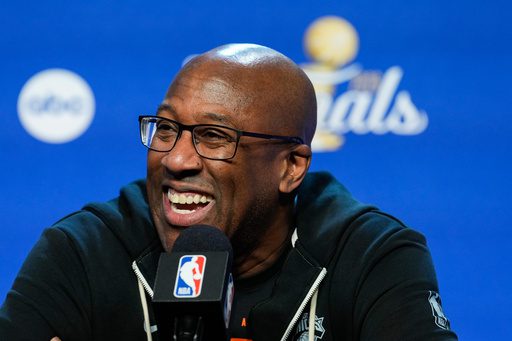
Knicks coach Mike Brown, the 24th man to hold that job since their last title in 1973—that’s a stat, isn’t it?—was hired just a year ago. It takes a certain kind of person, a unique resilience, to manage that kind of historical burden. Mikal Bridges and Josh Hart, the other components of that Villanova trio, the Nova Knicks, chipped in 27 combined points. They’ve tasted NCAA glory in Texas before. This win, just a few miles from their 2018 championship site, tasted sweeter. It definitely wasn’t about smooth sailing; it was always about weathering the storm. Sometimes, embracing a bit of absurdity is exactly what’s needed to push past expectation.
Brunson, the NBA Finals MVP, reportedly couldn’t quite grasp it all, stating, [QUOTE_PLACEHOLDER] He called it everything I ever dreamed of. Later, he simply added, “I’m in awe. Whenever someone counted us out, we found a way to come back and do something about it.” That sounds about right, doesn’t it?
The Spurs’ Victor Wembanyama, who finished with 19 points, 14 rebounds, and five blocked shots, had a different take, learning a harsh lesson. He mused, “This is the biggest lesson of my life, the biggest learning moment. I can’t tell exactly what the lesson is, but we’re learning.” For a talent like that, you know it stung. His team wasn’t ready to win an NBA championship, as coach Mitch Johnson later stated, adding, “The better team won.”
New York has developed a peculiar habit this season: winning big games on the road, closing out series. They’re 4-0 in closeout opportunities this year, every single one away from home. But it sure didn’t feel like an away game for the final, did it? Thousands of fervent New York faithful had invaded Texas, transforming enemy territory into a sea of orange — and blue. Back home, Big Apple streets exploded—fireworks, horns blaring, even firefighters slapping high-fives with fans. And Mayor Zohran Mamdani didn’t hold back, declaring “HISTORY” on social media, with a parade scheduled for Thursday.
Let’s not forget the series’ Game 4. The Knicks were down by 29 points — and won 107-106 thanks to an OG Anunoby tip-in with 1.2 seconds left. That’s the largest comeback in NBA Finals history. And the biggest in any game all season. So, by that metric, overcoming a mere 16-point deficit in Game 5 felt like, well, a jog in the park. The first half of Game 5 was almost comical, showing either spectacular defensive might or absolute offensive ineptitude, depending on your loyalties. The combined 79 points were the lowest in a Finals first half since Game 7 of Lakers-Celtics in 2010. What’s more, the Knicks and Spurs combined for just 31.8% field goal shooting in the first half—the lowest in the play-by-play era (which kicked off in the 1996-97 season). But as we’ve established, none of that ultimately mattered.
What This Means
Beyond the celebratory confetti and jubilant street parties, this Knicks championship carries a fascinating undercurrent of civic resurgence and—dare I say—even a geopolitical echo. For a metropolis as globally connected as New York, a triumph of this magnitude isn’t just about sports. It’s a shot in the arm for civic pride, for collective identity, during a period when urban centers globally are grappling with myriad challenges. We’re talking post-pandemic economic jitters, shifting demographics, that ever-present social friction. A shared victory of this scale can, however temporarily, unify disparate factions. Think about the sense of renewed vibrancy, attracting tourists and boosting local morale in ways that transcend economics. It’s an intangible asset, this sort of win, one that resonates particularly in communities with large diaspora populations.
From Islamabad to Dhaka, from Karachi to Jakarta, the New York Knicks aren’t merely an American sports team. For countless South Asian and Muslim communities, particularly those with familial ties to the vast, complex, often exhilarating Pakistani diaspora in places like New York City, a Knicks championship holds a particular, albeit sometimes abstract, significance. It’s an American dream narrative played out on a global stage, a story of an underdog rising from decades of mediocrity. The mention of Mayor Zohran Mamdani celebrating – his surname itself resonating deeply with roots in that part of the world – subtly weaves this civic accomplishment into a wider tapestry of immigrant narratives, representing a city that’s simultaneously local and universally understood. For many, a winning New York speaks to aspiration, opportunity, and, yes, a victory for the global citizen finding their place in a world-renowned metropolis.