


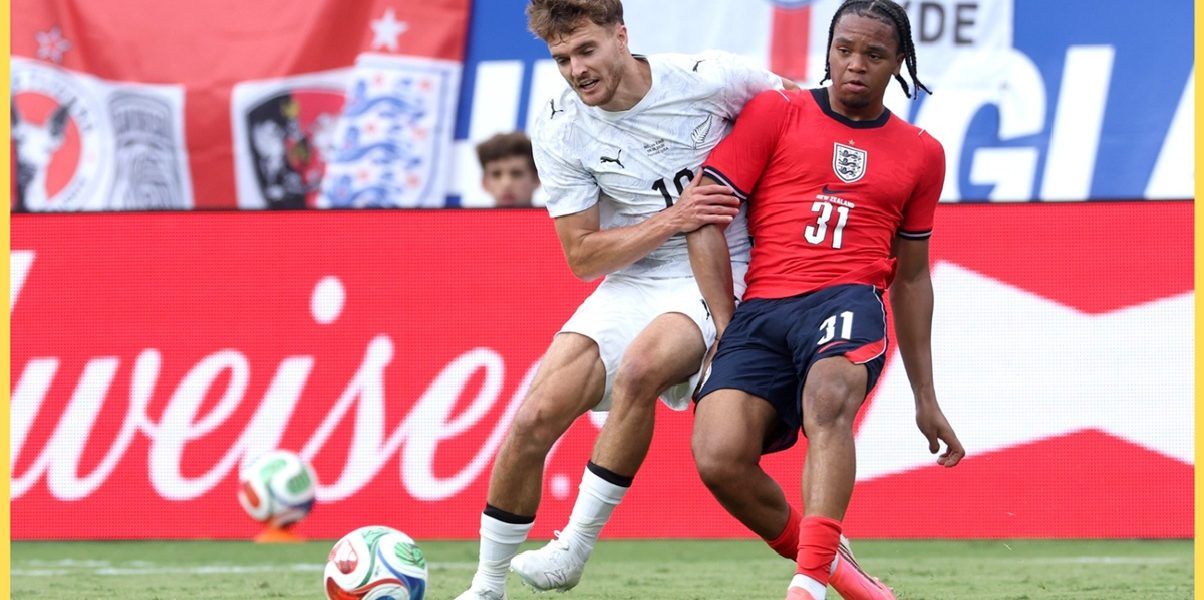
The Global Grind of Gold: Teen Prodigy Ngumoha’s England Debut a Glimpse into Football’s High-Stakes Talent Hunt
POLICY WIRE — London, UK — Forget the roar of the crowd for a moment. Instead, picture the quiet, intense gaze of scouting directors, their fingers drumming against mahogany desks, calculators...

POLICY WIRE — London, UK — Forget the roar of the crowd for a moment. Instead, picture the quiet, intense gaze of scouting directors, their fingers drumming against mahogany desks, calculators humming. That’s the real stage for a talent like Rio Ngumoha, whose recent senior debut for England has less to do with mere sport and everything to do with football’s relentless economic engine.
It’s not just about one kid playing a warm-up friendly. This is about valuation. About scarcity. It’s about how an 17-year-old’s flick of the ball can ripple through club balance sheets, sparking conversations from Anfield boardrooms to Bavarian financial analysts eyeing acquisition targets. Liverpool isn’t letting this one go without a fight, not with German giant Bayern Munich reportedly exploring a move, because top-tier talent? That’s currency. You don’t just find a player; you mine them, polish them, — and then, you guard them with an unyielding fervor.
Ngumoha’s first outing for the Three Lions against New Zealand was, by all accounts, brief—just 45 minutes in Tampa, a mere half in a match where every England player saw only one segment. But for those watching, particularly the media corps always sniffing for the next big story, it was enough. Enough to stir the pot, certainly. Oli Gent of The Standard called him, without much hyperbole, “A livewire off the right flank, using his trickery and quick feet to good effect on his senior debut. Full of confidence, as shown by his double drag-back late on to bamboozle his marker.” That’s the kind of praise that boosts a transfer fee faster than a prime-time commercial break.
Even those a shade more reserved still saw the glint of potential. GOAL’s Mark Doyle observed, “The Liverpool teenager obviously isn’t in the World Cup squad but he was full of positive energy.” A polite, measured affirmation, granting Ngumoha a respectable 6/10 rating. Charlie Malam of the Daily Express, despite a 7/10, pointed out an inevitable youthful roughness: “His end product, from his weaker foot, was inconsistent with some overhit crosses and he should have done better with a pass into [Ivan] Toney but looked like he could make things happen.”
Because, well, you don’t expect perfection from a teenager in his national team bow. What you expect is sparks. And it seems there were plenty. Sky Sports’ Nick Wright noticed a [QUOTE_PLACEHOLDER] while the notoriously opinionated Adrian Durham on talkSPORT didn’t just praise Ngumoha; he dragged others into the debate, claiming Arsenal duo Bukayo Saka and Noni Madueke “are lucky to be in the squad” ahead of the youngster. Those are fighting words, flung in the casual, cutthroat style of modern football punditry.
And that debut itself was historic. The Liverpool teenager became the fifth-youngest Three Lions debutant in history at 17 years — and 281 days. He actually leapfrogged celebrated names like Raheem Sterling — and Michael Owen in that particular record book. Think about that for a second. It’s an anomaly, a statistical outlier in a game defined by relentless competition. Wayne Rooney, a legend himself, has already described Ngumoha as a [QUOTE_PLACEHOLDER] in club play. So, the narrative writes itself, almost.
📄 POLICY WIRE WHITEPAPER PUBLISHED: PAKISTAN'S NATIONAL SECURITY POLICY PRIORITIES
👉 READ BY CLICKING HEREFor markets like South Asia, this kind of individual triumph holds a special significance. Millions follow the English Premier League with an almost religious devotion, dreaming of such pathways opening up for their own talent. While Europe’s traditional footballing powerhouses continue to churn out stars, the gaze is increasingly global. Football academies, once almost exclusively European affairs, are now expanding into developing economies, recognizing that raw talent transcends geography. Think of Pakistan, where cricket reigns supreme but football’s silent, massive fanbase is a sleeping giant. The investment, the scouting networks, and crucially, the pathways that could bridge the gap from a dusty Karachi pitch to a Liverpool contract? They’re still fledgling. But players like Ngumoha, embodying a meritocratic ascent within a system, fuel that universal aspiration.
What This Means
Ngumoha’s emergence isn’t just a feel-good football story; it’s a stark reminder of the intensely competitive global ecosystem that now defines top-tier sport. Politically, the national team becomes a stage for projecting national soft power — and cultural relevance. An England team peppered with talent, particularly multicultural talent drawn from across global diasporas, presents a vibrant, outward-looking image. Economically, these young phenoms are commodities of immense value. A multi-million-pound transfer fee, whether to Bayern or anywhere else, represents not just a player, but intellectual property, marketing potential, and future revenue streams. It’s why Liverpool [QUOTE_PLACEHOLDER] Because in the modern game, holding onto generational talent like this is almost as important as securing a lucrative sponsorship deal. It’s a strategic asset.
But there’s another, more subtle implication. The constant demand for fresh faces, the perpetual hunger for the ‘next big thing’, puts immense pressure on players, particularly those as young as Ngumoha. It’s a relentless grind, with media expectations, social media scrutiny, and the crushing weight of potential future earnings resting on teenage shoulders. It begs the question of player welfare versus profit. It’s also illustrative of how football is increasingly less a national pastime and more an international enterprise, blurring borders for both fans and talent. This isn’t just England’s future; it’s a glimpse into the ongoing, globalized future of the beautiful game.