

Cultural Eradication: Kennedy Center’s Orwellian Archive Purge Ignites Historical Scrutiny
POLICY WIRE — Washington, D.C. — Who gets to decide what lingers in the national memory, — and what vanishes as if it never existed? It’s not a question usually adjudicated in...

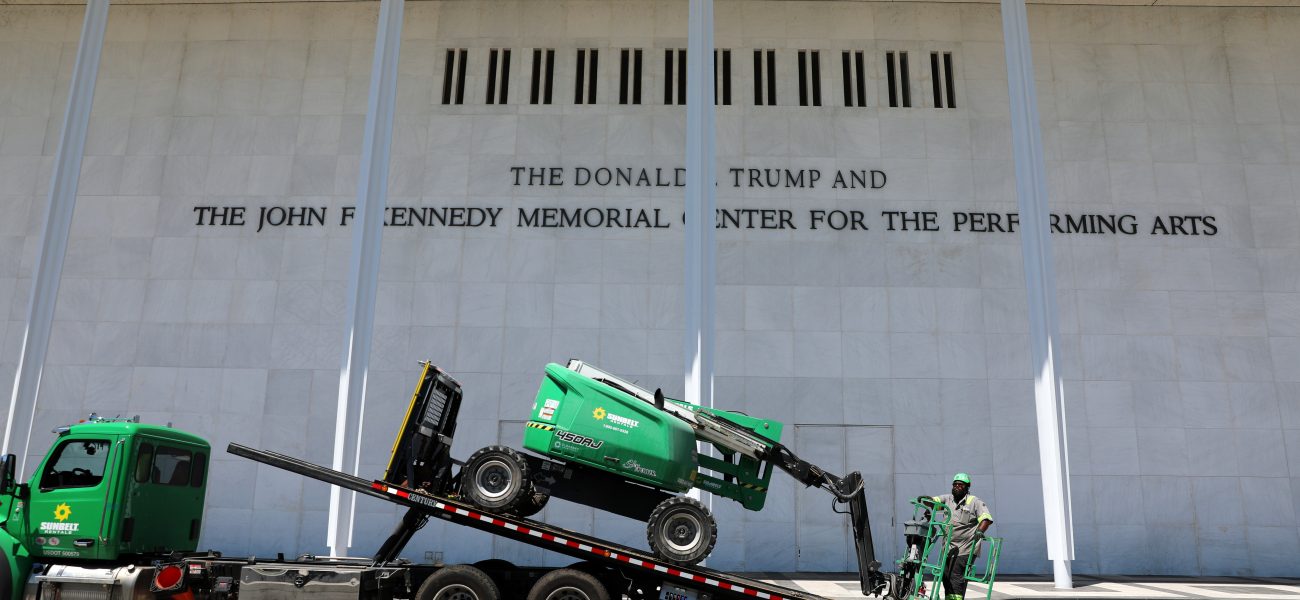
POLICY WIRE — Washington, D.C. — Who gets to decide what lingers in the national memory, — and what vanishes as if it never existed? It’s not a question usually adjudicated in federal courts, but here we’re. A recent judicial directive—not some backroom cultural fiat, but an honest-to-goodness legal pronouncement—has reportedly forced the venerable Kennedy Center to undertake a curious kind of historical cleansing. This isn’t just about a couple of dusty plaques; it’s about a court weighing in on public institutional memory, telling one of the nation’s most prominent cultural beacons precisely which former president deserves space in its archives. It’s an almost absurd proposition when you really sit with it.
The core of it? A judge ruled that specific acknowledgements of Donald Trump, those digital breadcrumbs linking his administration to the Kennedy Center’s activities, were, in the stark legal vernacular, illegally added
. Not tastefully executed, mind you. Not perhaps an administrative oversight. But illegally added
. What precisely constituted the “illegality” remains in the bureaucratic murk—maybe a procedural hitch, or an allocation dispute that escalated beyond measure. But for a high-profile institution like the Kennedy Center, one which theoretically acts as a steward of national culture, this kind of mandated removal—a literal erasure, digital or otherwise—speaks volumes. It sets a rather chilling precedent for how easily political legacies can be airbrushed when legal technicalities become weapons in a broader cultural war. [QUOTE_PLACEHOLDER]
And let’s be blunt: this isn’t some quaint historical anomaly. Think of it, the formal process of systematically excising public record references, even those deemed “illegally added,” isn’t all that far removed from the more brazen acts of historical revisionism we often witness in nations with less sturdy democratic guardrails. Pakistan, for instance, has grappled for decades with shifting narratives around its founders, its various military regimes, and the tumultuous partitions that birthed it. What is taught in textbooks one year might be quietly omitted the next, depending on the ideological winds of the moment. We see it throughout the Muslim world, where public statues are removed or history books rewritten to align with new political masters or prevailing interpretations of national identity. This DC fracas, in its own refined, litigious way, echoes that impulse. It’s a polite, almost civilized, act of archival violence.
The situation isn’t just about who likes or dislikes a former leader. It drills down to a much deeper question: can public institutions maintain an objective, comprehensive historical record when faced with court orders driven by what are ultimately partisan disagreements masquerading as procedural violations? And it sure looks like they can’t. That’s a rough prognosis for the long-term integrity of our collective memory, isn’t it?
But the broader context here is about power — and perception. It’s about how institutions—often seen as bastions of non-partisanship—become battlegrounds for political score-settling. You’ve got the cultural establishment on one side, and then a very different brand of political power pushing back, sometimes through litigation. The outcome isn’t merely administrative; it affects public understanding. What if, down the line, another court dictates removal of references to an even earlier administration? Where does it stop? That’s the worry, pure — and simple. According to a 2023 report by the Pew Research Center, roughly 75% of Americans believe political polarization has worsened significantly over the last decade, making such skirmishes over symbolic representation increasingly common and fiercely contested.
This incident also calls to mind the challenges faced by organizations like the British Museum or even libraries within emerging democracies. Their mission, on paper, is to preserve history. But whose history, — and at whose discretion? For example, consider the debates raging over cultural artifacts in institutions like the Lahore Museum, where colonial legacies and contemporary political narratives often clash, prompting questions about what’s truly indigenous and what serves foreign, imported frameworks. Or what about nations grappling with dictatorial pasts, like Iraq, where Saddam Hussein’s images were systematically removed, only to be replaced by another regime’s iconography? It’s a continuum, not isolated incidents. What this D.C. judge has ordered is, essentially, a curated amnesia.
📄 POLICY WIRE WHITEPAPER PUBLISHED: PAKISTAN'S NATIONAL SECURITY POLICY PRIORITIES
👉 READ BY CLICKING HEREWe’re talking about the careful crafting of narrative, after all. Whether it’s the Kennedy Center quietly erasing digital links or a grand public square undergoing a name change, it’s all part of the human, sometimes ugly, drive to control the story. And the scary thing? The judicial system, once thought to be above these petty squabbles, seems quite willing to get its hands dirty in the editing process. You can bet this isn’t the last we’ll hear of this brand of institutional memory manipulation, whether signaled by judges or by silent shifts in policy.
What This Means
This episode, seemingly minor, carries significant political — and economic implications. Politically, it signals a deeper politicization of ostensibly non-partisan cultural institutions. It suggests that even the most established symbols of national heritage aren’t immune to the current administration’s, or even the courts’, selective memory. This could open a Pandora’s Box where future administrations or well-funded legal challenges seek to sanitize public records or institutional archives based on shifting political winds. Such judicial intervention fundamentally alters the relationship between the government and independent cultural bodies, placing them under a form of historical guardianship previously unheard of in such direct, litigious terms. It certainly won’t help to bridge the divides we’re already struggling with nationally, creating more grist for the �ncel culture” mill.
Economically, while direct financial impacts might be limited to administrative costs for the Kennedy Center—likely a pittance for an organization of its size—the longer-term effects are harder to quantify. Donations — and public funding often rely on an institution’s perceived impartiality. If the Kennedy Center, or others, are seen as being forced to kowtow to partisan directives, it might erode trust and, by extension, future support from benefactors or even legislative bodies. International cultural exchange programs, too, often depend on an image of a stable, consistent approach to national memory. A fragmented, legally mandated historical record, even for domestic affairs, could subtly damage America’s standing as a reliable cultural partner, suggesting a less robust commitment to historical continuity than many global partners might expect. Ultimately, it’s a net loss for institutional credibility, something you can’t easily put a price tag on.