


Hoops and Hard Power: Game 2 of NBA Finals Mirrors Global Branding Battles
POLICY WIRE — SAN ANTONIO, USA — When millions across the globe tune in, what they’re actually witnessing isn’t just a contest of physical prowess, it’s a meticulously crafted...

POLICY WIRE — SAN ANTONIO, USA — When millions across the globe tune in, what they’re actually witnessing isn’t just a contest of physical prowess, it’s a meticulously crafted exercise in soft power and economic might. For Friday night’s second act of the NBA Finals, between the venerable New York Knicks and the re-emergent San Antonio Spurs, the true stakes extend far beyond the Frost Bank Center’s polished hardwood.
No, this isn’t simply about baskets and bragging rights; it’s about brand leverage, media reach, and the subtle indoctrination of global audiences into a specific cultural zeitgeist. Consider the commercial leviathan that descends on cities like San Antonio, momentarily transforming them into a pulsating hub of international attention. It’s an economic pulse point, drawing in dollars and eyeballs—a phenomenon not lost on nations navigating their own global standing. From the bustling streets of Lahore to the high-rises of Karachi, millions might track these games, their personal allegiances sometimes reflecting aspirational economic or cultural ties, often divorced from direct national interests. But this absorption into a globalized sports narrative remains profound. [QUOTE_PLACEHOLDER]
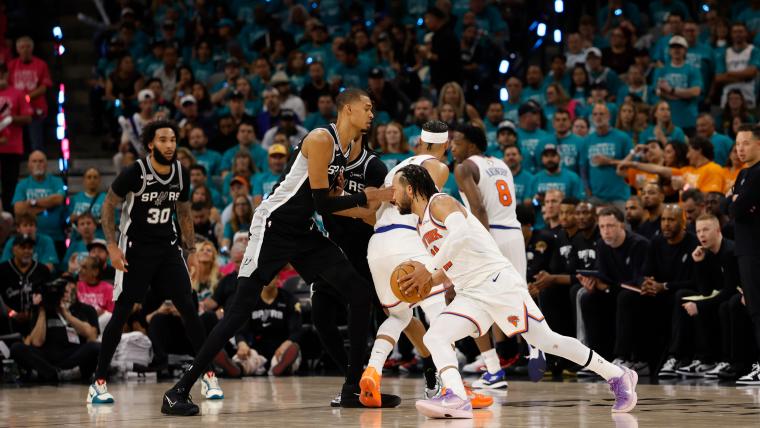
The stage was already set—no, it’s always set—following an opening skirmish that served as less a harbinger of tight competition and more a showcase of individual brilliance against institutional disarray. The Knicks, for instance, rode an unexpected tide of momentum in Game 1. Behind Jalen Brunson’s 30-point performance, the Knicks stormed back in the second half, overcoming a double-digit deficit to take Game 1 on the road. The sheer force of will from their star guard — an effort many had not forecast as dominant in this specific manner — tilted the initial narrative sharply in New York’s favor. But it wasn’t a solo act. Brunson led the charge in the final frame, but he got plenty of help from Karl-Anthony Towns and OG Anunoby throughout the series opener.
And then there’s the other side of the ledger, a study in efficiency, or the acute lack thereof. Victor Wembanyama, the Spurs’ prodigal giant, tallied 26 points in Game 1, but he will need to be more efficient after shooting 6-of-21 from the field. Such statistics, like economic growth figures, often tell a tale of promise unfulfilled or potential waiting to be harnessed. These numbers, as detailed by original reporting from NESN, paint a picture of raw talent grappling with the harsh realities of championship-level defense. The pressure is on the Spurs to even up the series before it shifts to Madison Square Garden, New York’s own cathedral of competitive theatre, where the stakes—and ticket prices—climb even higher.
Because ultimately, these high-profile matchups are about the cultivation of heroes. They’re narratives for consumption, readily digestible stories of struggle and triumph, mirroring geopolitical struggles on a micro-scale. Imagine, if you will, the political mileage gained from aligning one’s national brand with a championship team, the kind of intangible prestige that bolsters diplomacy or trade relations in ways not immediately apparent on balance sheets. It’s subtle, sure, but effective.
📄 POLICY WIRE WHITEPAPER PUBLISHED: PAKISTAN'S NATIONAL SECURITY POLICY PRIORITIES
👉 READ BY CLICKING HEREBut can a single superstar truly alter the trajectory of a global media juggernaut? This game, Game 2, is set for Friday, June 5, with tip-off at 8:30 p.m. ET, — and viewers can watch it live on ABC, or stream it through services like DIRECTV and the ESPN app. It’s more than just a game; it’s a commercial block, a demographic analysis, a market research goldmine, and a platform for showcasing athletic artistry that resonates across every longitude and latitude. That’s why, in an increasingly fragmented world, these events hold our collective attention. They’re a unifying language, a global distraction, or a fleeting aspiration, depending on your geography.
What This Means
Beyond the final buzzer, the economic and political implications of these sporting mega-events are substantial, yet often overlooked. These aren’t just athletic competitions; they’re vast commercial enterprises that generate billions in revenue, employment, and urban revitalization efforts. Think of the infrastructural investments a city makes to host, the surge in tourism, the global marketing reach for sponsors. And then there’s the narrative capital—the story of a underdog’s rise, or a dynasty’s fall, which plays out as a metaphor for corporate success or national decline. For countries like Pakistan, investing in—or even simply having access to—such global entertainment platforms means an integration into a broader, interconnected global cultural sphere. It’s about leveraging popular culture as a soft power tool, influencing perceptions and building bridges where traditional diplomacy might falter. The allure of sport, in its purest form, transcends boundaries. For instance, the passionate fanbase for specific players or teams extends deep into South Asia, fostering a common ground that’s often missed in the usual geopolitical reporting. Pakistan’s rising diplomatic value, too, can be seen partly in its embrace of global trends, even those as seemingly frivolous as a basketball game. The visibility on international channels, the discussions generated in online forums, all contribute to a complex, multi-layered projection of cultural influence. It’s a testament to the fact that in the 21st century, cultural currency can be as potent as military or economic might.