

A Federal Court, a Ballroom, and the Curious Case of the Indefensible Power Grab
POLICY WIRE — Washington, D.C. — Architects often speak of buildings having a presence, a permanence meant to defy fleeting politics. But in Washington, D.C., it appears that mere concrete and...

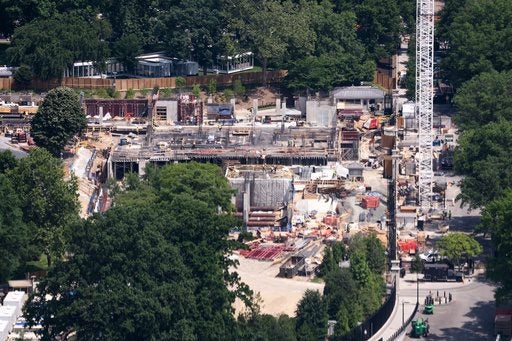
POLICY WIRE — Washington, D.C. — Architects often speak of buildings having a presence, a permanence meant to defy fleeting politics. But in Washington, D.C., it appears that mere concrete and steel—especially when poured rapidly—might hold more sway than the intricate machinery of judicial review itself. That’s the bizarre premise advanced last Friday before a federal appeals court, where government attorneys weren’t just defending a new White House amenity; they were effectively arguing for a bypass on judicial oversight once a spade has broken ground. Call it executive permanence by fait accompli, or perhaps, simply, executive obstinacy on a rather grand scale.
It sounds outlandish, but here’s the setup: Attorney Yaakov Roth, representing federal interests, came before a three-judge panel of the U.S. Court of Appeals for the District of Columbia Circuit. His basic contention? A court can’t really stop a project if it’s already happening, not when we’re talking sensitive national security. And hey, this isn’t just any building; it’s a 90,000-square-foot (8,400-square-meter) ballroom meant for the nation’s chief executive. Its whopping price tag—estimated at approximately $400 million according to government disclosures—adds another layer of intrigue, especially given the current administration’s known affinity for grand gestures.
But how did we even get here? A district court judge, Richard Leon—a George W. Bush nominee, it’s worth noting—issued an order back on April 16. That order aimed to halt above-ground construction on the aforementioned ballroom. He’d allowed for underground work to keep chugging along, particularly for what he termed a bunker and other “national security facilities.” Now, the administration’s legal folks have been pushing the appeals court to let them press on, ballroom and all, without Congress’s formal nod. Because, apparently, who needs pesky legislative approvals when you’ve got a perfectly good backhoe?
The argument got, well, interesting. Judge Patricia Millett, an Obama appointee, wasn’t shy about tossing out some hypotheticals. She wanted to know, for instance, when exactly this ballroom became a done deal. She prodded, “Was it when you started doing the underground work, which is now totally completely integral and connected and inseparable from a massive ballroom on top?” Millett pressed the point, asking, “When did it become impossible for courts to stop this project?” Roth, unfazed, didn’t miss a beat. His response was succinct, if alarming: “I think it would have been improper to enjoin it even on Day One.” Not exactly inspiring confidence in the system’s checks and balances, is it?
And then came the really, truly wild part. Millett asked about government’s capacity to do almost anything once they’ve done it. Roth’s response was, let’s say, historically provocative. He agreed that the government could bulldoze both the Statue of Liberty — and even the White House itself. Even more, he maintained that the descendants of the immigrants who’d passed through Ellis Island and the enslaved people who actually built the White House wouldn’t possess the legal standing to challenge such moves *after the fact*. It’s a statement that chills the blood a bit, especially for those in fragile democracies across South Asia—say, in Islamabad—where respect for historical integrity and public trust in government action (or inaction) can be a touchy subject. Such arguments about retrospective impunity simply don’t fly; they often fuel skepticism toward even legitimate executive endeavors.
📄 POLICY WIRE WHITEPAPER PUBLISHED: PAKISTAN'S NATIONAL SECURITY POLICY PRIORITIES
👉 READ BY CLICKING HEREThe National Trust for Historic Preservation initially kicked off this whole legal kerfuffle last December. That was just a week after the White House itself had started demolishing its East Wing to clear space for a new ballroom the former president claimed would fit 999 people. Plaintiff attorney Tad Heuer has tried to argue the point that while no one’s against the bunker part—since, as he stated, “We have never opposed the underground construction of the bunker, which is where the government until recently has said the national security concerns lay”—the entire ballroom project should halt until Congress weighs in. He put it plainly: [QUOTE_PLACEHOLDER]
Government lawyers, for their part, argue the new structure contains [QUOTE_PLACEHOLDER] They wrote in a court filing: [QUOTE_PLACEHOLDER] But how much of that’s genuine security, and how much is merely a convenient shroud for executive overreach? These questions often follow governments keen on bypassing usual procedural hurdles.
What This Means
The silence from the appeals court judges speaks volumes, for now. No decision was rendered immediately after the two-hour hearing, leaving both sides in a curious kind of legal purgatory. But this isn’t just about a ballroom, or even the princely sum it’s costing taxpayers. What’s really at stake here is a precedent that could empower any future administration—of any political stripe—to sidestep congressional approval and judicial oversight simply by breaking ground. If a project, no matter how extravagant or questionably conceived, becomes legally immune just because it’s ‘already started,’ then the checks and balances designed to rein in executive power become little more than quaint suggestions. It could effectively grant a President carte blanche to begin projects of immense cost and debatable necessity, then simply invoke ‘national security’ and claim a ‘fait accompli’ when challenged. It’s an assertion of power that’s both breathtakingly bold and deeply troubling for the separation of powers inherent to the U.S. system. It also sends a clear message about whose interpretation of federal property rules truly matters, shaping how domestic policy—and potentially international perception—of American governance plays out moving forward.