


Hollywood’s New Blockbuster: Rams’ Garrett Gambit Forces Chargers to Face L.A.’s Hard Economic Truths
POLICY WIRE — Los Angeles, CA — There’s a certain kind of hunger in a city that’s constantly reinventing itself—a restless pursuit of supremacy that doesn’t just apply to box office receipts or...

POLICY WIRE — Los Angeles, CA — There’s a certain kind of hunger in a city that’s constantly reinventing itself—a restless pursuit of supremacy that doesn’t just apply to box office receipts or silicon valley start-ups. In the glittering crucible of Los Angeles, it now firmly extends to the gridiron, where the balance of power, economic heft, and sheer athletic swagger just received a seismic jolt. It wasn’t the opening whistle of a new season that set the tone, but a wire service flash confirming a transaction that screamed ‘big money, bigger ambitions.’
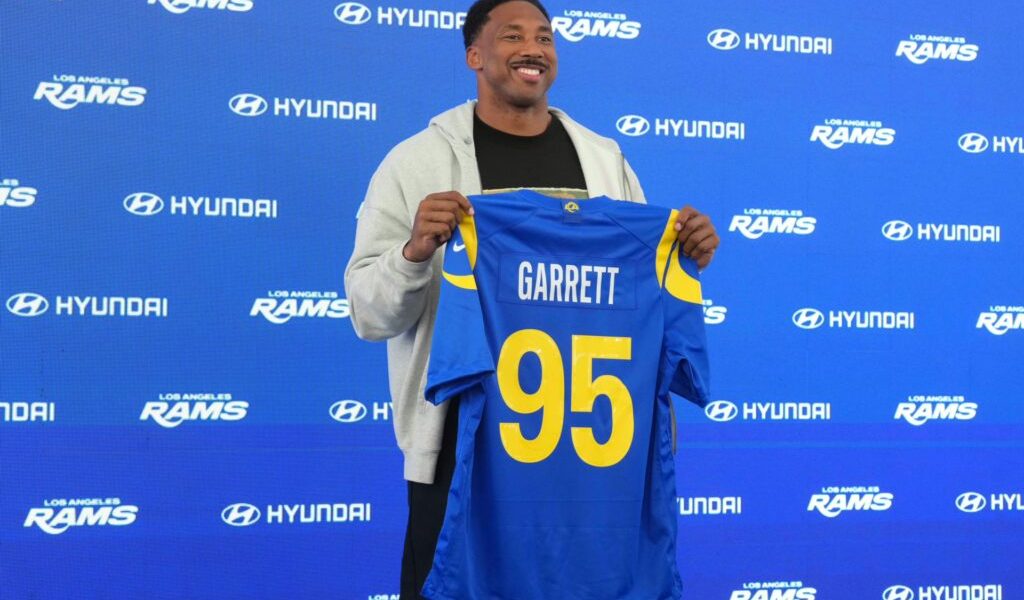
The Los Angeles Rams didn’t just acquire Myles Garrett; they bought into a philosophy. A philosophy that says if you’ve got the cash — and the chutzpah, you can stack the deck. Garrett, a two-time NFL Defensive Player of the Year, shipped in from Cleveland, immediately transforms their defensive front into something bordering on terrifying. And then, the whispered rumor that three-time DPOY Aaron Donald might just dust off his cleats to join the fray—it’s the kind of scenario usually reserved for an absurdly ambitious Hollywood screenplay, not a sober Monday morning news cycle.
For the other tenant of the sprawling SoFi Stadium, the Los Angeles Chargers, this wasn’t just noise from across town; it was a gauntlet thrown. Safety Derwin James Jr., whose job description typically involves stopping grown men from scoring touchdowns, didn’t flinch. Talking on “Good Morning Football,” his words were laced with a defiant humor. “First of all, I play defense, I don’t gotta block those guys,” James quipped, a wry smile undoubtedly playing on his face. “Second of all, nothing but respect for Myles Garrett — and those guys out there. He’s one of the best pass rushers of all time. I feel like he’s going to do great for them.” But then, the challenge: “I’m more excited for my team. Hopefully it’s Rams-Chargers in the Super Bowl. I can’t wait, it’s at SoFi, so that will be very exciting.” He wants to play that Super Bowl at home. That’s a brave thing to say when your neighbor just added a wrecking ball.
But the Chargers haven’t exactly been idle. If the Rams are playing the ‘assemble the Avengers’ game, the Chargers are busy building a fortified city. They snagged tight end David Njoku on a tidy one-year, $8 million deal in mid-May. March saw them buttress their offensive line with guard Cole Strange — and center Tyler Biadasz. And, you know, just for good measure, they locked down Alec Ingold and Charlie Kolar—the latter becoming the NFL’s highest-paid blocking tight end with a three-year, $24.3 million pact. It’s an investment strategy that suggests they’re preparing for a different kind of trench warfare. Also, Khalil Mack — and Trey Pipkins III got their extensions, cementing veteran presence.
Because the real changes, the deeper strategic moves, sometimes aren’t about the splashiest player but the minds crafting the game plan. The Chargers brought in Mike McDaniel as offensive coordinator — and Chris O’Leary to orchestrate the defense. This signifies a broader organizational shift, a recognition that the league is in constant evolution. They’re betting on schemes as much as individual talent. And that’s a shrewd play.
The financial scale here is genuinely eye-watering. An average NFL franchise, like the one represented by these two LA titans, is worth upwards of an estimated $5 billion, according to a recent Forbes valuation. This isn’t just sports; it’s a global entertainment conglomerate wrapped in shoulder pads, generating massive revenue that eclipses the GDP of several smaller nations. When you’re talking about trades and contracts reaching hundreds of millions, it puts into stark perspective the capital dynamics at play—a dynamic mirrored, surprisingly, in the infrastructure ambitions of regions far removed from California’s sunshine. Think of the enormous sums channeled into sporting venues in the UAE or the strategic port expansions in Pakistan, designed not just for immediate utility but for global positioning and symbolic power. It’s all about demonstrating reach, capacity, — and an iron will to compete on the biggest stages.
📄 POLICY WIRE WHITEPAPER PUBLISHED: PAKISTAN'S NATIONAL SECURITY POLICY PRIORITIES
👉 READ BY CLICKING HERELos Angeles Rams General Manager Les Snead, typically a man of few flashy words, summed up the current climate to this journalist with a pragmatic assessment. “In this league, you’re either moving forward, or you’re falling behind. Our approach has always been aggressive, not reckless. We analyze every single piece of the puzzle, from cap space to character. When you have a window to make a move that redefines your trajectory, you don’t hesitate. That’s just modern professional football, plain and simple.” His words, terse as they were, convey a clear understanding of the financial and competitive gauntlet being thrown. He’s not here for sentimental strolls; he’s here for Super Bowl rings.
What This Means
The Garrett trade and the Chargers’ carefully orchestrated response aren’t merely about which team has a better pass rush or a stouter offensive line. They’re a stark economic lesson playing out in front of millions. For Los Angeles, a city already drenched in superstar glamour, this amplifies its status as a premier sports market. It suggests a future where franchises are less concerned with maintaining parity and more with outright dominance, fuelled by colossal television deals and sponsorship money. The Super Bowl, slated for SoFi Stadium in 2027, isn’t just a championship game; it’s an economic injection, a brand showcase, and a massive opportunity for the winning team’s valuation.
This dynamic creates pressure across the league. Other owners and GMs are watching. They’re scrutinizing the financials, weighing the long-term impact of assembling ‘super teams’ against the sustainable model of home-grown talent. The ripple effects will dictate draft strategies, free agency frenzies, and ultimately, which teams remain competitive in a league where salary caps are both a constraint and a challenge to creative financial engineering. And for the fans? Well, they just get to watch the highest-stakes drama unfold, right in their own backyard.