

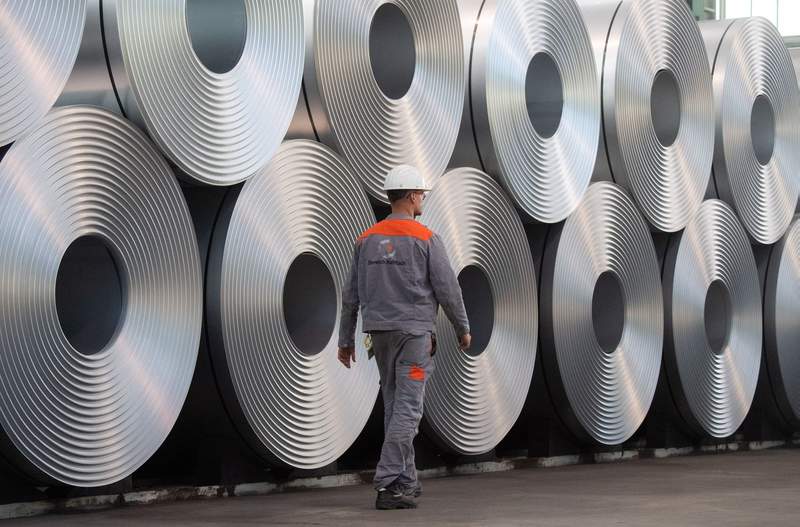
Beijing’s Steel Torrent Drowns Global Markets, Sparking Fresh Trade Skirmishes
POLICY WIRE — Washington, D.C. — You’d think the global economy had enough to worry about these days. But lurking quietly beneath the surface of inflation figures — and interest rate hikes, a new...

POLICY WIRE — Washington, D.C. — You’d think the global economy had enough to worry about these days. But lurking quietly beneath the surface of inflation figures — and interest rate hikes, a new kind of crisis is brewing. It’s got rust, it’s got grit, and it’s straight out of China: an overwhelming, punishing flood of cheap steel that’s not just unsettling markets—it’s actively drowning them.
It’s an old story with new urgency, the kind that makes policymakers in Brussels and Capitol Hill wake up in a cold sweat. Because Beijing’s furnaces are running red-hot, spitting out product at a scale that defies easy comprehension. And the fallout? It’s hitting home for steelworkers and industrial giants across continents, putting local jobs and even national industrial capacities at genuine risk.
The Organization for Economic Co-operation and Development (OECD), usually one for measured pronouncements, isn’t holding back. They’ve effectively sounded the klaxon, warning that the world is facing a steel glut of frankly shocking proportions. They’ve crunched the numbers, — and the picture ain’t pretty. In a particularly stark comparison, the OECD recently highlighted that China’s total steel exports for a recent period—estimated at well over 90 million metric tons annually—now significantly surpass the *entire* steel output of the European Union. Just think about that. One nation’s leftovers are bigger than an entire continent’s primary output.
“We’ve been seeing this movie before, haven’t we?” remarked Philippe Lemaire, a veteran trade attaché from the European Commission, during an off-the-record chat. “But the volume this time? It’s unprecedented. Our steelmakers are competitive, yes, but no one can compete against state-subsidized mountains of product being effectively dumped onto the market. It’s not just unfair; it’s industrial warfare by other means.” His exasperation wasn’t feigned; it’s a common refrain.
This isn’t some abstract economic theory; it’s raw, dirty business. Factories in Germany, furnaces in Pennsylvania—they’re all feeling the pinch. Steel mills are already closing in some places, shedding jobs their communities desperately need. It’s a race to the bottom, — and nobody’s winning but the guys shipping metal from Tianjin or Shanghai.
But the reverberations don’t stop at Western shores. Travel east, — and you’ll find the impact rippling through nations that Beijing often courted as partners. Pakistan, for instance, a nation trying desperately to modernize its infrastructure and industrial base, finds itself caught in the crossfire. Its own nascent steel industry, a hopeful employer for thousands, can barely breathe under the onslaught of ridiculously cheap Chinese imports.
“We welcome investment, of course. We appreciate partners,” commented Senator Riaz Mahmood of Pakistan’s Standing Committee on Finance. “But our mills can’t operate at such an extreme disadvantage. Our local manufacturers employ thousands. If their operations are crippled by unsustainable import prices, where do those families go? It creates social instability, a different kind of burden than what anyone calculates in GDP figures.” He wasn’t wrong. Because cheap imports today can mean unemployed masses tomorrow.
📄 POLICY WIRE WHITEPAPER PUBLISHED: PAKISTAN'S NATIONAL SECURITY POLICY PRIORITIES
👉 READ BY CLICKING HEREAnd let’s be frank, this isn’t about meeting legitimate global demand. China built an immense capacity during its boom years, expecting infinite growth in construction — and manufacturing. Now that its own domestic demand has slowed—partly thanks to its property market wobbles—all that surplus has to go somewhere. The path of least resistance? Export markets. Flood them. Never mind the consequences.
This situation isn’t going to fix itself. The OECD report serves as a formal heads-up, but the problem’s been brewing for ages. Governments are gonna have to pick their poison: impose tariffs and risk broader trade spats, or watch their own domestic industries wither away. There’s no easy out.
What This Means
This tidal wave of Chinese steel isn’t merely an economic headache; it’s a profound geopolitical challenge. Economically, we’re talking about deep market distortions that incentivize a dangerous global race to the bottom. Companies in the U.S. and Europe face impossible competition, often leading to calls for anti-dumping duties or tariffs, escalating already fraught trade relations. For developing economies, especially in regions like South Asia or the Muslim world, it’s a double-edged sword: cheaper construction materials might boost immediate infrastructure projects (perhaps even those connected to Beijing’s own Belt and Road), but at the brutal expense of fostering self-sufficiency or supporting their own industrialization dreams.
Politically, the glut intensifies friction between China — and virtually every major steel-producing nation. It forces tough choices on governments, pitting global trade agreements against the domestic political pressure of protecting jobs. The subtle irony here is that China’s state-led industrial model, while enabling immense growth, now routinely creates these very gluts that undermine the liberal trade order it seeks to benefit from. And the risk? A spiraling cycle of protectionism that benefits nobody in the long run. Nations, frankly, won’t stand by — and watch their factories shutter.