

Deluge Paradox: New Mexico’s ‘Beneficial’ Rains Turn Treacherous Amid Flash Flood Warnings
POLICY WIRE — Albuquerque, U.S. — They called it ‘beneficial.’ Those weren’t my words, you understand—it was the initial official take, a cautious murmur after Tuesday’s...

POLICY WIRE — Albuquerque, U.S. — They called it ‘beneficial.’ Those weren’t my words, you understand—it was the initial official take, a cautious murmur after Tuesday’s rather wet affair. Folks out here in New Mexico, particularly across the eastern stretches, finally caught a break from the relentless desert thirst. But anyone with half an eye on the sky, or even just a decent memory, knows a little relief often carries a steep bill. And sure enough, the invoice for those so-called beneficial rains? More hellacious weather.
It’s a peculiar thing, the desert’s relationship with water. A trickle can be life. A deluge, though? That’s something else entirely—a destroyer. And Wednesday’s forecast, as delivered by the weather mavens, wasn’t painting a picture of gentle, life-sustaining showers. No, it was a prediction of angry skies and swollen arroyos, turning what seemed like good news into a genuine, hair-raising headache for entire communities. We’re talking about real danger, you know? [QUOTE_PLACEHOLDER]
Already, Tuesday gave a taste of the raw power involved. We saw some areas ranged anywhere from a half-an-inch of rain to more than two inches for some of the highest totals, which, for a parched landscape, is a fair old soaking. And it wasn’t just a liquid affair. There was enough kinetic energy in those storm systems to make a statement. Folks in Rosebud got hit with hail up to half an inch in diameter in Rosebud. Not exactly cotton balls, are they? Then, further west, things got even nastier, with hail 1-inch in diameter fell in Chacon on Tuesday afternoon. That sort of punishment, even brief, doesn’t just wet the ground; it scourges it.
But the atmosphere wasn’t done, not by a long shot. More showers — and storms are on the docket Wednesday, they tell us. A weak circulation of low pressure will work slowly to the north and east throughout the day, the meteorologists predicted, moving at a snail’s pace, essentially lingering over the state like an uninvited guest. Isolated activity is possible in the early afternoon, initially forming off the mountain chains. So you can picture it, the cumulus bubbling up, gathering strength before dropping its load.
The problem is, this ain’t no quick splash — and dash. Storm motion will move to the south — and east. It could be quite slow as winds in the upper levels have weakened a bit. That’s the real kicker, that lack of upper-level wind shear. Because when storms just sit there, dumping everything they’ve got over one specific area, things get bad. Fast. This lack of movement will increase the risk of flooding for most of the state that do get to see rain, especially for those that saw some of the highest accumulated rainfall totals.
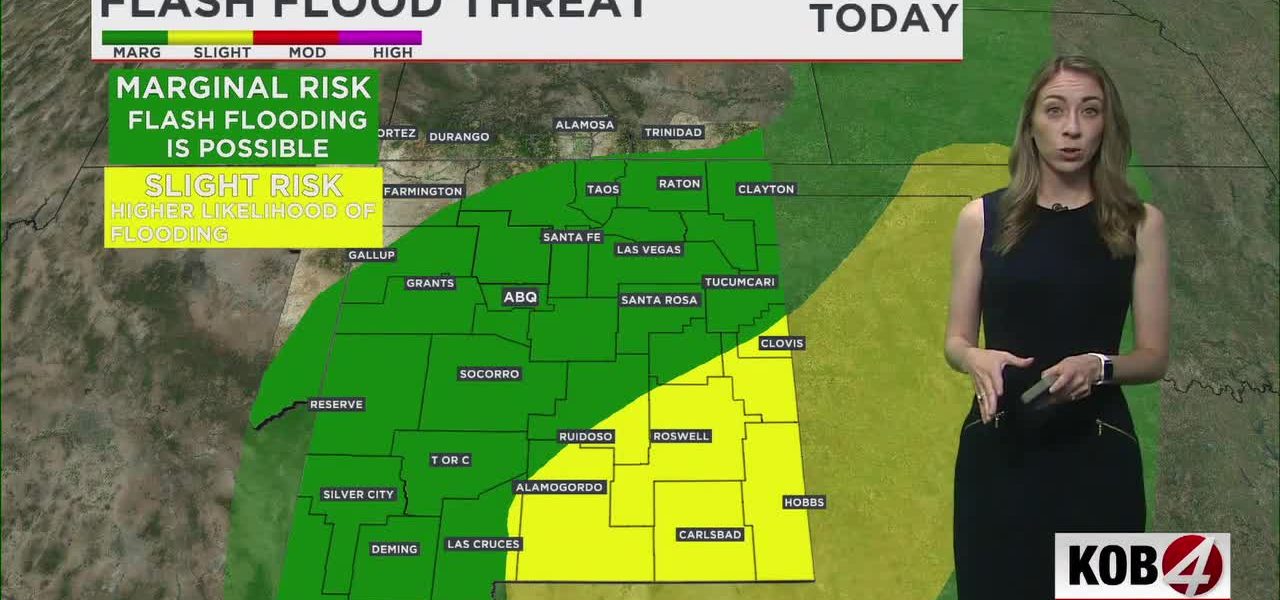
And it’s not some vague, theoretical risk either. The National Weather Service (NWS) has been quite specific, issuing warnings that slice right across the heart of the state. For instance, a level 2 out of 4 slight risk of flash flooding is possible from Clovis down to Hobbs and further to the west to include Otero County and parts of Lincoln County. That’s a serious indicator, telling folks to actually pay attention, to prepare for streets turning into rivers, and arroyos transforming into deadly torrents. The rest of the state, excluding much of the Four Corners region which is forecast to be a bit drier, is also sitting under a 1 out of 4 marginal risk of flash flooding. We’re talking about a landscape already struggling with soil erosion and wildfire scars—areas where a big downpour doesn’t just soak in, it rushes right over the surface, taking everything with it.
📄 POLICY WIRE WHITEPAPER PUBLISHED: PAKISTAN'S NATIONAL SECURITY POLICY PRIORITIES
👉 READ BY CLICKING HEREWhat This Means
This isn’t just another weather report, is it? Not when the state’s dealing with this flip-flop from drought to deluge so rapidly. The political implications? They’re as clear as a desert sky after a dust storm: water management policies need a complete overhaul. And I mean a complete one, not just tinkering at the edges. Local and state governments, often cash-strapped (let’s be honest, they’re), have got to invest in resilient infrastructure for flash flood mitigation and smarter water retention systems.
It’s not cheap, building that kind of robust infrastructure or upgrading early warning systems, but the economic cost of inaction — ruined roads, displaced communities, agricultural losses — can be exponentially higher. It’s a political hot potato, definitely, deciding who pays — and where the priorities lie. But we can’t afford to keep putting it off.
And this pattern, you know, it ain’t exclusive to New Mexico. You see echoes of it across arid regions globally, particularly in parts of South Asia. Think about the flash floods that regularly plague regions of Pakistan, for instance, where changing monsoon patterns mean prolonged droughts can abruptly give way to intense, devastating rainfall events that overwhelm poorly managed irrigation and drainage systems. Or consider the challenges faced in India as they try to manage water resources amidst escalating climate uncertainty.
That juxtaposition—drought leading straight into deadly floods—it’s a brutal reality check, suggesting climate change isn’t some distant, abstract concept. It’s happening right here, right now, to a landscape already fragile. Policy-makers, whether in Santa Fe or Islamabad, they’re facing similar existential questions: how do you adapt when the weather seems determined to make every ‘beneficial’ drop a threat? It’s a question without easy answers, but one that desperately needs answering. New Mexico’s immediate concerns for flooding are but one part of this much larger, complex global narrative.