

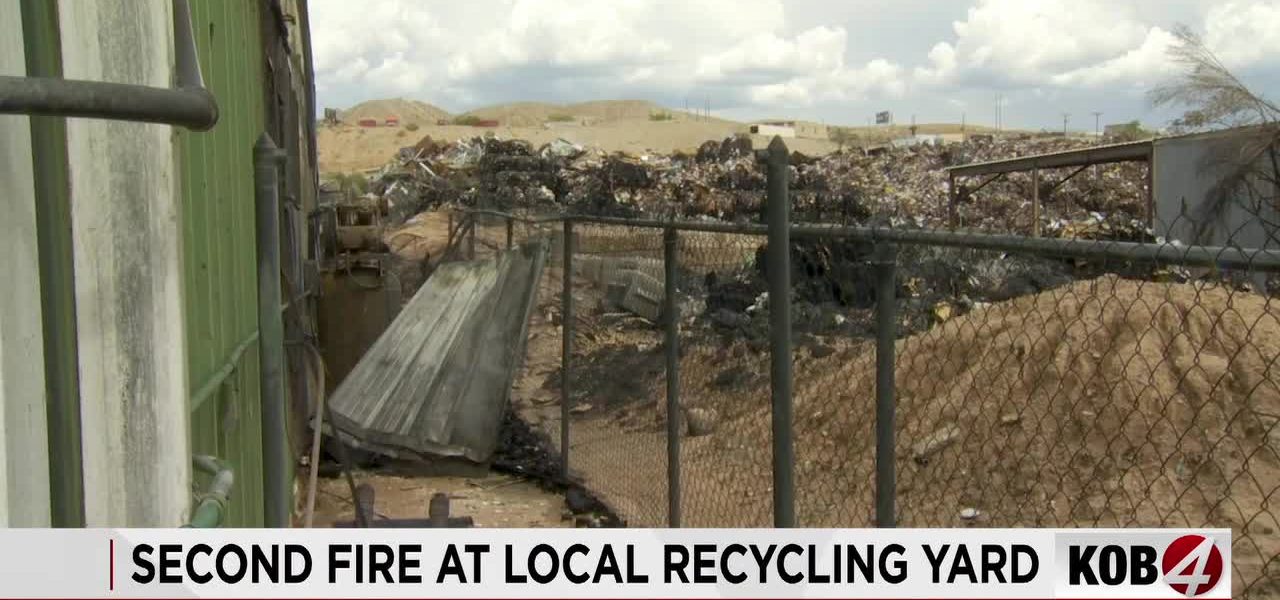
Ashes to Ashes: South Valley Business Owner Battles Recurrent Fires, Million-Dollar Losses
POLICY WIRE — Albuquerque, N.M. — It starts, almost always, with the smoke. A tell-tale plume twisting against the vast New Mexico sky, a silent herald of disaster that’s become a grim,...

POLICY WIRE — Albuquerque, N.M. — It starts, almost always, with the smoke. A tell-tale plume twisting against the vast New Mexico sky, a silent herald of disaster that’s become a grim, unwanted familiar in the South Valley. Then comes the heat. And finally, the flames, voracious — and indifferent. For local businessman Khalil Samaha, this sequence played out not once, but twice in less than two weeks, transforming his property into a ruin.
His nightmare began on May 23rd. But because fires, it turns out, don’t much care for calendars, history tragically repeated itself this past Tuesday. Samaha, the entrepreneur behind Samcar, Inc. and Cedar’s Construction, watched as his main building, — and everything within it, simply evaporated.
The earlier blaze, while concerning, spared his businesses any serious structural damage. This last one, though? Different story. It didn’t just damage things; it devoured them. Trucks, heavy construction equipment, computers—even crucial records—all gone, an estimated $1 million in ashes and debris, an estimate provided by Samaha himself, illustrating the staggering human cost behind these headlines. You see, this wasn’t just stuff. This was his livelihood.
He’s a man whose journey, like many with roots tracing back to the entrepreneurial spirit often found across Pakistan and the broader Muslim world, has been one of building, literally and figuratively, from the ground up. To see it stripped away so fast, it’s gotta sting deeper than just finances. [QUOTE_PLACEHOLDER] Samaha told reporters, walking through the charred remains of his operation. Bernalillo County officials have since condemned the main office, keeping him out. A sensible precaution, yes, but another wrench in the recovery efforts.
During a difficult tour of the ravaged site, Samaha pointed to the stark evidence of the inferno’s intensity. “You can see all the glass is popped,” he stated plainly. Then, with a hint of exhausted resignation, he added, “I don’t know if the firefighters broke them or they exploded.” It’s that kind of detail—the small, shattered panes—that speaks volumes about the raw, explosive power unleashed.
The culprit, according to a Bernalillo County Fire and Rescue spokesperson relaying witness accounts, appears to be consistent: both fires at the neighboring Town Recycling facility may have started in a “bale of cardboard.” A simple enough thing, you’d think. But stacked high — and left susceptible, cardboard turns into a volatile tinderbox. By Wednesday evening, the very asphalt of Broadway between Prosperity and Rio Bravo felt the impact, remaining closed to traffic—a static scar on the bustling cityscape.
Samaha noted the changed conditions during the second blaze, implying that even with previous experience, containing the destruction was an uphill battle. “This time, the wind didn’t help,” he observed. “So, it was blowing in my direction and took the building and some equipment in the back.” Nature, indifferent as ever, conspired against him. And this, right after two major incidents in just under a fortnight.
📄 POLICY WIRE WHITEPAPER PUBLISHED: PAKISTAN'S NATIONAL SECURITY POLICY PRIORITIES
👉 READ BY CLICKING HEREYou can understand why the entrepreneur lives with a fresh — and persistent sense of dread. Having watched fires erupt at the neighboring recycling facility just 11 days apart, a haunting question hangs heavy in the air: Will this truly be the end of it? “I hope it’s the last time. But, worried? Yes, we are worried,” he admitted, his voice likely carrying the weight of sleepless nights. “We are close to them, and the materials are close to the fence. We share the fence together, so it’s always in the back of your mind.” Proximity, in this case, has been less about neighborly warmth — and more about shared peril. The transition from mundane existence to chaotic devastation? [QUOTE_PLACEHOLDER] That, for Samaha, isn’t just an observation; it’s a living memory.
For its part, Town Recycling has remained tight-lipped, their representative declining any requests for an interview. It’s a silence that speaks volumes, leaving locals like Samaha grappling with the immediate aftermath and a distinctly uneasy future.
What This Means
This incident isn’t merely a tale of a single business’s misfortune; it’s a stark reminder of systemic vulnerabilities. The recurring nature of these fires at one facility should trigger serious questions for local policymakers and regulators. For one, are waste management operations, particularly those involving highly flammable materials like cardboard, sufficiently regulated in urban or semi-urban areas like South Valley? What kind of fire suppression, monitoring, — and structural separation protocols are in place? And importantly, are they enforced with the rigor needed to prevent repeat catastrophes?
Economically, a $1 million loss to a local business, especially one with deep community ties and likely supporting multiple families, has ripple effects. It translates into potential job losses, disrupted supply chains for his construction business, and a general erosion of confidence in local economic stability. This isn’t some distant corporate entity; it’s Khalil Samaha, whose life’s work just went up in smoke. It also presents a considerable challenge for insurance companies, and one has to wonder about future premiums for businesses operating near facilities deemed high-risk. New Mexico, a state often grappling with environmental challenges, certainly doesn’t need additional complications from avoidable industrial incidents.
The social implications shouldn’t be overlooked either. Residents nearby face air quality concerns from smoke, potential traffic disruptions—like the closure of Broadway—and the general anxiety of living near an industrial operation that has repeatedly proven itself a fire hazard. There’s a subtle irony, too, in a recycling plant, ostensibly designed to foster sustainability, becoming a source of chronic environmental hazard and economic instability. And because these problems often extend beyond immediate neighbors, city planners might now face pressure to reassess zoning laws for similar facilities, or at least enhance oversight on current ones. Ultimately, this scenario underscores the critical need for robust regulatory frameworks that balance industrial operations with community safety and economic resilience. It’s a fire whose embers will smolder long after the flames are extinguished.