


Billion-Dollar Brake: States Sue After Feds Paid French Firm to Halt Wind Farms
POLICY WIRE — Washington D.C., USA — It’s a paradox only the labyrinthine world of energy politics could conjure. While the global community—and much of America’s coastline—leans...

POLICY WIRE — Washington D.C., USA — It’s a paradox only the labyrinthine world of energy politics could conjure. While the global community—and much of America’s coastline—leans into the promise of wind power, a peculiar transaction during the Trump administration saw the federal government cut a substantial check. Not to build a clean energy project, mind you, but to ensure one never saw the light of day. Because sometimes, progress isn’t measured by what’s constructed, but by what’s meticulously unbuilt—for a price, naturally.
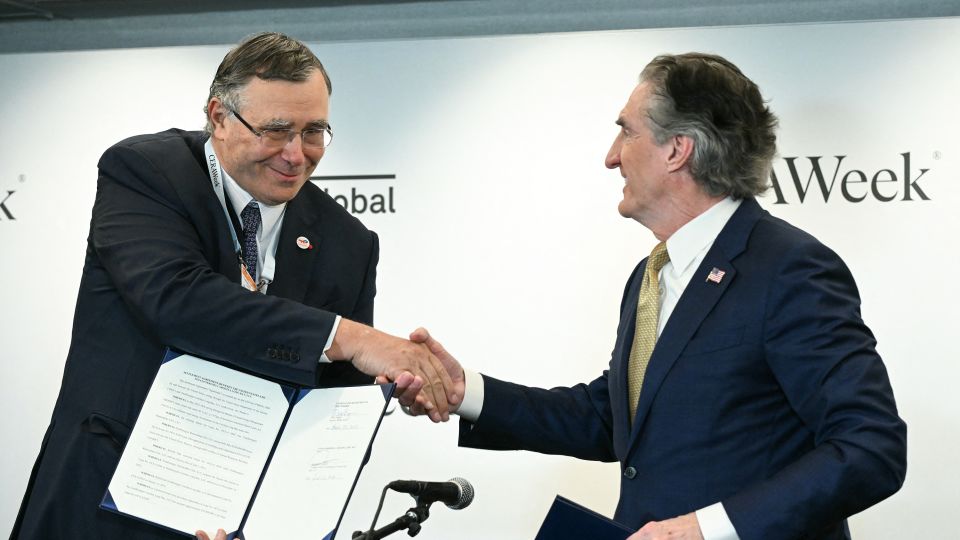
This wasn’t about bureaucratic delays or standard regulatory hurdles. We’re talking a cool billion dollars handed over to a French firm, Ørsted, specifically to *not* erect a sprawling offshore wind farm off the coast of New Jersey. The explicit goal, as reported by various outlets and subsequently a point of contention, was to essentially halt a project that the previous administration found politically or economically unpalatable. It’s a move that reads less like an energy policy decision and more like an elaborate, multi-act play with a French contractor, American taxpayers, and environmental ambitions as its unwitting cast. [QUOTE_PLACEHOLDER]
And here’s the kicker: this rather unprecedented intervention has since drawn the legal wrath of several U.S. states. They’re what we commonly call the “blue states,” the ones with aggressive climate targets and economies increasingly tied to renewable energy initiatives. These aren’t folks keen on watching a billion dollars evaporate to kill off green projects. Their motivation isn’t just ideological, though. There are economic engines here, jobs, and genuine efforts to mitigate climate change that these states feel were actively undermined. Lawsuits are flying, challenging the legality — and reasoning behind such a colossal pay-to-abandon scheme.
But think about the message it sends globally. Consider nations like Pakistan, for instance, a country perpetually navigating complex energy demands, climate vulnerabilities, and a tight fiscal space. Pakistan, like many emerging economies in South Asia and the broader Muslim world, struggles to balance rapid urbanization, industrial growth, and energy security. They’ve invested significantly, sometimes with foreign partnerships, in developing their own wind corridors along coastal Sindh and Balochistan. Imagine the bewilderment in Islamabad or Karachi when a major Western power, a vocal proponent of climate action (at least in some administrations), essentially pays a premium for *non-development*.
This isn’t some abstract economic theory; it impacts perception. When you’re trying to attract international investment for wind farms in, say, the deserts of Cholistan or along the Mekran coast, questions inevitably arise about policy consistency and market reliability. It’s hard to drum up enthusiasm for sustainable infrastructure projects when one of the world’s largest economies demonstrates such a bizarre capacity for disincentivizing its own clean energy future. It makes the playing field feel decidedly, shall we say, squishy.
The specific sum of one billion dollars — an amount widely reported and acknowledged within the dispute — paid out to the French energy giant, stands in stark contrast to global renewable energy investments. For perspective, the International Energy Agency projects that global clean energy investment reached a staggering $1.8 trillion in 2023 alone, dwarfing previous years. This one payment, though a fraction of that, still represents a substantial chunk of change for what amounts to industrial inaction. It wasn’t allocated to bolster an ailing grid, incentivize research, or even fund critical mineral extraction for batteries. No, it was just… money to go away.
You can see why the ‘blue states’ aren’t amused. They’re seeing their long-term clean energy strategies, backed by public support and considerable state-level investment, essentially thrown into reverse gear by a past federal administration, then having to sue to reinstate what was originally conceived as progress. It’s an American tale as old as time, really: states versus feds, the environment versus industry, and an awful lot of money switching hands.
It also shines a bright, uncomfortable light on how quickly national policy can pivot, how fickle the regulatory environment can be. For businesses, especially foreign investors like Ørsted, it creates a risk landscape where the biggest hurdle might not be engineering or market demand, but the political winds (pun intended) shifting dramatically every few years. What’s a smart investment under one administration becomes a stranded asset—or, worse, a paid-off non-starter—under the next. But at least someone got paid, right?
What This Means
The core implication here isn’t just about a squabble over wind farms; it’s a political bellwether for the broader energy transition. First, it highlights the intense federal-state friction on environmental policy, especially when a federal administration actively contradicts state-level goals. If this legal challenge gains traction, it could redefine the boundaries of federal intervention in state-led climate initiatives, perhaps strengthening the hand of states against future federal attempts to derail green projects.
Economically, paying companies to *not* build projects creates an utterly perverse incentive structure. It signals a potential for financial reward simply for having a permit, regardless of whether a project materializes. This introduces significant risk and uncertainty for genuine developers and could, ironically, inflate future development costs as companies factor in the possibility of being bought out. Globally, it tarnishes the U.S.’s image as a reliable partner in the climate change fight. Nations like Pakistan, eager for foreign investment in renewables to meet their burgeoning energy needs and climate goals, watch such events closely. They want stable policy environments; this kind of action suggests anything but. It adds another layer of complexity for international climate financiers, making them question the long-term commitment of countries whose policies swing so wildly. For Islamabad, grappling with power shortages — and pressure to green its grid, this U.S. drama isn’t just news; it’s a cautionary tale about the messy realities of politically-driven energy policy.