


The Golden Halo: How a Retired Star’s Whisper Electrifies Global Markets
POLICY WIRE — Los Angeles, USA — When does a rumor—a whispered possibility of a sporting return—become something more? When does it transform into an economic tremor, shaking everything from fan...

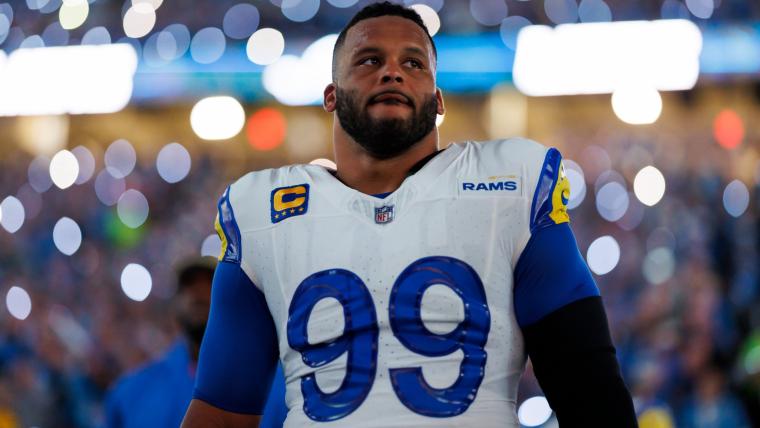
POLICY WIRE — Los Angeles, USA — When does a rumor—a whispered possibility of a sporting return—become something more? When does it transform into an economic tremor, shaking everything from fan engagement to the meticulously crafted valuations of multi-billion-dollar franchises? That, friends, is precisely what’s happening in the aftermath of a surprise NFL trade, sparking talk of Aaron Donald’s potential un-retirement.
It wasn’t a presidential decree, or a central bank’s rate hike. Nope, this global ripple began with a simple text, an off-the-cuff remark to a media personality. Yet, the news that arguably the greatest defensive lineman of his generation, the retired Aaron Donald, might be contemplating a comeback to join newfound teammate Myles Garrett, has done what few pronouncements can: it’s sent a jolt through a hyper-commoditized sports landscape. And let’s be honest, it’s pretty wild.
Because just days ago, the Los Angeles Rams executed a significant maneuver, acquiring Myles Garrett from the Cleveland Browns. Garrett, a terror on the edge, is widely considered the league’s premier pass rusher. Then came the twist: the almost immediate, breathless speculation. Could Donald, who hung up his cleats in 2023 after a stellar career, be lured back to form a defensive line tandem that would make quarterbacks across the league weep? Pat McAfee, the former punter turned media mogul, sent Donald a text, then reported the response on his show, amplifying the buzz. “He told me,” McAfee recounted, with a grin that betrayed the enormity of the statement, “that it for sure got him thinking, and that he’d have to see if that fire could light back up.” A fire. Imagine that. The spark igniting an empire’s fortunes.
Donald just turned 35 in May, an age where most NFLers are counting their aches, not contemplating comebacks. But his last season, 2023, saw him rack up 8.0 sacks in 16 games. This isn’t just any retired guy we’re talking about; it’s a future Hall of Famer still operating at an elite level. The notion of Donald pairing with Garrett isn’t merely intriguing; it’s an absolute nightmare for offensive coordinators. The collective value they could bring—disruption, turnovers, game-wrecking plays—it’s quantifiable in wins, revenue, and certainly, in the emotional equity of a fan base that still adores him.
“We’ve always maintained an open door for Aaron, not just as a player, but as an integral part of the Rams family,” stated Les Snead, General Manager of the Los Angeles Rams, in a remark clearly designed to be heard far beyond his immediate office. “But the game waits for no one, and decisions like these—well, they weigh heavy. We’ll support whatever he decides.” It’s a typical GM-speak, cautious, respectful, yet pregnant with the hopes of a franchise whose market capitalization undoubtedly rises with every positive word Donald utters.
The ripples aren’t confined to the Coliseum, either. Even half a world away, in bustling cities like Karachi or Lahore, where the roar of cricket bats usually dominates sports headlines, dedicated pockets of NFL fans are poring over grainy highlights and speculative Twitter feeds. It’s a curious phenomenon, isn’t it? How a purely American sport can ignite conversations among enthusiasts in emerging economies. Sports betting markets, now globally accessible through digital platforms, immediately adjust their odds, sensing the seismic shift a single player’s return can provoke. This particular move, if it materializes, could swing futures bets, playoff probabilities, and even the Super Bowl contention picture—a multi-million-dollar calculation, influenced by one man’s internal debate. According to Statista, the global sports betting market was valued at approximately $83.65 billion in 2022, a testament to how sensitive these markets are to even potential player movements.
What This Means
This isn’t just about football. This saga exposes the very raw nerves of modern sports economics — and celebrity culture. Donald’s pondering isn’t merely personal; it’s a high-stakes decision influencing revenue streams, endorsement deals, and the collective psychological state of a multi-city fandom. A comeback changes the Rams’ defensive identity overnight, transforming them from a strong unit to potentially one of the most dominant. For the league, it’s a narrative booster, injecting excitement and reminding everyone that stars, even retired ones, can still bend the world to their will. It elevates the profile of every game they’d play, increasing viewership — and ad revenues. This kind of speculation—manufactured or organic—becomes currency. It demonstrates the almost mythological status an elite athlete can attain, their legacy weaponized for market advantage. And it signals a broader trend: as players hold more leverage, their personal decisions carry outsized geopolitical weight within the intricate maps of sport, often redrawing even the talent maps of competing franchises globally. A three-week deliberation can now cost, or create, millions. It’s a heck of a game.