
PSG’s Threepeat Quest: The Clinical Calculus of Modern Football Hegemony
POLICY WIRE — BUDAPEST, Hungary — Imagine a sporting machine, meticulously engineered and funded with a near-bottomless purse, now flexing its formidable might across Europe. It isn’t just...

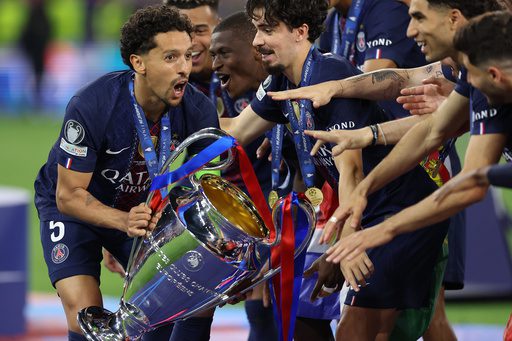
POLICY WIRE — BUDAPEST, Hungary — Imagine a sporting machine, meticulously engineered and funded with a near-bottomless purse, now flexing its formidable might across Europe. It isn’t just about winning the UEFA Champions League anymore; it’s about establishing an era, an empire, a hegemony. Paris Saint-Germain, having clinched back-to-back European titles, doesn’t merely *want* a threepeat—it’s a foregone conclusion if current trajectories hold, an expectation laid bare for all rivals.
For some, this represents the pinnacle of sporting achievement. But for a cynic, it looks more like the predictable outcome of an uneven economic battlefield, where one side brings state-level financial power to a club fight. That’s Paris Saint-Germain’s current state. This club, backed by Qatar Sports Investments since 2011, isn’t just buying players; it’s buying an advantage, shaping the very landscape of elite football with an unapologetic assertiveness. [QUOTE_PLACEHOLDER]
It’s no small feat to beat an opponent, not least a determined Arsenal side, in a penalty shootout. But the roar from the Puskas Arena sidelines didn’t just herald a victory; it echoed an ominous promise. Team president Nasser Al-Khelaifi, a man who rarely minces words about his ambitions, wasted little time telling TNT Sports during the victory celebrations, Of course we’re going to go to the market. This isn’t a humble acknowledgement of needing to strengthen; it’s a declaration. Because when Qatar-backed PSG decides to shop, it buys, often reshaping an entire league’s ecosystem.
Remember their Galactico phase with Ibrahimovic, Neymar, Mbappé, — and Messi? That was a spectacle. Now, they’ve refined the model. PSG has built a squad, with an average starting age of 25.8 years as of the recent final, according to team statistics — younger, hungrier, and terrifyingly cohesive. Luis Enrique, the Spanish perfectionist at the helm, has sculpted a unit capable of sustained dominance. But he’s no sentimentalist; he proved his ruthless side when he shuffled goalkeepers last year, opting for freshness over established reputation.
What really strikes a chord here is the strategic investment originating from the Gulf. Qatar’s substantial stake in PSG mirrors broader economic and political strategies unfolding across the Muslim world, particularly in the Middle East. Consider how nations like Saudi Arabia and the UAE are also channeling immense capital into diverse global ventures, from infrastructure to technology to, yes, popular sports. It’s not just about winning trophies; it’s about projecting soft power, diversifying economies beyond fossil fuels, and claiming a prominent seat at the global table. These aren’t just football club owners; they’re sovereign wealth funds playing a long game, using sporting success as a high-visibility marketing campaign. And this strategy inherently creates friction—and a compelling narrative—in traditional European sports circles. The best don’t stand still, — and neither do their patrons.
Even rival managers concede. Arsenal manager Mikel Arteta, after watching his team succumb to PSG’s pressure, stated, What they’re able to do with the ball, individual actions, I haven’t seen it (before). Such praise from the opposition, albeit through gritted teeth, tells you something. PSG’s possession-based, high-intensity football, combined with electrifying individual talent, pushes the boundaries of tactical expectation. But keeping such a finely tuned machine running requires constant attention, — and investment.
📄 POLICY WIRE WHITEPAPER PUBLISHED: PAKISTAN'S NATIONAL SECURITY POLICY PRIORITIES
👉 READ BY CLICKING HEREVitinha, a key midfielder — and the final’s man of the match, encapsulated the squad’s ambition: It’s whet our appetite. You always want to win again. Never give up. Never stop. He added, Luis Enrique is probably guilty of that and I hope that he will continue to push us so we can win more and more. Doué, another young star, echoed the sentiment, We’re really hungry. We’re a young team, — and we know we’re really ambitious. So next season we have to go again. It’s an almost chilling drive, isn’t it? A collective will forged not just by coaching, but by the relentless expectation that accompanies astronomical investment.
The coach, Luis Enrique, isn’t planning a radical overhaul either. We’re going to follow the same line. We don’t need a lot of players because it’s very difficult to find the right players to play in our team, he explained. We already have a great squad — and we need some players to change some different positions. But we’re the champions of Europe the last two years. This suggests surgical enhancements, not a rebuild. Perhaps that’s to mitigate the physical strain; after 56 games last season and 65 the year prior, even the fittest athletes face burnout. Ballon d’Or winner Dembélé, for example, didn’t hit the same towering heights last campaign. And fatigue—a human element in a machine of perfection—remains PSG’s only truly formidable adversary, though its deep pockets offer unique solutions to even that problem.
Other clubs, like Ajax or Kylian Mbappé’s old Monaco, have assembled formidable young squads only to see them dismantled by wealthier European giants. But PSG? They’re the giant, impervious to outside poaching because they’re financially unshakeable. Vitinha puts it plainly: It’s normal that big clubs want PSG players because they’re at the top right now. Today we can say we’re the best in the world, the best in Europe and we take a lot of pleasure being here to play in this incredible group. That’s a stark reality for the rest of Europe. Maintaining this power, however, likely depends on retaining their exceptional coach. Al-Khelaifi effused, He’s fantastic. He’s the best coach in the world. High praise. But even the best coaches have ambitions. Keeping them, too, has a price.
What This Means
PSG’s sustained dominance isn’t just about football; it’s a living blueprint for geopolitical soft power. The continuous inflow of Qatari capital, seemingly limitless, has distorted the competitive balance of European football, transforming it into a high-stakes arena where financial might often trumps traditional club development models. This economic asymmetry challenges long-held notions of meritocracy in sport. While exciting for PSG fans, it sparks concerns across Europe about fair play and the potential for a small, wealthy group of clubs to permanently shut out aspirational rivals. Economically, this translates to an unprecedented flow of wealth from the Gulf region directly into the European sports ecosystem, bolstering player salaries, transfer fees, and club valuations. It effectively anchors a significant portion of the continent’s sporting economy to sovereign wealth fund decisions. Politically, this acts as a massive public relations effort for Qatar, enhancing its global standing and influence beyond its regional geopolitical context. It showcases Qatar as a capable, modern global player, while subtly distracting from any scrutiny of its human rights record or labor practices. For clubs not blessed with state-level patrons, it’s a grim forecast: compete at an ever-increasing financial disadvantage or find a similarly deep-pocketed investor. The era of the self-sustaining, community-rooted European super-club appears to be, sadly, a fading memory. The future of football looks increasingly less about goals — and more about petrodollars.