


San Antonio’s ‘Dynastic Dividend’ Rattles NBA, Foreshadows Global Power Plays
POLICY WIRE — Washington D.C., USA — Forget the conventional wisdom, the predictable arcs of sports dynasties that lumber into being over years of incremental improvement. The San Antonio Spurs...

POLICY WIRE — Washington D.C., USA — Forget the conventional wisdom, the predictable arcs of sports dynasties that lumber into being over years of incremental improvement. The San Antonio Spurs didn’t just win a conference title; they delivered a stark, unforgiving object lesson in accelerated power acquisition. What played out in Oklahoma City—a brutal seven-game series clincher against a once-reigning Thunder squad—was less a basketball game and more a calculated declaration of global intent. This isn’t just about hoops anymore. It’s about a playbook for dominance, born from strategic foresight and the ruthless exploitation of market inefficiencies, with echoes far beyond the court.
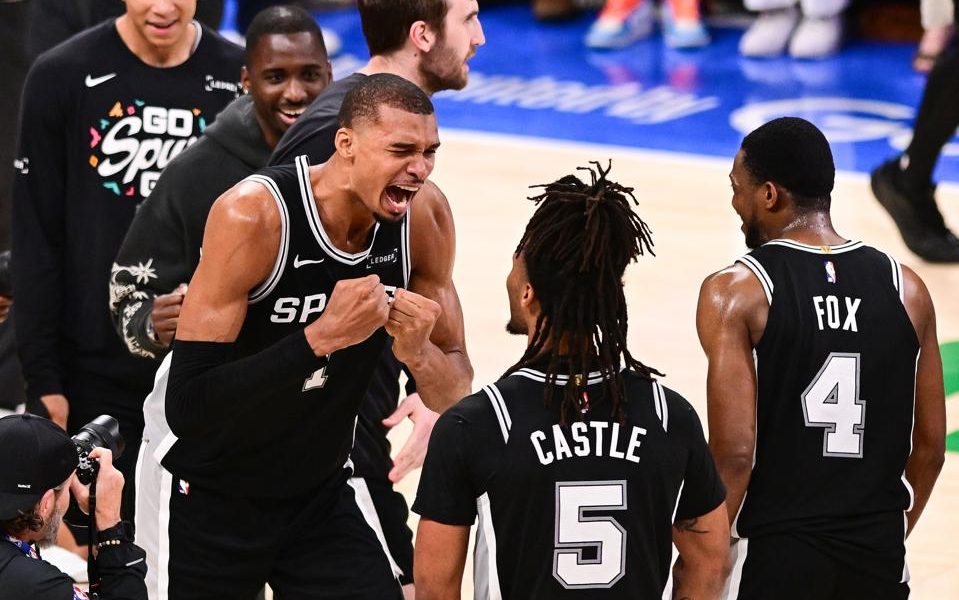
It used to be you had to earn your stripes. Suffer a few lean years, collect some draft picks, and maybe — just maybe — turn into a contender. But these Spurs? They fast-forwarded the entire timeline, bypassing the traditional queue with a cold efficiency that’d make any developing nation’s central planner nod in appreciation. They had back-to-back 22-win seasons, which netted them Victor Wembanyama with the No. 1 overall pick in 2023 — and Stephon Castle with the No. 4 overall pick in 2024. Then they went — and landed Dylan Harper with the No. 2 overall pick in this past year’s draft. That kind of talent accumulation doesn’t just happen. It’s an aggressive resource grab, plain and simple. [QUOTE_PLACEHOLDER]
Consider the broader implications here. Much like Pakistan and other rapidly industrializing nations — navigating a volatile global economic chessboard while trying to maximize indigenous talent and acquire top-tier resources — the Spurs have made a monumental bet on a concentrated few. And it’s paid off handsomely. They’re built different. Their ascent, anchored by 22-year-old wunderkind Victor Wembanyama, sent the defending champion Oklahoma City Thunder packing. They prevailed 111 to 103, a decisive end to a contentious fight. But this isn’t simply a sports story; it’s a blueprint. Because while other organizations (and perhaps countries, if you’re keeping score) are busy planning their five-year incremental improvements, San Antonio just said, ‘Hold my championship trophy, we’re taking ours now.’
The Thunder themselves pulled off a similar, though slightly less aggressive, pivot a few years back. They landed Chet Holmgren with the No. 2 overall pick — and Jalen Williams with the No. 12 overall pick in 2022. They went from 24-58 to 57-25 in the span of two years, proving that with the right combination of talent and strategy, seismic shifts aren’t just possible — they’re the new norm. And now, the Spurs have mirrored that ascent, even surpassing it with a 62-20 regular season finish, beating out the Thunder’s peak win total.
This team is structured not just for immediate victory, but for sustained, relentless pressure. The NBA just passed a massive draft lottery reform, part of which prohibits teams from receiving top-five picks in three straight years. Too late for San Antonio, though. They’d already harvested their talent. It’s a classic case of navigating the regulatory landscape, executing before the rules catch up to your innovative approach.
And then there’s the money. Always the money, right? The Spurs are heading into the offseason with only $156.4 million in salary on their books. With an expected salary cap of $165 million, they’ve got flexibility. That’s a crucial differentiator. It allows them to use the full $15.0 million non-taxpayer mid-level exception at their disposal. It lets them be nimble. Their core players, the foundational pieces of this rapidly forged empire, are largely locked in place for the next three seasons. Victor Wembanyama, eligible for an extension, is a near-certainty to sign a max deal starting at 30% of the salary cap if he nabs MVP or Defensive Player of the Year, or makes an All-NBA team. He was just named the first unanimous Defensive Player of the Year in NBA history. He’s making his case as a greatest-of-all-time candidate if he can stay healthy. And that’s the kicker, isn’t it? The grand vision relies on the physical integrity of a player never quite seen before, an NBA2K Create-a-Player come to life.
📄 POLICY WIRE WHITEPAPER PUBLISHED: PAKISTAN'S NATIONAL SECURITY POLICY PRIORITIES
👉 READ BY CLICKING HEREIt’s worth noting the human element amidst all this statistical analysis. Shai Gilgeous-Alexander, after facing down this nascent leviathan, wasn’t just diplomatic. He observed, “They're young. They're talented. Well-coached. They play the right way, play together. Seems like they like each other. They’ve the makeup for sure.” Then, a starker admission of their immediate power: “You don't beat us without the makeup. So they’ve the makeup to go get [a title].” That, friends, is the sound of an incumbent acknowledging the new force in town.
The Spurs aren’t merely in the championship conversation. They’re set to anchor it for years. The ghost of past greatness—that quiet, almost understated mastery of sustained success—now inhabits a team poised to write a terrifyingly efficient new chapter. They’re, per ESPN Research, the “second-youngest Finals team based on weighted minutes played,” behind only the 1977 Portland Trail Blazers. Their top two scorers aren’t older than 22, a first for any team reaching the Finals. That’s not just a young team; it’s a terrifyingly well-prepared machine, fueled by top-tier talent — and financial savvy. You just don’t see this often. Ever.
What This Means
The San Antonio Spurs’ rapid ascension provides a potent case study in hyper-efficient nation-building, if you will, but in a sporting context. For the rest of the NBA’s 29 other front offices, this isn’t just about losing a few games; it’s a systemic shock, forcing a complete re-evaluation of long-term strategy and talent development. Financially, their judicious cap management and early acquisition of cornerstone players represent a critical economic advantage. It’s not unlike how smaller, more agile economies sometimes outmaneuver traditional global powers through shrewd resource allocation and early investment in disruptive technologies.
Politically, the Spurs’ emergence establishes a new hegemon in the Western Conference, likely influencing trade deadlines, draft strategies, and even coaching tenures across the league for the next decade. Think of it as a new, unavoidable geopolitical bloc. Their immediate success, and the overwhelming evidence suggesting its durability, signals an era where talent centralization (driven by early draft picks and strategic signings like Fox’s four-year, $221.8 million max extension) becomes the primary, if not sole, pathway to elite status. Teams, much like states, will scramble to emulate this model, or face the stark reality of being left behind in a new global sporting order. And because they’ve gotten in before strict rules fully kicked in, other contenders are now trying to rebuild on a playing field already tilted against them. Policy Wire notes that all cited statistics, unless otherwise noted, are compiled from NBA.com and Spotrac, painting a picture of deliberate, almost surgical, financial and talent management.