


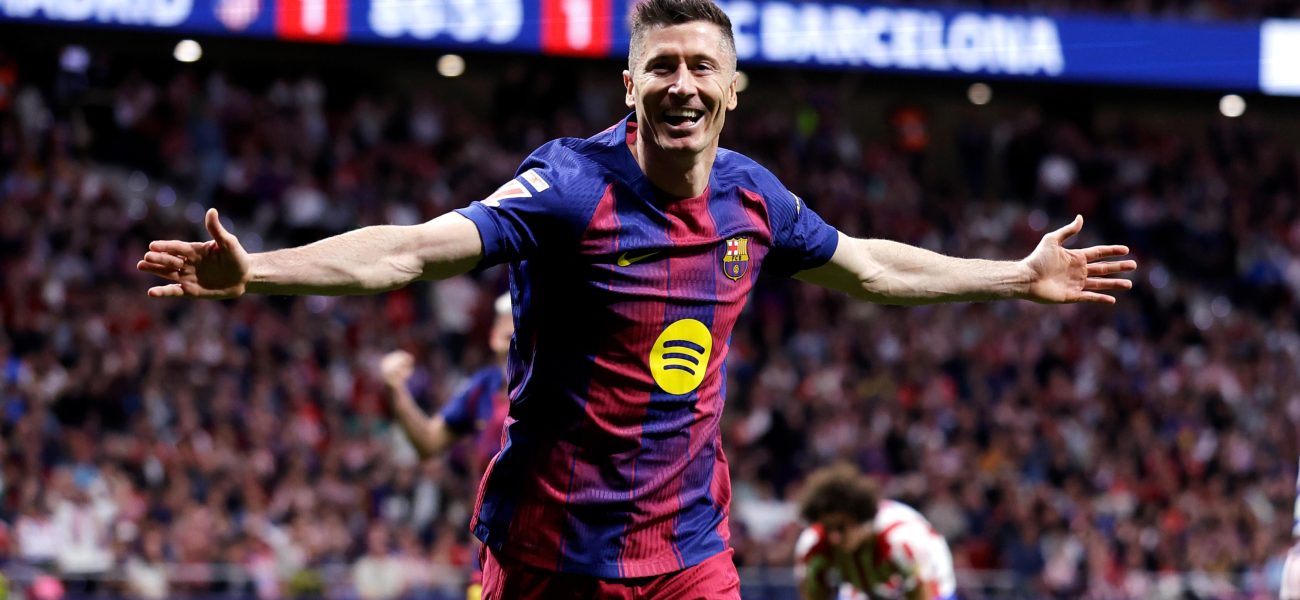
The Grand Illusion: Lewandowski’s Barca Exit & The Precarious Business of Modern Loyalty
POLICY WIRE — MADRID, SPAIN — For devotees across Barcelona’s historic Gothic Quarter, the morning routine typically involves strong coffee and maybe a glance at the daily news—unless, of course, the...

POLICY WIRE — MADRID, SPAIN — For devotees across Barcelona’s historic Gothic Quarter, the morning routine typically involves strong coffee and maybe a glance at the daily news—unless, of course, the news involves football, then it’s an entire emotional overhaul. This week, however, delivered not a tactical victory, but a quieter, more personal form of upheaval. Robert Lewandowski, the Polish marksman whose tenure often felt less like a contract and more like a high-stakes, spiritual crusade, has taken his final bow at Camp Nou.
It’s a peculiar theatre, professional football. Million-dollar contracts, a constant carousel of talent, and then this deep, almost illogical emotional investment from millions worldwide. We often view these figures—athletes—through a romantic lens, yet their careers, like all high-value assets, are governed by cold economics. Lewandowski’s exit isn’t just a farewell; it’s a sharp reminder of how even deep-seated affections often yield to commercial realities.
Because let’s face it, loyalty in sport today often comes with an expiry date—a bitter pill for fan bases, but a stark truth in boardrooms. Lewandowski’s decision, whether forced or sought, reverberates far beyond Catalonia. It echoes in Lahore, Karachi, and Jakarta, where football fan clubs dedicate entire evenings to arguments over team selections, tactical shifts, and, yes, the sudden departure of their heroes. This isn’t just about the transfer of a player; it’s about the commodification of hope, exported globally to passionate audiences who perhaps expect more fidelity from their heroes than the market allows.
Fans remember what the narrative demands they remember. In Barcelona’s case, that narrative will certainly feature his arrival. I mean, few moments stick with you, right? There was an almost feverish belief he could pull this storied club from its financial quicksand and onto something resembling solid ground. And he did. People speak of it as an almost sacred agreement. [QUOTE_PLACEHOLDER] one ardent observer wrote, reflecting a widely held sentiment. He brought moments of sheer joy. You know, like [QUOTE_PLACEHOLDER] or that [QUOTE_PLACEHOLDER] He was a lightning bolt, they say. He actually delivered.
But every lightning bolt fades. And what remains are the stark statistics. According to Forbes, FC Barcelona was valued at $5.1 billion in 2023, ranking it as the world’s third most valuable football club. A staggering sum, reflecting an entity far larger than any single player, even one of Lewandowski’s caliber. Yet, clubs this massive still navigate perilous financial waters, forcing tough calls about ageing assets, regardless of past glories or fan adulation. They’ve gotta keep the lights on, after all.
The collective sentiment in Catalonia was palpable during his send-off. The original ode, an emotional goodbye, struggled with the very definition of professionalism, saying, [QUOTE_PLACEHOLDER] That admission, unintentional though it may be, illustrates the chasm between the cold, corporate management of modern football and the searing, irrational passion of its devotees. The two rarely align neatly.
📄 POLICY WIRE WHITEPAPER PUBLISHED: PAKISTAN'S NATIONAL SECURITY POLICY PRIORITIES
👉 READ BY CLICKING HEREAnd those fans, whether gathered en masse in Camp Nou or watching on screens from hundreds of different time zones, aren’t just consumers of a product. They’re invested, financially — and emotionally. They saw him as the solution. They still see him as part of their story, perhaps even part of what made their club “mes que un club.” The idea that a single individual can embody an entire institution’s struggling spirit, and then elevate it, is powerful stuff.
It’s why his departure, despite its predictability in the ruthless calendar of a footballer’s career, feels different. It’s not just a transfer; it’s another lesson in the ephemeral nature of glory. “We have Robert Lewangoalski… you know Robert LewanGOALski!” a prominent Bayern Munich personality once quipped. The sentiment, now belonging to history, rings a touch bittersweet. Because now, Barcelona has simply “had Robert Lewandowski. You know, the Barcelona hero that took us back to the top.”
He’ll leave, probably, to more silverware — and accolades elsewhere. But for the Catalan faithful, he left behind a memory. A powerful one, undoubtedly. His name now carved into a short but significant chapter, demonstrating that even a footballing powerhouse needed an external jolt to regain its footing—a perilous art of prediction in any major institution’s lifespan. These moments, where individual brilliance shores up institutional instability, captivate us all, from Madrid to Manila.
What This Means
Lewandowski’s exit isn’t an isolated sporting event; it’s a symptom of the ever-increasing transactional nature governing global institutions, from sports franchises to multinational corporations. For FC Barcelona, it highlights the delicate balance between maintaining a competitive edge and managing significant financial constraints—a scenario not unfamiliar to state-backed enterprises grappling with austerity measures. His departure, regardless of cause, signals a recalibration, potentially towards fostering emergent talent or a strategic pivot that might displease a legacy fanbase. Economically, this mirrors broader global trends where talent migration is driven not solely by prestige but increasingly by optimized economic incentives or a strategic quest for specific market advantages. In places like Pakistan or Indonesia, where European football enjoys colossal viewership, the constant flux of star players can create a sense of disconnect, yet simultaneously foster new allegiances, reinforcing the notion that modern fandom is less about static loyalty and more about allegiance to a narrative or a moment. It serves as a reminder that even the most ingrained cultural entities, like venerable football clubs, are ultimately subject to the ruthless pragmatism of the global market, creating a sports distraction from deeper global anxieties.