


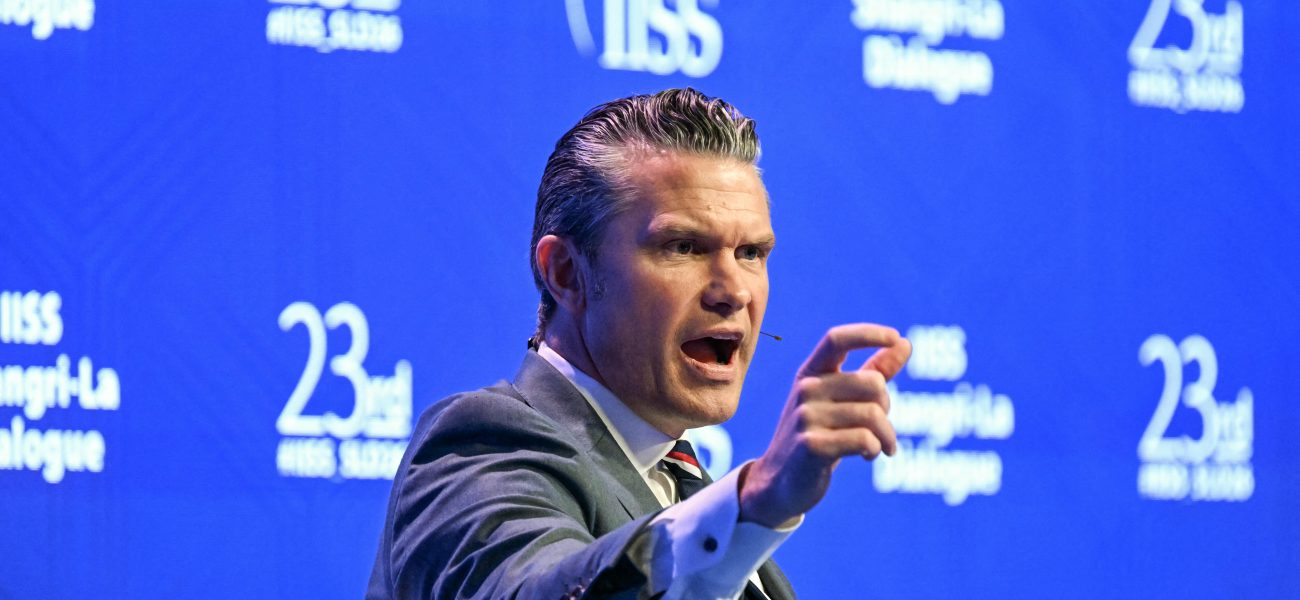
Hegseth’s Peculiar Diplomacy: Softening the China Stance in Asia
POLICY WIRE — Singapore, Southeast Asia — Anyone who’s watched a cable news debate knows the playbook: when China comes up, you pull out the heavy artillery. Threats, economic aggression,...

POLICY WIRE — Singapore, Southeast Asia — Anyone who’s watched a cable news debate knows the playbook: when China comes up, you pull out the heavy artillery. Threats, economic aggression, global dominance—it’s usually a greatest hits of geopolitical alarm. But then, you get Pete Hegseth, the Fox News personality known for his unvarnished takes, landing in a strategically sensitive corner of Asia, and things get weird. His usual fiery rhetoric, typically set to a backdrop of dire warnings about Beijing’s designs, seemed to, well, soften. It’s a pivot, not quite a U-turn, but enough to make seasoned observers — and a few actual diplomats, one presumes — raise an eyebrow or two.
It’s like expecting a rock concert — and getting a jazz trio; still music, just… different. He arrived, reportedly, with the usual buzz of an influential voice traversing critical geopolitical fault lines. But as the discussions unfolded, the volume on China’s looming menace seemed to drop a few decibels. Forget the bluster we’re accustomed to. The message, at least in its public iteration, was far more modulated than many might’ve predicted from someone whose brand thrives on confrontation. He even [QUOTE_PLACEHOLDER], which, coming from him, is practically an olive branch wrapped in velvet.
And it wasn’t just a one-off comment. Across various engagements—the private sit-downs, the carefully staged photo opportunities, even the off-the-record whispers filtering back to us—the dominant note was one of… caution, almost a subtle restraint concerning Beijing’s regional ambitions. Some might say it was merely pragmatic; others might suspect a deeper political calculation. You see, Hegseth isn’t just a media figure; he’s connected, steeped in a particular strand of conservative thought that often shapes Washington’s discourse. So, when that particular strand starts fraying at the edges, it’s worth asking why.
Because America’s policy toward China, despite all the tough talk, has always been a Gordian knot. It’s economic codependence mixed with ideological rivalry, spiced with strategic competition. One cannot simply [QUOTE_PLACEHOLDER] without considering the immense trade implications. Take, for instance, the sheer volume of U.S.-China trade in goods and services, which the U.S. Bureau of Economic Analysis reported at approximately $760 billion in 2022. That’s not pocket change; it’s a colossal entanglement that makes sweeping pronouncements tricky. This tempering of rhetoric might just be a reluctant acknowledgement of that reality.
The reception in the region, one gathers, was less about relief — and more about cautious observation. Local officials are old hands at this game. They’ve heard it all before, the sharp swings of American policy depending on who’s talking or campaigning. For countries like Singapore, which expertly navigates the tightrope between global superpowers, any hint of nuanced messaging is scrutinized. It’s like watching a tightrope walker suddenly slow down their pace. You don’t applaud yet; you just watch for the wobble.
📄 POLICY WIRE WHITEPAPER PUBLISHED: PAKISTAN'S NATIONAL SECURITY POLICY PRIORITIES
👉 READ BY CLICKING HEREThis particular diplomatic dance—or perhaps, solo performance—holds specific interest for Pakistan. A nation that has consistently found itself in a delicate balance between aligning with the West and embracing its growing economic and strategic ties with China. The Belt and Road Initiative, after all, isn’t some abstract concept on Pakistani soil; it’s tangible infrastructure, deep investments. Beijing’s footprint is considerable. Any American figure, particularly one with a platform like Hegseth’s, who starts sounding less like a Cold War general and more like a cautious businessman, offers a curious signal to Islamabad. It doesn’t mean a pivot from Beijing, not by a long shot. But it suggests that perhaps, just perhaps, the American view of China’s rise isn’t monolithically confrontational. Pakistan’s leaders might find subtle encouragement for their own pragmatic approach.
It’s all part of the theatre, isn’t it? The public posturing versus the private calculus. We’ve seen similar shifts, subtle recalibrations in global affairs that don’t make headlines but slowly, inexorably, alter the course of nations. It’s the kind of diplomatic judo that reminds us that policy isn’t static; it’s a living, breathing, sometimes contradictory beast. Hegseth’s visit might be a fleeting moment in a chaotic election cycle, but its subtle messages will be decoded in capitals across Asia, not least in Islamabad and Beijing itself. This wasn’t the usual grandstanding, you see. And that’s what makes it so fascinating. He simply didn’t hammer home the usual talking points. He held back, or was made to hold back. One can only guess.
What This Means
Hegseth’s moderated tone, unexpected from his typical public persona, points to a deeper strategic recalibration within certain hawkish circles in Washington, or at the very least, a tactical recognition of regional complexities. It’s not necessarily a softening of long-term U.S. goals concerning China, but rather a potential acknowledgement that an unremittingly aggressive posture might be counterproductive, particularly in engaging economically entangled nations. This shift, however slight, gives countries like Pakistan—a nation that’s simultaneously courted by the U.S. and deeply dependent on China—a bit more breathing room. It might be interpreted as an opening for less rigid alignments, fostering an environment where states can pursue multi-vectored foreign policies without immediately facing an American ultimatum. The perilous art of prediction in geopolitics often hinges on such subtle alterations in public messaging, which can ripple through economic partnerships and regional power dynamics, influencing trade agreements and security pacts that affect millions. Essentially, if even the most vocal critics are capable of nuanced public discourse, it suggests an evolving understanding that the stakes with China are too high for one-note rhetoric alone. It’s less about a grand pivot and more about the recognition of shades of grey in an otherwise black-and-white narrative. The implications for the global supply chain, regional alliances, — and even potential investment trends are real. Because when the hardliners dial it back, everyone else takes notice.