


Germany’s Green Paradox: Protests Mount as Energy Realities Collide with Ambitions
POLICY WIRE — Düsseldorf, Germany — It’s a strange sort of progress, isn’t it, when the vanguard of environmental activism finds itself staring down the barrel of infrastructure designed—at...

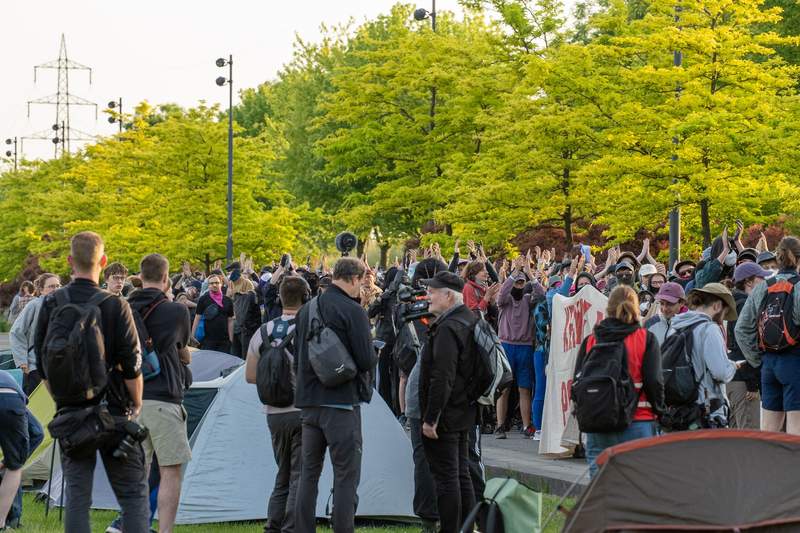
POLICY WIRE — Düsseldorf, Germany — It’s a strange sort of progress, isn’t it, when the vanguard of environmental activism finds itself staring down the barrel of infrastructure designed—at least ostensibly—to bridge an energy gap. In a nation often celebrated for its staunch commitment to a greener future, the reality of maintaining industrial heft has thrown a rather hefty spanner in the works. Thousands, in a familiar sight for anyone who’s followed European energy politics, took to the streets in western Germany this week, not just against coal, which is old news, but against gas—the supposed interim solution. It’s a tricky bind. You ditch nuclear, you ditch coal, but the sun doesn’t always shine, — and the wind doesn’t always blow.
The demonstrations unfolded across cities, echoing concerns that these planned gas plants are just another fossil fuel trap, dressed in slightly less sooty attire. Participants weren’t subtle. Their message: don’t exchange one dependency for another. This sentiment captures a broader unease; a fear that policy decisions made under duress are simply kicking the environmental can down the road, making Germany’s energy transition less of a sprint and more of a protracted, rather expensive shuffle. But what’s the alternative, short of a total shutdown of the economy? No one seems to have a clear answer to that one. [QUOTE_PLACEHOLDER]
It’s not just a German problem, either. The global scramble for reliable, affordable energy hits different. Think about nations like Pakistan. They’ve faced their own energy crises, crippling blackouts, and economic slowdowns—issues that hit home much harder than an ideological debate about a long-term carbon footprint. While Germany debates the purity of its transitional fuels, nations with fewer resources just need the lights to stay on. The very real struggle in Islamabad or Karachi often comes down to fundamental access, not just the source’s environmental credentialing. For Pakistan, reliable energy can be the make-or-break for a developing industrial sector, or even just keeping households warm (or cool, depending on the season). Germany’s protestors want to see an accelerated sprint to renewables. Other places, they’re still learning to crawl, often on the same fossil fuels Western nations got rich using. It’s a conversation worth having, about who gets to go green first.
And let’s be frank, the protestors have a point about the emissions. Gas, though cleaner than coal, is far from carbon-neutral. Constructing new gas-fired power stations commits the nation to decades more of carbon output. That’s a bitter pill for those who believed the energy Energiewende—that great German transformation—would mean a clean break sooner rather than later. For them, every new gas project is a step backward, an unholy compromise with a dying fossil fuel era.
But the government faces immense pressure from industrial giants. Chemical plants, automotive factories, the sheer manufacturing heart of Germany—they can’t just run on good intentions and solar panels after sunset. They need consistent, high-output power. It’s a foundational requirement. And if they don’t get it at a reasonable price, well, they’ll just pack up — and go somewhere that does. That’s a stark economic truth no politician wants to grapple with in an election year. In 2022, natural gas comprised approximately 26% of Germany’s primary energy consumption, according to data from the German Federal Ministry for Economic Affairs and Climate Action—a statistic that really tells you where things stand, or don’t stand.
The official line is, of course, that these are ‘bridge technologies,’ necessary until renewables can carry the full load. But how long is that bridge, exactly? No one’s quite sure. Critics say the government isn’t investing aggressively enough in battery storage or grid modernization to truly transition, instead falling back on the easy option. It’s not unlike the global policy gaps seen when an athlete’s ACL snaps, suddenly revealing the fragility of larger systems. It feels less like a bridge — and more like an indefinite detour on a road no one wanted to travel anyway.
📄 POLICY WIRE WHITEPAPER PUBLISHED: PAKISTAN'S NATIONAL SECURITY POLICY PRIORITIES
👉 READ BY CLICKING HEREThe visual of thousands rally in western Germany against gas-fired power stations presents a unified front of discontent, yes, but also hints at deep internal divisions within Germany’s celebrated green movement and its industrial bedrock. It’s an ideological clash with very real-world consequences for every German household — and factory floor. You’ve got to wonder if anyone in Berlin is actually listening. Or, perhaps, if they just don’t have a better idea.
What This Means
This escalating confrontation over gas infrastructure is more than just another protest; it’s a profound canary in the coal mine for Europe’s entire energy transition strategy. Politically, it complicates the Greens’ already tricky coalition balancing act, pitting their core environmental principles against economic stability—and voters, after all, feel their wallets first. Economically, prolonged uncertainty or sudden shifts in energy policy create a toxic environment for long-term industrial investment. Companies won’t commit to billions in plant upgrades if the energy future is constantly debated, unstable, or outrageously priced.
Germany’s pivot away from both Russian gas and nuclear power, alongside its coal phase-out, presents a powerful global case study—or, some might say, a cautionary tale. If a wealthy, technologically advanced nation like Germany struggles this much with a ‘managed’ transition, what does that say for emerging economies in South Asia or the Muslim world, many of whom have less fiscal wiggle room and greater immediate needs? They’ll watch closely, learning if ambition truly trumps pragmatism. Their choices might not reflect Europe’s idealised green agenda, especially if the cost is simply too high. Germany’s headache today could well become the global standard, or a reason to forge entirely different paths.