

Spelling Bee Champion’s Redemption Arc: A Blink-and-You-Miss-It Triumph
POLICY WIRE — WASHINGTON, D.C. — Imagine having the whole country — or at least, the kind of folks who obsess over lexical esoterica — watch you mess up. Badly. On a word as utterly basic as...

POLICY WIRE — WASHINGTON, D.C. — Imagine having the whole country — or at least, the kind of folks who obsess over lexical esoterica — watch you mess up. Badly. On a word as utterly basic as "calipers." That’s the ghost that haunted Shrey Parikh, not just for a moment, but for a year, a raw, humiliating misstep that derailed his path to the National Spelling Bee until Thursday night.
Because sometimes, you hit rock bottom, then you get mad, — and then you just plain work your tail off. The 14-year-old from Rancho Cucamonga, California, wasn’t just some wunderkind who effortlessly sailed to victory. No, this kid took an unusual route, a detour through the very pit of a speller’s shame — missing his regional bee because of a fever, sure, but also, because "he blanked on the word ‘calipers’ and bowed out of a competition that any speller of his talent would consider child’s play: the spelling bee at Day Creek Intermediate School." A low point? You bet your dictionary it was. But it’s often from those kinds of gut punches that true champions emerge. [QUOTE_PLACEHOLDER]
Fast forward, and there he was, under the bright lights of Constitution Hall, body shaking, nerves doing a jig every time he faced pronouncer Jacques Bailly. You could almost feel the adrenaline, the echoes of that past defeat. But then, a subtle shift: Bailly would utter a word, and Shrey would give a vigorous nod, a little tell that let everyone know, yes, "he knew the words he was asked to spell. All of them." And his perspective? Straightforward, almost clinical: "Once I get the word, I’m not really nervous anymore, because then it’s all in my control."
This year’s Bee felt like a high-stakes poker game, right down to the final hand against Ishaan Gupta. Sarv Dharavane, a previous contender, bowed out in third, leaving Shrey and Ishaan for a single conventional round before the much-debated spell-off commenced. But then, a classic moment of live television jitters: a technical glitch with the buzzer, forcing Shrey to stand there, waiting, raw nerves exposed, for a full five minutes. "That was really, like, scary for me," he admitted. Talk about adding insult to injury – or rather, suspense to an already intense showdown.
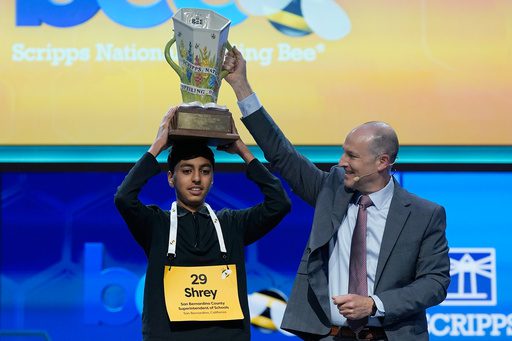
The tiebreaker, a blur of 90 seconds, is designed for speed and rote memorization, stripping away much of the strategic guesswork Bee purists often love. Shrey didn’t just win it; he owned it. He spelled an astonishing "32 words correctly in 90 seconds," setting a new benchmark for the rapid-fire format. Ishaan, admirable in his fight, managed "25 words right" but just couldn’t match the blistering pace. Shrey’s mother, Khyati Mehta, was counting along: "And at that point, I’m like, ‘I think this is it.’" And just like that, it was over. The winning word, later revealed, was "bromocriptine" — quite a mouthful for a blink-and-you’ll-miss-it victory.
And so, a new champion was crowned, pocketing $52,500 — and a custom trophy. It’s a win that also highlights a fascinating cultural narrative: Shrey "becomes the 31st of the past 37 champions with Indian heritage." This isn’t just a quirky stat; it speaks volumes about the incredible drive and emphasis on academic achievement within the Indian diaspora in the U.S., a trait often shared by many South Asian and Muslim-majority communities globally, from Karachi to Kuala Lumpur. Parents in places like Pakistan often push fiercely for educational excellence, seeing it as the ultimate escalator to a better life, a direct path for their kids to, well, excel — be it in spelling or medicine or engineering.
Not everyone’s a fan of the new format. The spell-off, introduced in 2022, is still a tough pill for the traditionalists. Navneeth Murali, a former competitor turned coach, put it plainly: "It’s a perversion of many values that I and many in the spelling community hold dear." Because it swaps strategic word dissection for pure speed, robbing audiences of those nail-biting moments where a speller logically deconstructs a gnarly polysyllabic beast. "I think everyone would have liked to see a duel, but it looks like the spell-off is here to stay. It’s something that we’ll have to adapt to." He’s probably not wrong.
But adapt they will. This year’s field was no slouch, starting with nine finalists who blazed through the early rounds. The crowd at Constitution Hall, despite the controversial new rules, was lively, engaged by more intimate seating. Ishaan — and Sarv, both young eighth-graders with eligibility left, can surely dream of their own comebacks. But Thursday belonged to Shrey. No confetti shower this time — a slight letdown, honestly — but his father, Gaurav Parikh, summed it up perfectly: "When it comes to competition, he goes all the way." And another coach put it even more succinctly, saying Shrey has "that dog in him."
What This Means
Shrey Parikh’s victory, particularly his phoenix-like rise from the "calipers" debacle, isn’t just a feel-good story; it reflects several evolving undercurrents in American competitive culture and its global linkages. Economically, the high stakes of competitions like the National Spelling Bee, even at the youth level, implicitly foster an early understanding of reward for intense dedication. These kids are investing immense time, supported by coaching — a micro-economy of academic achievement — that hones a disciplined, goal-oriented mindset. It’s essentially early training for the competitive grind of future professional life, be it in finance or tech.
Politically, the continuous dominance of spellers of Indian heritage (31 out of 37 recent champions is an eye-watering statistic) might seem narrow, but it carries broader implications. It symbolizes the successful integration and exceptional drive of certain immigrant communities, a living testament to how diverse cultural values, like prioritizing education as the paramount vehicle for social mobility, directly shape outcomes in the American melting pot. This phenomenon isn’t exclusive to the Indian diaspora; similar academic zeal can be seen among other South Asian and Muslim-majority communities — from Pakistanis to Bangladeshis — who often transplant an intense focus on scholastic achievement from their home countries, seeing it as a crucial investment in future generations, irrespective of political or economic instabilities they might have left behind. Their success in these public arenas quietly, but powerfully, reshapes the national narrative of accomplishment, and even provides aspirational templates for other striving groups globally.
Finally, the growing pains of the spell-off highlight a generational tussle between tradition — and efficiency. The shift to a faster, more results-driven format reflects a broader societal push for immediate gratification and quantifiable outcomes. It’s less about the elegant process of deduction — and more about raw, explosive performance. This isn’t just a spelling bee dilemma; it’s a microcosm of how institutions grapple with maintaining "integrity" while catering to modern demands for speed and entertainment. What’s next? An AI-judged poetry slam? One thing’s clear: academic glory, in its newest iterations, still shines blindingly bright.