


Celestial Ambition Meets Earthly Detonation: The Cost of Commercial Space Dreams
POLICY WIRE — Van Horn, Texas — For all the lofty rhetoric about humanity reaching for the stars, the actual journey often involves a rather more terrestrial phenomenon: fire and debris. One moment,...

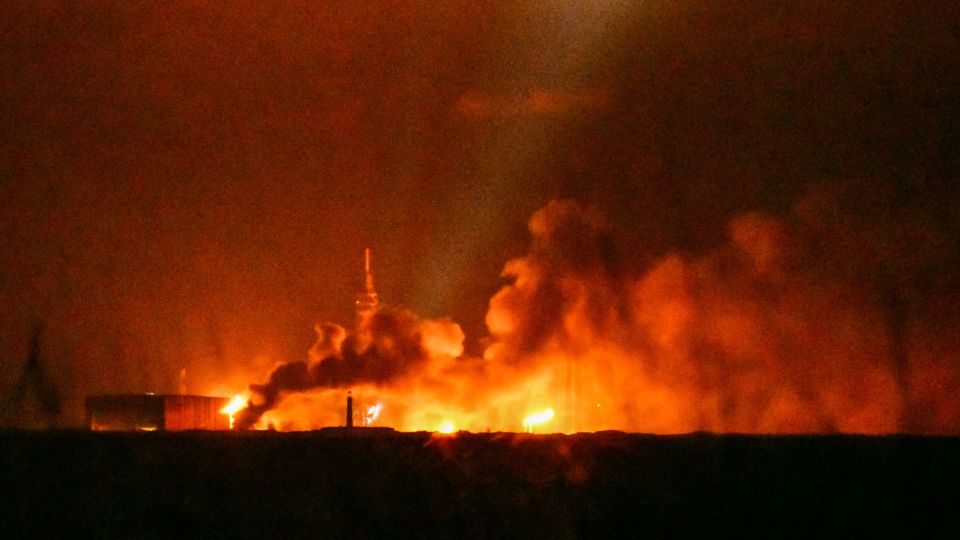
POLICY WIRE — Van Horn, Texas — For all the lofty rhetoric about humanity reaching for the stars, the actual journey often involves a rather more terrestrial phenomenon: fire and debris. One moment, engineers were monitoring a highly complex propulsion system. The next, a rather spectacular assertion of physical laws—a rapid, unscheduled disassembly—shattered the desert calm. It wasn’t a launch gone wrong; it was something far less cinematic, yet perhaps more telling, a ground test designed to push boundaries until, well, the boundaries pushed back with explosive force.
This wasn’t some isolated anomaly either. It’s an inconvenient truth, a loud, clear signal emanating from West Texas, suggesting that even the best laid plans for our celestial future are prone to quite ordinary—and expensive—failures. Jeff Bezos personal space enterprise, Blue Origin, saw one of its BE-4 rocket engines, destined for crucial upcoming missions, decide to return to its component parts in a most dramatic fashion. The company didn’t precisely gloss over it, but the corporate communique, as one might expect, preferred words like [QUOTE_PLACEHOLDER] when describing the incident. Engineers, surely, weren’t surprised, just disappointed—a professional euphemism for when something costing untold millions turns into a cloud of smoke and fragments.
But the incident isn’t just about a broken engine or a delayed launch manifest. It rips the bandage off a persistent wound in the shiny veneer of the commercial space industry. We’re in an era where billionaires, not nation-states, largely dictate the pace of interstellar expansion. It’s a heady mix of ambition, engineering genius, and colossal capital, yet for every triumphant orbital flight, there are countless unseen hurdles—design flaws, material stresses, unexpected pressures. And, sometimes, quite literally, things blow up. It happens. The question, however, is what price are we, collectively, willing to pay for this new frontier? What happens when these private aspirations inevitably run headfirst into public skepticism, or worse, tragedy?
This particular mishap with the BE-4 is more than just an operational hiccup. The BE-4 engine, you see, isn’t just for Blue Origin’s rockets. It’s slated to power United Launch Alliance s new Vulcan Centaur rocket, a vehicle that s meant to be America s primary access point to space for national security missions and NASA scientific endeavors. That’s a big deal. Delays here don’t just affect tourism dreams; they could ripple through sensitive defense infrastructure and scientific discovery alike. One engineer, speaking off the record (because, you know, corporate policies), simply stated [QUOTE_PLACEHOLDER]. They’ve been at this game a long time, these folks, watching ambition wrestle with physics.
And what does this mean for nations beyond the usual suspects in the space race? Countries like Pakistan, for instance, are meticulously cultivating their own nascent space programs. They aren’t sending billionaires to the edge of space, but rather focusing on more pragmatic applications: communication satellites, earth observation for agriculture and disaster management. Their investment, often constrained by complex economic realities, is geared toward tangible, immediate benefits for their populations. For them, every dollar spent, every kilowatt of propulsion, every gram of payload is calculated against national development goals.
It’s a stark contrast: the often-extravagant pursuits of commercial giants versus the disciplined, often austere, endeavors of developing nations. While Blue Origin’s mishap is an engineering problem for a Western powerhouse, it represents a cautionary tale, an illustration of the high-stakes, high-cost nature of the entire endeavor. Developing countries can hardly afford to replicate the trial-and-error approach common in Western labs, where a percentage of failures is sometimes baked into the developmental budget. Data from the European Space Agency suggests that for new rocket engine development programs, the failure rate for initial ground tests can exceed 30%, highlighting the inherent risks in pushing these technological envelopes.
Consider the broader context, too. Investment in high-tech ventures, whether for space tourism or satellite internet, pulls capital — and talent. It creates an almost aspirational divide, a technologic schism between those nations who can play in the trillion-dollar sandbox of orbital mechanics and those who watch from the periphery, grappling with more fundamental earthly concerns. The Muslim world, for all its scientific heritage, finds itself navigating this uneven terrain, balancing indigenous technological advancement with reliance on established spacefaring nations for critical infrastructure. This single, fiery incident—a Blue Origin rocket engine failing spectacularly on a test stand—isn’t just an internal problem. It’s a macroscopic mirror, reflecting the complexities, costs, and inequities of humanity’s enduring, fiery ambition to reach for the stars.
What This Means
This Blue Origin engine test failure isn’t just a technical glitch; it’s a financial jolt that reverberates across the private space economy. Delays stemming from such setbacks can push launch schedules back by months, or even years, which means lost revenue and increasing development costs for companies operating on razor-thin margins and aggressive timelines. For companies like United Launch Alliance, dependent on Blue Origin’s BE-4 engines, this translates directly into potential postponements for high-profile government and commercial satellite deployments—think secure communications going up late, or cutting-edge scientific instruments staying grounded. The economic impact isn’t speculative; it’s a direct blow to investor confidence — and strategic planning.
Politically, these incidents complicate the narrative of American technological superiority, especially when competing with state-backed programs like those in China or Russia. While failures are inherent in innovation, their frequency or significance can be seized upon by geopolitical rivals to question reliability and assert their own advancements. the increasing commercialization of space means that private sector problems can quickly become national security concerns, requiring closer oversight and potentially new regulatory frameworks from federal agencies. It’s no longer just NASA failing; it’s a multinational supply chain under scrutiny, demanding resilience and redundancy—attributes that come at an exorbitant cost.