


The Perplexing Payout: Baseball Stats, Algorithmic Failure, and the Mirage of Certainty
POLICY WIRE — Washington D.C., USA — Somewhere in the sprawling digital ether, algorithms are crunching millions of data points, trying to predict the arc of a baseball, the swing of an election, or...

POLICY WIRE — Washington D.C., USA — Somewhere in the sprawling digital ether, algorithms are crunching millions of data points, trying to predict the arc of a baseball, the swing of an election, or the stability of a distant market. Yet, for all their supposed precision, the machine’s quest for an absolute forecast often hits a wall. Consider, for instance, the recent fortunes of one particular predictive model, focused not on geopolitical tremors or commodity price shifts, but the comparatively trivial business of whether a man might hit a ball over a fence.
It’s a peculiar mirror, this granular dissection of athletic performance, reflecting grander human endeavors. After all, what’s policy but an educated guess at future outcomes? The models we build for foreign aid, for trade negotiations with, say, Islamabad or Dhaka, aren’t always so different in their aspirations. Both crave certainty, both rely on complex data, and both, occasionally, hit what the original architects of this particular analysis would bluntly call a [QUOTE_PLACEHOLDER] – or a much more sophisticated ‘statistical anomaly’ for those in less-gritty fields.
This particular system, meticulously designed to forecast home runs in America’s pastime, currently logs a rather embarrassing statistical ledger. Its track record for its signature recommendations now stands at 8 successes out of 42 attempts in the current season, as reported in the financial press. You don’t need a quantum supercomputer to know those aren’t exactly winning odds. But even more striking is the net financial return: after two months of this data-driven drudgery, someone following every suggested wager of $100 sits [QUOTE_PLACEHOLDER], up a princely $25. One wonders what sort of policy advice, when boiled down to its essential ROI, yields a similarly underwhelming sum despite immense effort. We’re often told how AI and big data will revolutionize everything, but sometimes, they just give us another way to be wrong, expensively so.
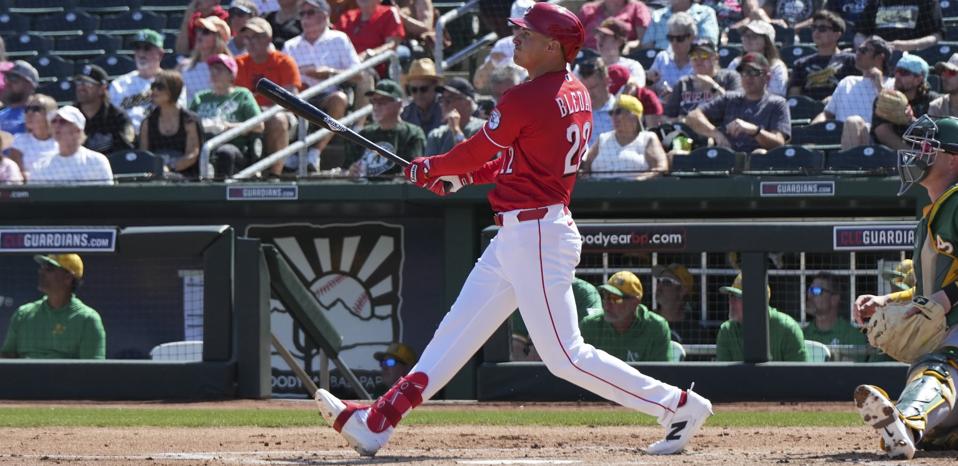
And it’s not like the inputs were trivial. Take JJ Bleday. The reports detail a granular analysis of his play. He’s had a [QUOTE_PLACEHOLDER] according to earlier assessments. His 2024 performance saw him hit 20 home runs, a personal best. Fast forward to 2026, — and he’s [QUOTE_PLACEHOLDER]. He’s managed seven homers in just 27 games. But you’ve got to dig deeper. He’s belted [QUOTE_PLACEHOLDER] in only 85 plate appearances against right-handed pitchers. Those are some niche numbers, aren’t they? And his batted-ball metrics? They’re practically off the charts. He’s [QUOTE_PLACEHOLDER]. He’s also done an outstanding job of lifting the ball, with the 15th-steepest launch angle (21.5 degrees).
This isn’t some back-of-the-envelope stuff. This is the kind of forensic data crunching we laud when it helps design a drone or optimize a shipping route through the Strait of Hormuz. His projected opponent, Grant Holmes, has a dismal record, allowing 1.55 home runs per nine innings. That’s [QUOTE_PLACEHOLDER] among today’s probable starting pitchers, we’re told. So, what’s going on? You have a top-tier batter in a power-friendly park, facing a statistically weak pitcher, yet the overarching predictive model is in a rut.
Then there’s Ben Rice. Sixteen home runs on the season for the Yankees’ first baseman, placing him among the league’s top six. He, too, exhibits [QUOTE_PLACEHOLDER] He’s ranked tied for 10th in barrels per plate appearance rate and 13th in hard-hit rate. But for Rice, the analytical lens swings to the opposition: Luis Severino. After starting the season without giving up a homer in three starts, he’s surrendered eight in eight subsequent appearances. Four starts at home? He’s coughed up two homers in each. Again, the data appears overwhelming, designed to give the betting algorithms—and the punters who follow them—an edge. Yet, the broader ‘system’ remains stagnant.
But when algorithms, like people, get it wrong so often, even with seemingly irrefutable data, what does it say about our contemporary faith in pure empiricism? It’s a sobering thought for policy-makers trying to forecast, say, the public mood in Lahore after a contentious political decision, or the economic ripple effects of a new trade pact across the sub-continent. Data, it seems, can always be defied by the messy, unpredictable nature of reality.
What This Means
This seemingly innocuous look into baseball betting lays bare a few uncomfortable truths about modern governance and economy. First, the fetishization of data, no matter how granular or exhaustive, doesn’t guarantee foresight. Just as home runs are [QUOTE_PLACEHOLDER] so too are the complexities of international relations or socio-economic shifts. It’s a powerful lesson in humility, particularly for those in high-stakes positions. When data points can’t predict a simple ball flying out of a park, perhaps our faith in algorithms to predict market crashes or voter behavior needs tempering.
Second, the vast global reach of betting operations, largely facilitated by digital platforms, poses complex regulatory challenges, particularly in regions with differing legal and ethical stances on gambling. Consider nations in the Muslim world, including Pakistan, where such activities are often proscribed. The ease with which these Western-centric digital predictions and betting markets can bleed across borders presents a nuanced policy conundrum. Governments must grapple with safeguarding national values and legal frameworks in an increasingly borderless digital economy, all while sophisticated algorithms relentlessly try to parse probabilities. The pursuit of profit in one sector, however benign it may seem, can quickly create unforeseen headaches in another. And it certainly gives pause to anyone convinced that enough computing power can always solve human problems. It’s better to be [QUOTE_PLACEHOLDER], perhaps, but that’s not exactly a rousing victory cry.