


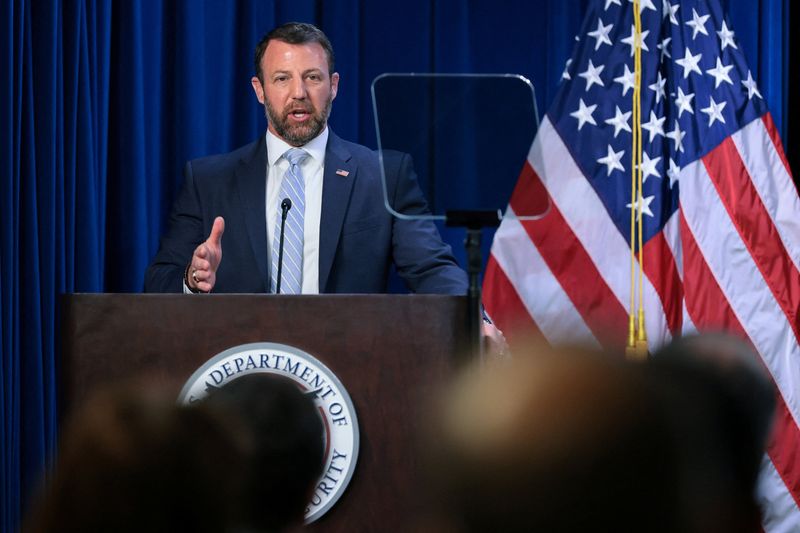
Homeland Security Threatens Airport Chaos: ‘Sanctuary’ Cities Brace for Federal Clampdown
POLICY WIRE — Washington D.C. — Imagine stepping off a 16-hour flight from Lahore, jet-lagged and wired, only to find yourself caught in a six-hour queue for immigration, your customs forms gathering...

POLICY WIRE — Washington D.C. — Imagine stepping off a 16-hour flight from Lahore, jet-lagged and wired, only to find yourself caught in a six-hour queue for immigration, your customs forms gathering dust while officers pace, short-staffed. It sounds like a bad dream. But for travelers to some of America’s biggest cities, it might soon be their reality.
Because the bureaucratic gears are grinding, slow and deliberate, in Washington D.C., as federal authorities cook up a rather inventive strategy. Sources close to the Department of Homeland Security (DHS) whisper of a contingency — perhaps a trial balloon — that could severely curtail, even suspend, immigration and customs services at airports within what it labels as ‘sanctuary jurisdictions.’ It’s a blunt instrument, this. A declaration of war on municipal defiance, played out in arrival halls — and baggage claim carousels.
It’s no secret that the Biden administration, despite campaigning on a more humane approach, finds itself pinned between humanitarian pressures and persistent allegations of a porous southern border. The current approach, a kind of administrative whack-a-mole, clearly isn’t appeasing everyone. The move to weaponize airport operations against cities like New York, Los Angeles, and Chicago — bastions of urban liberalism, largely — seems designed to inject a fresh dose of chaos into an already fractious immigration debate. It’s a ‘we’ll show you’ message delivered through international travel delays — and snarled supply chains.
The White House, naturally, remains tight-lipped. Spokespeople for DHS aren’t confirming anything specific. They’re only reiterating a long-standing position: [QUOTE_PLACEHOLDER] all available tools are on the table to ensure border security and enforce immigration law. But the chatter isn’t accidental. It’s part of a carefully orchestrated campaign, intended to put pressure on local governments to — what? Fall in line? Abandon their principles? It’s not like San Francisco’s mayor will suddenly roll out the welcome mat for federal ICE agents at Terminal 2, no matter how many flights are backed up. Don’t kid yourselves.
This isn’t just about hassling vacationers or delaying business travelers. It’s a systemic chokehold being threatened. Think about it: customs processing is tied to global commerce, imports, exports, — and critical logistics. What happens when goods, not just people, sit in limbo? The economic ripples wouldn’t just affect tourists trying to see the Empire State Building. They’d hit international trade partners—and, boy, would that grab headlines. Many families from Pakistan, for example, have substantial ties — and frequent travel to these metropolitan areas. Their plans, their businesses, even critical medical travel—it’d all get thrown into disarray. Because that’s what happens when politics gets nasty enough to tamper with established logistical networks.
And let’s not pretend this policy proposal comes from a vacuum. For years, federal-state tensions have flared over immigration policy, often pitting a conservative federal stance against more progressive urban and state policies. This escalation, if implemented, represents a significant ramping up of those tensions. The financial services sector, for instance, a cornerstone of New York’s economy, relies heavily on frictionless international travel for executives and high-value clients. An obstructionist policy like this isn’t just an inconvenience; it’s an attack on their operational efficacy.
There’s also a deeply cynical argument underlying this play. It essentially aims to shift the public perception of the ‘burden’ of undocumented immigrants from federal enforcement to municipal resistance. [QUOTE_PLACEHOLDER] Our hands are tied by these cities, the argument might go. But, the reality is, such a move could alienate significant voter blocks — and business communities. The Association of International Air Transport reported that direct and indirect air transport activities supported nearly 6.7 million jobs in the US in 2022, contributing hundreds of billions to the economy. Mess with that, — and you’re messing with serious money, and even more serious political capital.
📄 POLICY WIRE WHITEPAPER PUBLISHED: PAKISTAN'S NATIONAL SECURITY POLICY PRIORITIES
👉 READ BY CLICKING HEREBut Washington’s penchant for playing chicken with its own infrastructure runs deep. This tactic, designed to inflict maximum pain on opposing political strongholds, is straight out of the old playbook. It’s an exercise in leverage, pure — and simple. The idea is to make life so uncomfortable, so unworkable, that these cities blink. Or perhaps, it’s just a threat—a way to spook cities into compliance without actually having to pull the trigger. After all, nobody wants to be the mayor who crippled JFK.
Critics are already lining up to denounce the mere consideration of such measures. They warn of potential lawsuits, civil rights challenges, — and severe disruptions to daily life and the broader economy. And it’s not hard to see why. Such a drastic step wouldn’t merely be punitive; it’d be self-inflicted damage on an already strained travel system. Consider the Muslim-American community, many of whom have endured heightened scrutiny for decades at entry points. This sort of policy, irrespective of its stated aims, will inevitably add another layer of suspicion and hardship, fueling anxieties about discrimination and arbitrary enforcement.
The question isn’t whether they *can* do it; it’s whether they *dare* do it. The fallout would be substantial, touching everyone from multinational CEOs to families visiting relatives, and yes, those travelers returning from a long haul from South Asia. It’s a high-stakes gamble with America’s own welcome mat.
What This Means
This rumored federal initiative signals a concerning new phase in the ongoing immigration debate—a phase where the federal government isn’t just pushing for policy changes but actively threatening to degrade essential public services to compel local compliance. Economically, this move could trigger massive disruptions. Airports, particularly major international hubs located in these ‘sanctuary cities,’ are critical economic engines. Curtailing processing wouldn’t only infuriate individual travelers but could also lead to significant commercial delays, impacting everything from fresh produce imports to time-sensitive manufacturing components. The associated industries—airlines, hospitality, logistics—would suffer immediate and substantial losses. Politically, it’s a gamble. While it might energize the administration’s base by demonstrating a tough stance on immigration, it risks alienating moderate voters and galvanizing opposition from urban constituencies and powerful business lobbies. It sets a dangerous precedent where federal agencies can weaponize operational aspects against politically opposed local governments. Such an approach could invite widespread litigation — and create a permanent fissure in intergovernmental relations. More subtly, it underscores the persistent tension surrounding immigration within a deeply diverse nation, reflecting barriers emerging in progressive metropolises as public safety concerns intertwine with migrant inflows. it creates a layer of unpredictable bureaucratic friction that could reverberate globally, complicating diplomatic relations and international perceptions of American stability and hospitality, particularly for visitors from countries like Pakistan, India, or other Muslim-majority nations who frequently travel through these major gateways, increasing their travel woes and perceptions of arbitrary difficulty navigating U.S. entry.