


Ice From The Sky: Our Warmer World’s Billion-Dollar Hail Problem
POLICY WIRE — WASHINGTON — The planet, it turns out, is building its own artillery. Forget geopolitical machinations for a moment; the real threat dropping from the sky might be ice, the size of golf...

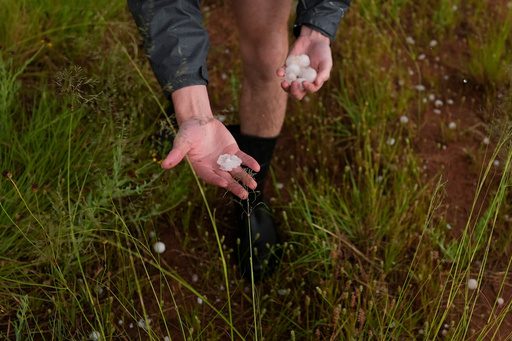
POLICY WIRE — WASHINGTON — The planet, it turns out, is building its own artillery. Forget geopolitical machinations for a moment; the real threat dropping from the sky might be ice, the size of golf balls, impacting unprepared cities and farms with increasing fury. It’s not just a seasonal nuisance for crops anymore, folks. The financial fallout from massive hailstones already makes hurricanes look, well, almost quaint sometimes.
It sounds dramatic, but a new study just laid out the cold, hard facts. A warmer world will likely make bigger — and more damaging hail, the research tells us. It’s a bitter irony, isn’t it? The very warming we’ve wrought now returns as chunks of frozen water, pelting our cars — and shattering our roofs. But here’s the kicker, the truly concerning bit: John Allen, a meteorology professor at Central Michigan University and co-author of the study, notes that hail already costs the U.S. about $10 billion a year and around $80 billion globally. Think about that for a second. Hail does more damage than tornadoes and generally costs more than a couple hurricanes a year now
. Yeah, you heard right. A couple of hurricanes. [QUOTE_PLACEHOLDER]
Because climate change, fueled by our fossil fuel burning, creates more high-energy unstable air—perfect conditions, apparently, for super-sized hail formation. And we’re talking about significant jumps: global storms bringing hail bigger than a large marble are projected to increase between 38% and 47% by the century’s end, the study published in Nature detailed. It depends on just how much heat-trapping gas we keep belching into the atmosphere. Smaller hail events, conversely, are expected to shrink by a few percentage points, researchers found.
But that’s no comfort, is it? It’s the big ones that do the real harm, the kind that shred crops — and turn parked cars into dimpled messes. We’ve seen record hailstones in recent years
, Allen said. And it’s worrying. I find this extremely concerning because we’re not really building our environment to be resilient to hail. We don’t include this in our design standards, for example, for built homes in the U.S. or indeed internationally.
This isn’t some niche weather event anymore; it’s a global phenomenon demanding structural foresight that simply doesn’t exist.
It’s all about physics, naturally. There’s more water vapor in a warmer atmosphere—almost 4% more per degree Fahrenheit. And that increases the available energy to the atmosphere and so we tend to get end up with stronger updrafts
, Allen explained. And that leads to more thunderstorms with updrafts capable of producing hail.
Smaller stones might melt in warmer air before they hit the ground, sure, but the bigger ones, they just keep on coming. Think of a tiny pebble versus a rock dropping. One might slow down; the other will punch through.
And don’t imagine this is an America-only headache. Previous research largely fixated on the United States, given its rather prolific hail habit. But Allen, drawing on this new study (which importantly, featured lead authors out of China and used advanced three-dimensional modeling), quickly shot down that notion. Hail is not just a U.S. problem
, he stressed. Yes, we do see large losses here, but the global hail losses seem to be something that’s really spiraling in recent years.
So, parts of Argentina, Europe, Canada, and the U.S. Northern Plains are likely to see the largest increase in these ice behemoths. But what about somewhere like Pakistan?
📄 POLICY WIRE WHITEPAPER PUBLISHED: PAKISTAN'S NATIONAL SECURITY POLICY PRIORITIES
👉 READ BY CLICKING HEREPakistan, with its massive agricultural sector and rapidly urbanizing, yet often inadequately constructed, cities, presents a harrowing case study for this burgeoning global issue. Already grappling with climate change-induced floods and droughts, escalating hail damage adds another devastating layer. A significant chunk of its population—its farmers and urban dwellers alike—simply can’t absorb the cost of repeat repairs or total loss for homes, vehicles, or annual harvests. The impact on food security alone in a nation heavily reliant on crops like wheat — and cotton could be disastrous. Even if parts of the broader Muslim world in the tropics might see a reduction in smaller stones, the regions bordering them are now exposed. That’s a heavy cost.
Study authors honed in on hail bigger or smaller than 1.2 inches (that’s between a marble and a golf ball, for reference), charting scenarios based on carbon emissions. Even in a somewhat optimistic, low-pollution future, large hail increases by 38%. In a grimmer, hotter world, that jump hits 47%. It’s a proper meaningful climate signal
, observed Walker Ashley, a meteorology professor at Northern Illinois, who wasn’t part of this particular study.
What This Means
This isn’t merely a weather report; it’s an economic earthquake in slow motion. The political ramifications alone are staggering. Governments globally are facing a silent fiscal drain, where billions that could go into schools or healthcare are diverted to mop up the mess from falling ice. And because disaster losses aren’t just driven by the peril itself, as Ashley noted. Climate change may be increasing the potential for larger, more damaging hail in some regions, but the future loss signal will also depend heavily on where people build, what they build, how resilient those structures are, and how land use changes.
But think about who gets hit hardest. It won’t be the shiny, well-insured neighborhoods; it’s always the less resilient communities, the farmers struggling season to season, the informal settlements with flimsy roofs. Wealthier nations, like America, can better absorb these shocks, though not without significant pain. Poor nations, particularly in places like South Asia, where infrastructure is often rudimentary and social safety nets frayed, face existential threats from something as seemingly innocuous as a hailstorm.
So, the challenge isn’t just about cutting emissions anymore—though that’s clearly important. It’s also about hardening our infrastructure, re-evaluating building codes for structures across climates, and implementing financial tools to protect those most vulnerable. Pakistan’s struggle with floods and its agricultural reliance means it’s an urgent test case for these escalating meteorological threats. Without serious planning and investment, nations face spiraling economic costs that could derail development goals for decades. It’s time to realize the threat isn’t always some abstract sea-level rise; sometimes, it’s a projectile the size of a pigeon egg, dropped from ten thousand feet, impacting everything we’ve tried to build. A silent, destructive tax. We aren’t really preparing, are we?