


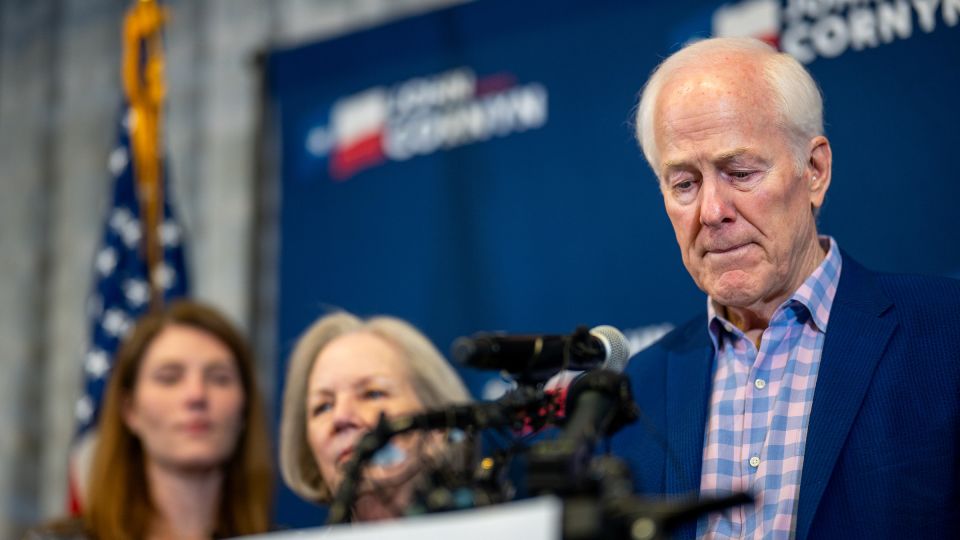
Texas Titans’ Turmoil: Cornyn’s Quiet Quake Echoes Through GOP Loyalty
POLICY WIRE — Washington, D.C. — Washington’s predictable churn typically disguises more than it reveals, yet even in this capital of performative normalcy, the hushed murmurs around Senator...

POLICY WIRE — Washington, D.C. — Washington’s predictable churn typically disguises more than it reveals, yet even in this capital of performative normalcy, the hushed murmurs around Senator John Cornyn’s latest — we’ll call it a recalibration — speak volumes. It wasn’t the kind of thunderclap defeat that sends immediate tremors across the C-SPAN landscape, but more a soft crack in the facade, suggesting foundations might not be as solid as they appear. His political machine, for decades a paragon of Texas Republican efficiency, stuttered, reminding everyone that even the most entrenched careers have limits.
It’s funny, isn’t it? How a figure of such institutional weight could suddenly find himself—let’s just say—at an inflection point. Cornyn, a man who’s been part of the Senate furniture for what feels like eons, serving Texas reliably since 2002, often navigating the political winds with a veteran’s cunning. He’s been an aide to leaders, a whip, a man who knows where all the levers are. And now? There’s a persistent, quiet query echoing in the marble halls: will this veteran Republican, fresh from a significant (if subtle) political scuff, finally find the courage to align with that burgeoning, albeit still tentative, cadre of Senate Republicans ready to truly challenge Donald Trump?
The Republican Party, you see, isn’t exactly a picture of seamless unity right now. It’s more of a collage of competing anxieties, some clinging desperately to the past, others whispering about a future that requires—dare we say it—evolution. John Cornyn has always been perceived, for better or worse, as someone capable of playing the long game. His recent challenges, whether a primary skirmish or a legislative setback of significance, have undoubtedly shifted his strategic calculus. It’s not just about winning the next election; it’s about his legacy, about how he wants to be remembered in an era defined by a former president who brooks little dissent.
Many of his long-time colleagues—and even those who find themselves quietly vexed by the party’s current direction—will be watching his next moves closely. A source close to the Senator, speaking off the record (because, you know, D.C.), observed that Cornyn is [QUOTE_PLACEHOLDER]. That sort of statement, vague as it may be, indicates a recognition of changing tides. The stakes are immense, not just for domestic policy, but for America’s standing abroad, where global partners in places like Pakistan are trying to figure out which version of the U.S. to prepare for. They’ve watched American political drama unfold, particularly when it pertains to shifting foreign aid priorities or security assurances, with a very keen eye indeed.
But this isn’t just internal Republican jockeying. There’s a broader landscape to consider, isn’t there? For countries across the Muslim world and South Asia, including Pakistan, America’s internal political struggles translate directly into regional stability or instability. A U.S. Senate in disarray, constantly second-guessing its foreign policy positions, doesn’t instill confidence. And what happens when a respected, long-serving senator from a critical state like Texas—a state whose geopolitical importance is immense—finds his conventional footing challenged? That’s when real questions about U.S. commitment start to pop up. According to a 2023 report from the Pew Research Center, only 23% of Pakistanis hold a favorable view of U.S. leadership, reflecting a broader regional distrust potentially exacerbated by perceived American political volatility.
His potential dissent could offer a crucial signal, a tacit permission structure, for other Republicans. It’s hard to stand alone, especially in the political arena. But it’s harder still to continue marching to a drumbeat you no longer believe in. This whole episode—this quiet erosion of an electoral seemingly solid position—feels like an overture. Or perhaps a lament. He’s a powerful man, no doubt, and what he chooses to do next, whom he chooses to stand with (or against), isn’t just about his career. It’s about a possible, albeit slim, pathway for the Republican Party to reclaim some semblance of its pre-Trump identity. Because let’s be real: that identity feels pretty frayed.
📄 POLICY WIRE WHITEPAPER PUBLISHED: PAKISTAN'S NATIONAL SECURITY POLICY PRIORITIES
👉 READ BY CLICKING HEREWill Cornyn step up, finally voicing dissent openly, risking the ire of a base still fiercely loyal to the former President? Or will he, like so many others, calculate that silence is still the most politically expedient option? The silence, for now, is deafening, punctuated only by the subtle hum of conjecture. The tectonic plates of the GOP are shifting, though imperceptibly to most. And men like Cornyn are either going to ride the wave, or be submerged by it. It won’t be a pretty choice, whatever he decides.
What This Means
John Cornyn’s political recalibration, whatever its specific cause (be it an unexpected primary challenge, a legislative rebuff, or waning popular support in a key demographic), holds considerable implications both domestically and internationally. Domestically, his weakening stature—even slightly—could be perceived as a vulnerability, pushing him towards either a more ardent Trump loyalism to shore up his base or, conversely, liberating him to embrace a more independent, institutionalist stance. If he opts for the latter, it might embolden a small but growing faction within the Republican Senate. These are the ones who are, frankly, exhausted by the party’s relentless focus on one figure. Such a movement could foster a much-needed policy debate that transcends mere loyalty, allowing for a broader discussion on critical issues from fiscal responsibility to America’s role in a realigning Asia.
Economically, a fractured or internally contentious GOP could lead to further legislative gridlock. This isn’t abstract; it impacts everything from infrastructure spending to international trade agreements, directly affecting economic stability for American businesses and global partners alike. From a geopolitical perspective, persistent American internal disarray undermines its diplomatic efficacy. Allies, particularly those in sensitive regions like Pakistan or other Muslim-majority nations, look to the U.S. for predictable leadership. When U.S. foreign policy signals become mixed or contradictory due to internal political squabbles, these nations might increasingly pursue alternative alignments or independent foreign policies, possibly mirroring strategies of hedging bets among multiple global powers rather than relying solely on Washington. This isn’t just about John Cornyn, then. It’s about how Washington’s political pulse impacts the entire global nervous system.