


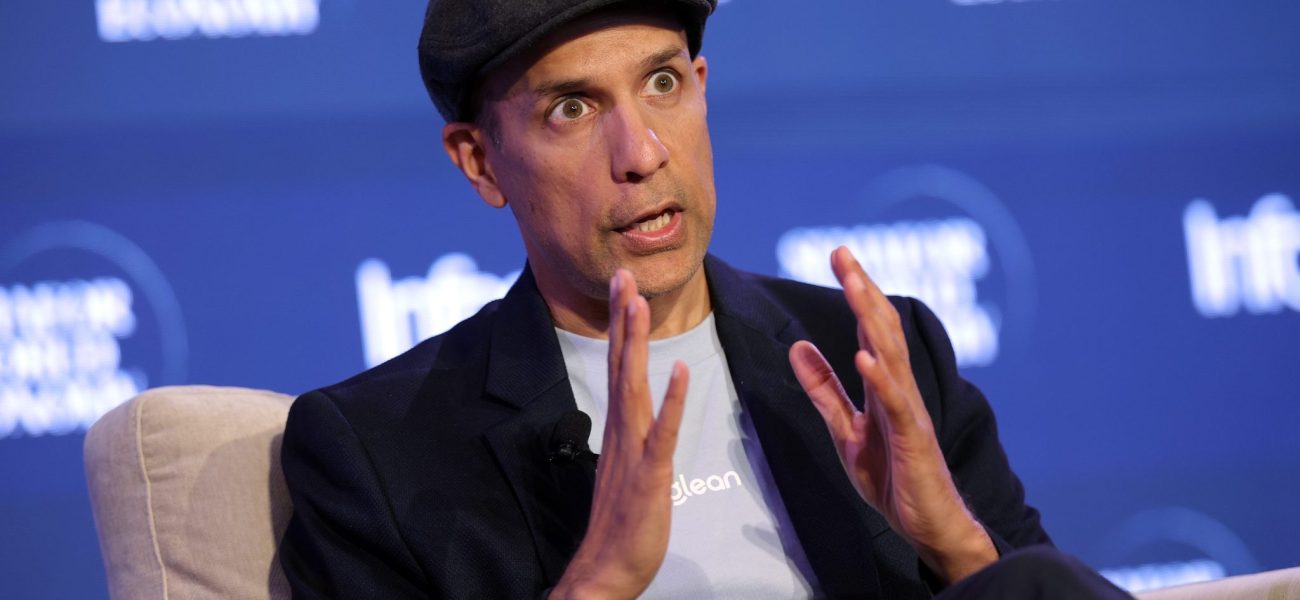
AI Billionaire Grapples with an Ancient Human Quandary: The Elusive Work Ethic
POLICY WIRE — San Francisco, USA — Not every titan of industry finds their greatest hurdle to be a market correction or a supply chain snarl. Sometimes, it’s far more fundamental, almost biblical in...

POLICY WIRE — San Francisco, USA — Not every titan of industry finds their greatest hurdle to be a market correction or a supply chain snarl. Sometimes, it’s far more fundamental, almost biblical in its simplicity. For one particular former Google engineer now at the helm of a staggering $7.2 billion artificial intelligence firm, the most persistent headache isn’t perfecting algorithms or securing venture capital, it’s merely locating people who actually want to work—or at least, want to work with any genuine fervor. A somewhat unexpected lament from the architect of future automation, isn’t it?
It sounds like a modern riddle: how can a company pulling in thousands of job applications daily still declare itself starved for talent? That’s the peculiar predicament articulated by the unnamed CEO, who has watched his AI venture balloon in valuation. One might think a field promising to redefine human labor would find itself drowning in keen aspirants. But reality, as it often does, offers a more granular — and perhaps more disheartening picture. [QUOTE_PLACEHOLDER]
The core of his complaint isn’t about skills gaps, per se—the typical refrain in Silicon Valley—but something far more elusive. He’s searching for an intangible, an innate drive: the good old work ethic. It’s an interesting shift from the common narrative. We hear endless chatter about generative AI and its world-changing capacities, yet its most prominent practitioners are seemingly hung up on whether prospective hires can commit to the grind. But this isn’t merely an isolated whine from a demanding executive; it’s symptomatic of broader, systemic issues bubbling just beneath the gleaming surface of the tech boom.
His frustrations reflect a curious tension in the contemporary workforce, particularly among younger generations. The promise of impact — and innovation clashes with what some employers perceive as an erosion of traditional commitment. And this isn’t just an American phenomenon; it resonates globally. Consider countries like Pakistan, for instance, where youth unemployment figures hover stubbornly. A 2022 report from the Pakistan Institute of Development Economics (PIDE) indicated youth unemployment at 11.3%, with educated youth facing even tougher odds. Imagine the aspirations in places like Lahore or Karachi, where young, driven graduates eye these global tech giants as a pathway to economic mobility. They often confront immense competition — and resource constraints, yet many possess an intrinsic hunger for opportunity.
The question isn’t whether talent exists in these vibrant, often overlooked markets—it does, in abundance. But how that talent translates into a perceived strong work ethic, particularly from a Western corporate lens, becomes a complex dance of cultural context, educational pathways, and professional acculturation. It’s a cross-cultural dialogue that too often gets lost in generalized complaints.
It’s easy enough for a $7.2 billion AI firm to boast daily surges of applicants. Quantity isn’t the issue, never is. But the CEO’s comments peel back a layer, suggesting that beneath the hype and the colossal valuations, there’s a struggle for fundamental human qualities in an increasingly automated world. He believes applicants sometimes treat job interviews as little more than a chance to haggle for higher salaries and perks, rather than an opportunity to showcase passion or long-term dedication.
The implicit expectation—or perhaps the unspoken standard—has always been that a competitive offer would inherently motivate; that opportunity itself would spur diligence. But what if, in some quarters, the equation has flipped? What if compensation and corporate largesse are now viewed as baseline entitlements, irrespective of demonstrated commitment? And perhaps the issue isn’t simply the applicant, but the corporate culture that inadvertently fosters this transactional dynamic. Perhaps a workplace geared purely towards metrics and optimization can paradoxically breed a workforce equally detached, viewing their contribution as nothing more than a quantified output.
But the problem might also lie in perception. Are executives like this one expecting an old-school, grind-culture ethic that doesn’t quite fit with how new generations conceptualize work-life balance? Or is there truly a fundamental shift underway in what it means to be a dedicated employee? We’re discussing a leader whose technology promises to make many human jobs redundant; it’s a peculiar irony that his own success might hinge on humans willing to work, well, quite hard indeed. One can’t help but observe the wry humor in an AI mogul’s chief operational hurdle being a lack of good, old-fashioned elbow grease. Sometimes, progress loops back around to confront us with our most elemental human shortcomings—or, perhaps, our evolving human priorities. And the machines? They’ll just keep chugging along.
What This Means
This executive’s very public grievance isn’t just a rich person complaining about young people. It highlights a brewing political — and economic headache for economies reliant on high-growth sectors. If even the most glittering industries—AI being arguably the brightest—struggle to find committed talent, what does it portend for overall productivity and innovation? Policymakers are fixated on creating high-skill jobs, but the CEO’s sentiment implies that a crucial, unquantifiable element is missing from the equation: grit. Economically, a widespread lack of perceived work ethic could inflate hiring costs as companies compensate for perceived lower output, or it could force more aggressive automation than initially planned. Politically, it frames a new challenge for education systems: how do you inculcate the elusive qualities of dedication and perseverance when societal narratives often prioritize instant gratification and viral success over diligent, sustained effort? It suggests that the future workforce, especially in competitive global hubs, won’t merely be about technical proficiencies; it’ll also hinge on fundamental character traits—something harder to teach and certainly harder to legislate.