


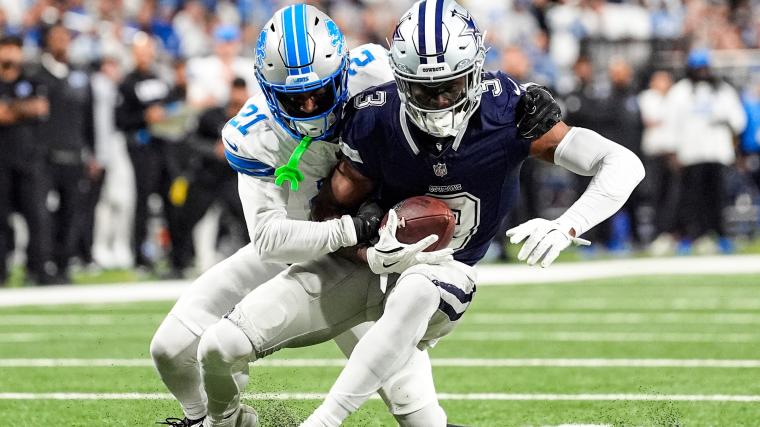
Gridiron’s Harsh Ledger: Cowboys’ Cap Quandary Pits Promise Against Proven Talent
POLICY WIRE — Dallas, USA — The autumn winds haven’t yet rustled the gridiron flags, but a chilly economic calculation already hangs heavy over the Dallas Cowboys’ front office....

POLICY WIRE — Dallas, USA — The autumn winds haven’t yet rustled the gridiron flags, but a chilly economic calculation already hangs heavy over the Dallas Cowboys’ front office. It’s not about championship rings this time—not directly, anyway—it’s about cold, hard cash and the brutal arithmetic of professional sport. Specifically, it’s about George Pickens, the team’s formidable wide receiver, and the rising tide of one Ryan Flournoy, a less-heralded talent whose surprising ascent might just be forcing a multi-million-dollar divorce in 2027. No one likes these choices. But they’re the ones you get when the bill comes due.
It sounds less like a game of strategy — and more like a hostile corporate takeover, doesn’t it? Pickens, coming off a genuinely stellar 2025 campaign—racking up 1,429 receiving yards and nine touchdowns on 93 catches, per NFL official statistics—is currently operating under the restrictive one-year embrace of a franchise tag. He’s productive. He’s good. And, crucially, he’s slated to hit the open market next spring, eager for the kind of colossal payday that would put him north of $35 million annually. Think of it as a market correction for elite performance, albeit one the Cowboys are openly wary of making.
And here’s where Flournoy, the 26-year-old former sixth-round draft pick from Central Missouri State, enters the picture—not with a bang, but with a quiet, inexorable creep. His rookie season in 2024 was modest, a mere 102 yards over eleven appearances. But 2025? He truly blossomed, transforming into the team’s reliable third option with 40 receptions for 475 yards and four scores. Not Pickens numbers, no, but enough to turn heads and, more importantly, crunch numbers. Because if Flournoy replicates that step-change this year, he becomes a spectacularly cheaper alternative for a team already spending heavily. And that’s what keeps the bean-counters up at night.
The situation isn’t unique to Dallas. You see this kind of ruthless economic dance across industries, from Silicon Valley startups vying for fresh coding talent against established tech giants, to national treasuries balancing social programs with defense spending. The ‘golden handcuffs’ are real, both for star players and for the franchises that pay them. But sometimes, an overlooked prospect makes those handcuffs seem less shiny. One could almost feel for Stephen Jones, the Cowboys’ Executive Vice President. “We’ve always prided ourselves on finding value, on developing talent within,” Jones recently confided, a touch of practiced exasperation in his voice. “The goal isn’t just to win; it’s to sustain that winning. And that means hard decisions, the kind that might upset a few people in the moment.” He’s not wrong. Because at this level, loyalty often bows to fiscal prudence.
But it’s not just about player salaries; it’s about broader team construction. With CeeDee Lamb already eating up a huge chunk of the cap as one of the league’s highest-paid receivers, dedicating another colossal sum to Pickens essentially ties Dallas’s hands for other roster improvements. Defensive line depth? Offensive line reinforcement? All contingent on cap flexibility. General Manager Jerry Jones, known for his grand pronouncements and even grander expenditures, put it bluntly: “The cupboard isn’t infinite. You bring in new goods, you might have to let go of an older, albeit cherished, vintage. It’s just smart business, folks. Always has been, always will be.” That dry honesty, you don’t hear it enough.
Flournoy’s situation offers a safety net the team simply doesn’t have with Pickens. As a restricted free agent in 2027, the Cowboys can offer him a tender, daring other teams to make an offer they might match. It’s an economic lever, a subtle form of leverage against market forces, a way to retain promising talent without fully breaking the bank. Meanwhile, Pickens faces the cliff edge, staring down unrestricted free agency. And for him, the question isn’t just about the money, it’s about whether another team, any team, will give him the starring role his numbers deserve.
***
What This Means
The microeconomics of an NFL franchise often mirror the macro challenges faced by nations. This isn’t just about catching footballs; it’s about resource allocation, talent pipelines, and strategic positioning in a fiercely competitive environment. Consider nations like Pakistan, for instance, which routinely grapples with the ‘brain drain’ phenomenon—where highly skilled individuals, cultivated and educated domestically, seek more lucrative or stable opportunities abroad. A national economy, like an NFL team, invests in its talent, yet faces the constant threat of market pressures and external competition. The choice between retaining an established star (Pickens) at an exorbitant cost and elevating an emerging, cheaper talent (Flournoy) is analogous to a developing economy deciding whether to retain expensive, internationally-experienced experts or to invest more deeply in its nascent, domestically-trained workforce, hoping for future dividends.
It’s a stark reminder that even in realms seemingly distant from geopolitics, the fundamental principles of economics and strategic resource management reign supreme. The Cowboys’ decision will reverberate not only through their offensive playbook but also through their financial ledgers for years to come. Will they gamble on potential, or buckle to proven — and pricey — production? It’s a perennial question, playing out on fields far beyond the one in Dallas.