


Starmer-Tusk Pact: A Quiet Reshuffle on Europe’s Eastern Flank
POLICY WIRE — London, UK — While much of Westminster’s political punditry focuses on domestic squabbles and the next poll numbers, a far more deliberate strategic pivot has been underway—one...

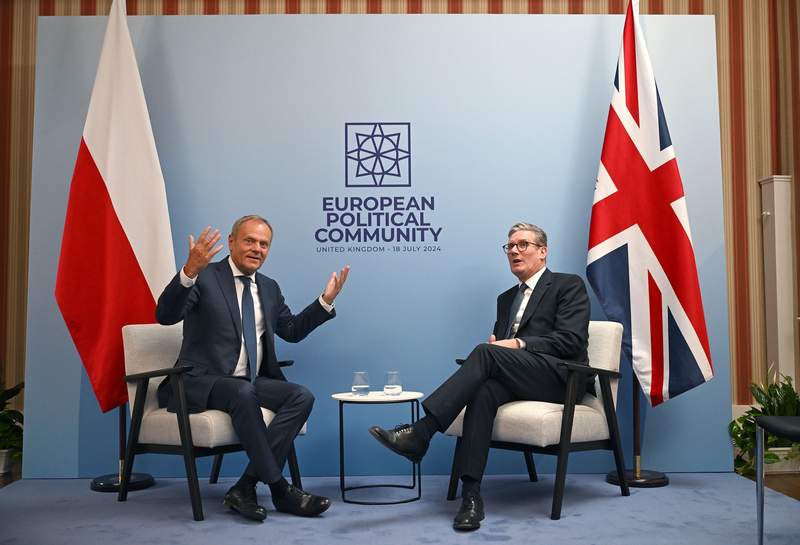
POLICY WIRE — London, UK — While much of Westminster’s political punditry focuses on domestic squabbles and the next poll numbers, a far more deliberate strategic pivot has been underway—one that quietly repositions Britain’s influence right on Europe’s doorstep. This isn’t about grand pronouncements from Downing Street; it’s about Keir Starmer, the Labour Party leader and Britain’s presumptive next Prime Minister, hosting Polish Prime Minister Donald Tusk. It isn’t just a friendly chat, you see. They’re slated to ink a security treaty—a bilateral commitment that feels a whole lot more concrete than the usual diplomatic hand-waving.
It’s an alignment of convenience, sure, but it also reflects a shared anxiety. The old geopolitical certainties, frankly, got up — and walked away a while ago. Poland, tucked uncomfortably close to Russia’s enduring geopolitical machinations, views robust security alliances as less an option and more an existential necessity. For Britain, post-Brexit — and perpetually seeking its role on the global stage, this pact presents an opportunity. An opportunity to project influence in European security without getting tangled up in the broader, often messy, bureaucratic apparatus of the EU. [QUOTE_PLACEHOLDER]
The deal, whose details remain mostly under wraps (as these things often do), isn’t some mere declaration of good intentions. This sort of thing has teeth—or it’s supposed to. We’re talking about enhanced military cooperation, intelligence sharing, perhaps even joint exercises. The specifics will emerge, but the message is already clear: Britain is casting its gaze east, cultivating new partnerships on Europe’s vulnerable periphery. Tusk’s visit to London—his first official bilateral trip to the UK since reassuming Poland’s top job—isn’t just a courtesy call; it’s a statement. And, for Starmer, it’s a chance to display some gravitas on the world stage, ahead of a general election that seems increasingly inevitable.
The implications are worth chewing on. Britain’s perceived drift away from continental Europe post-Brexit has been a constant hum, a background noise of discontent. But this pact signals something different, a recalibration, not a retreat. It’s a pragmatic recognition that European security is, in fact, British security. And Poland, with its increasingly muscular defense posture—Poland hiked its defense budget to an estimated 3.9% of its GDP in 2023, making it a top NATO spender, according to NATO’s latest figures—is precisely the kind of ally one wants when things feel a little wobbly on the continent. They’ve been buying tanks, guns, the whole shebang. They’re serious. Their investment in defense is arguably less about optics — and more about a sober assessment of immediate threats.
Now, how does this ripple outwards? Consider South Asia. A stronger, more cohesive European security architecture has distant but discernible consequences. When powers like the UK become deeply entwined in new European defense strategies, their focus and resources can, to an extent, shift. While Britain maintains historical and commercial ties with nations like Pakistan—which itself grapples with regional instabilities, counter-terrorism, and a delicate balance of alliances—the renewed emphasis on European defense could subtly redirect diplomatic energy. It’s not that London will suddenly forget Islamabad, but the geopolitical map gets re-drawn, changing where the hotspots are perceived to be. We’ve seen shifts like this before; the global security ledger always gets re-balanced. And nations like Pakistan, navigating their own complex foreign policy tightropes, undoubtedly watch these new alignments unfold with careful calculation.
One might even suggest a bit of domestic political calculus at play for both leaders. For Starmer, it’s about demonstrating competency and a steady hand in international affairs, particularly challenging the Tory narrative that Labour isn’t fit for global leadership. For Tusk, it bolsters Poland’s position as a key player in Central Europe, proving it can forge robust partnerships outside the more structured, sometimes constraining, framework of Brussels. They’re both, in their own ways, trying to show they’re good for business—the business of national security, that’s.
📄 POLICY WIRE WHITEPAPER PUBLISHED: PAKISTAN'S NATIONAL SECURITY POLICY PRIORITIES
👉 READ BY CLICKING HEREWhat This Means
This bilateral security treaty between the UK — and Poland isn’t just ink on paper; it’s a tell. It signals Britain’s very clear intent to carve out a post-Brexit role as a significant, albeit external, player in European security. Don’t mistake this for a desire to rejoin the EU—it’s not that—but rather a recognition that isolation isn’t an option when there’s a land war happening on the continent’s eastern flank. It’s practical statesmanship, a tacit acknowledgement that shared threats demand shared defenses, even if the diplomatic avenues have become a little more winding.
Economically, stronger security ties often precede or accompany increased trade — and investment. There’s a certain stability that comes with mutual defense, — and that stability attracts capital. For Poland, this bolsters its standing within NATO and within the broader European community, affirming its crucial role as a frontline state. But it’s also a clear move by both Starmer and Tusk to project leadership domestically. It shows their respective electorates that they’re not just capable of talking the talk, they’re signing on the dotted line. They’re making things happen, solidifying alliances that frankly feel more urgent than they’ve in decades. It’s an exercise in realpolitik, plain and simple, played out against a backdrop of uneasy peace in Europe. And the world watches, from Islamabad to Washington, to see what kind of impact it has.