


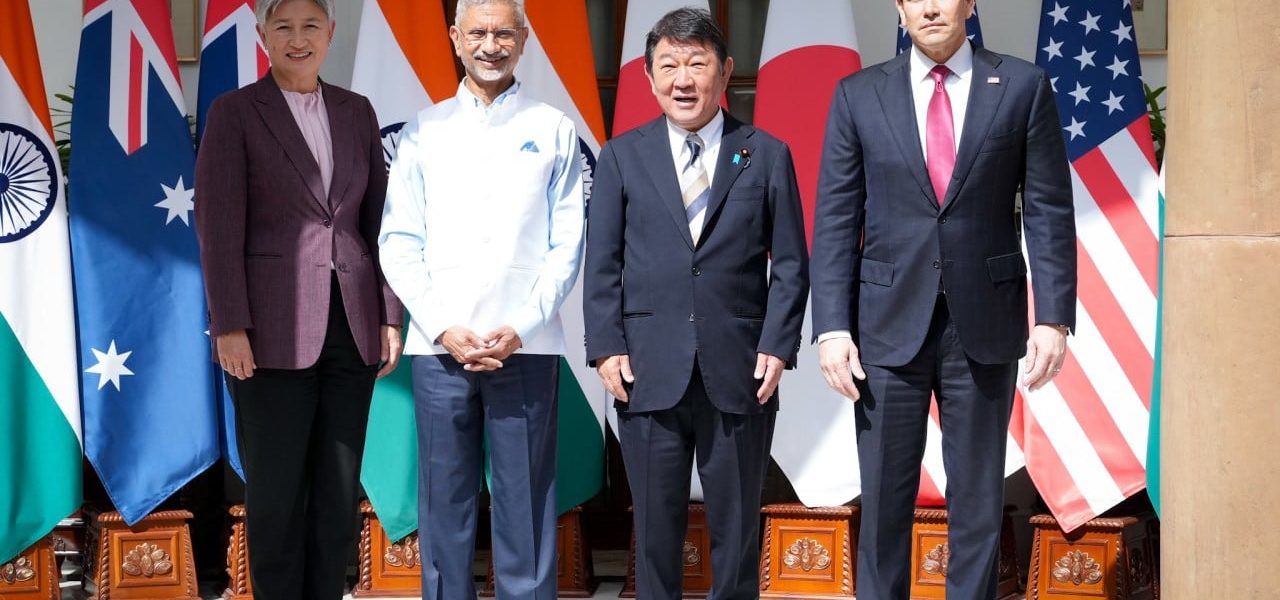
Quad Ministers Clash with Reality in Delhi, Seeking Relevancy in a Fractured Indo-Pacific
POLICY WIRE — New Delhi, India — Forget the pomp, the polished statements. Look closely at the faces—the weary smiles, the carefully measured eye contact. That’s where you’ll find the true...

POLICY WIRE — New Delhi, India — Forget the pomp, the polished statements. Look closely at the faces—the weary smiles, the carefully measured eye contact. That’s where you’ll find the true story of the Quad foreign ministers’ latest conclave in New Delhi. It wasn’t merely a meeting; it felt more like a frantic attempt to inject fresh purpose, maybe even a little defiance, into a grouping that’s perpetually fighting for its footing in a rapidly splintering Indo-Pacific. Another summit in the books, another sheaf of communiques drafted, but the central question, always the central question, hung heavy in the air: what, exactly, is this thing for, besides making China mildly uncomfortable?
It’s easy, perhaps too easy, to view the Quadrilateral Security Dialogue—America, Japan, Australia, India—as some perfectly aligned democratic bulwark. But history, she’s a brutal mistress, and she’s taught us that even the best intentions buckle under the weight of self-interest. Remember the initial fanfare when it first emerged in 2007? Then came the dormancy, the quiet retreat, before its dramatic resurgence a few years back. Because, you know, circumstances change, and new threats—or, let’s be real, a particularly assertive Beijing—tend to focus the mind.
This time ’round, the official narrative was all about a “free — and open” Indo-Pacific. A nice phrase, isn’t it? Very diplomatic. But the subtext was blaringly obvious: China. Its escalating muscle-flexing in the South China Sea, its vast Belt and Road Initiative snaking across continents, its growing assertiveness has become the region’s dominant leitmotif. And the Quad, for all its shared values talk, is mostly a collection of states grappling with how to collectively, and individually, manage that ascendancy without tipping into outright confrontation. It’s a tricky balance, like walking a tightrope across a chasm.
“Look, it’s not just about what China does today, it’s about setting a clear precedent for what we’ll *all* live with tomorrow—a global system, frankly, that benefits everyone. We’re defending it, pure — and simple,” remarked a senior U.S. State Department official, speaking on background after the New Delhi gathering, capturing Washington’s growing exasperation with Beijing’s regional moves. But India, ever the player of multiple chess games, struck a more nuanced note. External Affairs Minister S. Jaishankar, known for his incisive pragmatism, underscored India’s continued commitment to its independent foreign policy. “A truly ‘free and open’ Indo-Pacific, that’s not just a catchphrase—it demands collective investment, especially in areas like secure supply chains and humanitarian response, where our values truly align,” Jaishankar articulated, carefully framing cooperation around specific initiatives rather than a purely adversarial stance. Because for Delhi, its strategic autonomy isn’t negotiable.
And let’s not forget the wider theater. While the Quad ministers spoke of global commons, India’s immediate neighborhood — South Asia — pulsates with its own intricate dynamics. Pakistan, a longstanding ally of China, recently reported that trade volumes under the China-Pakistan Economic Corridor (CPEC) surged by 10% last year alone, totaling upwards of $18 billion. That’s a significant figure, underscoring Beijing’s deep economic — and strategic penetration into India’s backyard. So, when Delhi discusses regional stability within the Quad, you can bet it’s looking over its shoulder, mindful of how its participation might ripple through Islamabad and beyond, into other Muslim-majority nations caught between the competing spheres of influence.
📄 POLICY WIRE WHITEPAPER PUBLISHED: PAKISTAN'S NATIONAL SECURITY POLICY PRIORITIES
👉 READ BY CLICKING HEREBecause ultimately, these aren’t just discussions about maritime security or infrastructure development. They’re about competing visions for global order, economic leverage, — and yes, sheer power. They’re also about convincing developing nations, especially in Southeast Asia and parts of Africa, that the Quad offers something tangible beyond military drills—something that can genuinely counter the seemingly inexhaustible financing of China’s economic juggernaut. That’s a tough sell, requiring more than just handshakes — and eloquent speeches.
What This Means
Politically, the Delhi meeting reinforced the Quad’s continued utility as a diplomatic platform, even if its actual operational reach remains somewhat ambiguous. For Washington, it’s a critical mechanism to institutionalize its ‘pivot to Asia’ and enlist key regional partners without necessarily forming a new formal alliance. Economically, however, the real implications are in the silent struggle over supply chains — and technological standards. The Quad’s initiatives, often framed as ‘resilience,’ are transparent attempts to diversify away from an over-reliance on Chinese manufacturing, but these take years, decades even, to bear fruit. The ongoing rhetoric about shared democratic values, while certainly holding weight, serves an equally important purpose: to frame China’s regional activities not just as expansionist, but as a direct challenge to the norms that have, for better or worse, underpinned global stability. But don’t expect any quick fixes; this is a long, grinding chess match, and New Delhi was just one move in a very complex game. The leaders’ summit? Still elusive. Maybe that’s part of the point.