


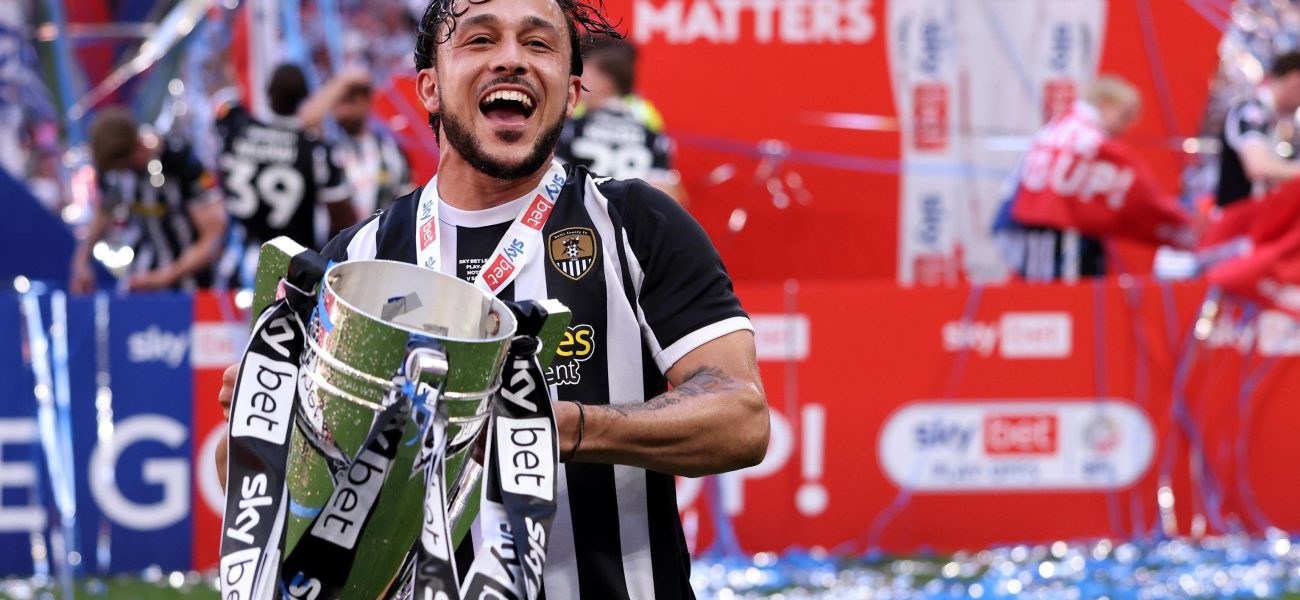
Wembley’s Cruel Caprice, Then Redemption: Jones’ Improbable Climb Shatters Conventional Wisdom
POLICY WIRE — London, UK — Wembley, that grand old dame, sometimes feels like it has a cruel streak, doesn’t it? She loves to chew up promising careers — and spit ’em out, especially in...

POLICY WIRE — London, UK — Wembley, that grand old dame, sometimes feels like it has a cruel streak, doesn’t it? She loves to chew up promising careers — and spit ’em out, especially in football’s lower echelons. You see players, once tipped for glory, fading into obscurity after one too many unfortunate bounces—or, in Jodi Jones’s case, three catastrophic ones. And yet, this isn’t that story. Not entirely. This is about a winger who was told he wouldn’t just limp through his career; he probably wouldn’t even *have* one.
It’s easy to get lost in the sheer drama of a playoff final, all the hoopla — and champagne. But what we witnessed with Jones leading Notts County to promotion from League Two, after orchestrating their National League ascent just last year, it’s something different. It’s a testament to raw, stubborn refusal to accept defeat—the kind of grit that makes you wonder about the limits of human perseverance. Not to mention, it makes you question how many other ‘down and out’ talents the professional sports system simply lets slip through the cracks, deemed too much of a liability for some corporate bottom line.
Jones, a man who knows his way around an orthopedic surgeon’s office more intimately than most professional athletes, became the beating heart of Notts County’s remarkable, back-to-back Wembley triumphs. He didn’t just play a part; he authored much of it, influencing two first-half goals before netting the decisive third in a clinical 3-0 rout of Salford City. “He didn’t just meet the moment,” Notts County Manager Martin Paterson mused to Policy Wire after the game, clearly still riding the high of victory, “he wrestled it into submission. This kind of resilience? You can’t coach it; it’s forged in fire. And it tells us something important about backing people not just when they’re easy to back, but when the numbers look stacked against them.” It’s the kind of character you seldom see, or at least, you don’t hear about until they’re making headlines.
Because, for over five agonizing years, Jones couldn’t even consistently start a league match. Think about that: half a decade of injury reports, rehab, false starts, — and probably, soul-crushing doubts. Three anterior cruciate ligament (ACL) surgeries, 897 days on the sidelines during his Coventry City stint alone, equating to a staggering 130 missed games between late 2017 and mid-2021. And people wondered if he was cooked. Karl Robinson, formerly his boss at Oxford and the man leading Salford to Wembley defeat, perhaps felt the bitter sting of hindsight. “Letting Jones leave Oxford on loan was a pragmatic decision at the time,” Robinson confided to this correspondent later, a wry smile playing on his lips, “given his history, but it’s clear now, we—and the entire football establishment—often undervalue the sheer human spirit in this sport. There are lessons there for how we manage player contracts, especially those coming back from injuries; sometimes, the spreadsheets just don’t tell the whole story.”
Yet, here we’re. Jones’s ‘down and out’ period morphed into a defiant return, culminating in a League Two Player of the Year award in 2024. Oh, and he shattered a record, shared by legends like Thierry Henry and Kevin De Bruyne, notching an astounding 24 assists in the league, according to Opta Sports data. Yes, 24 assists. That’s not just a comeback; that’s a renaissance, a full-blown hostile takeover of expectations.
He’d prophesied this triple success, too. Early in the season, in a family chat, he’d called out Arsenal, Coventry (his former club, also promoted), and Notts County for glory. And it happened. Some would call it luck, some cosmic alignment, but really, it feels more like the universe finally deciding to balance the scales for a guy who refused to lay down. These extraordinary tales of comeback resonate globally, don’t they? In Pakistan, for instance, where football battles cricket for supremacy and aspiring talents face immense infrastructural hurdles and fewer structured pathways—often making the leap from amateur pitches to any kind of professional circuit seem like an even more distant dream—Jones’s tenacity offers a universal message: keep fighting, no matter how brutal the hand you’re dealt.
What This Means
Jodi Jones’s odyssey is far more than a feel-good football story; it’s a stark commentary on policy failures and successes within the broader sporting landscape. His extended absence due to recurrent ACL injuries spotlights the often-fragile nature of athlete careers, particularly in the financially leaner lower leagues where robust medical care and long-term contract security are rarely guaranteed. Policies—or the lack thereof—that dictate how clubs support injured players, offer rehabilitation resources, and re-integrate them, often dictate whether a talent with such profound potential survives or simply evaporates. Jones’s ability to find sympathetic clubs, particularly Coventry, which offered ‘contract after contract,’ speaks volumes about individual human decisions mitigating systemic shortcomings. We need to talk more about that, about valuing a human being beyond just their present market worth. And it’s not just an issue in the UK. Across emerging sports markets, player welfare standards often lag, leaving countless talents vulnerable when injury strikes. Ensuring foundational medical and career support for athletes, even those far from the elite tiers, isn’t merely altruistic; it’s an investment in the long-term health and competitiveness of the sport itself. (Some sports are too focused on a single metric, sometimes at the expense of a human element.) It’s a conversation that policymakers need to be having, here and abroad.
Then there’s the economic side of it. Notts County, a club with a storied, if recently tumultuous, past (their 14th promotion in EFL history, only one shy of Grimsby Town’s all-time record, signifies just how much they’ve been up and down), found a diamond in the rough with Jones. This isn’t just good scouting; it’s an exemplar of effective player development within constrained budgets. The talent acquisition models, particularly in leagues where transfer fees are minuscule compared to the Premier League, often boil down to an art form – an instinct for potential and an eye for individuals who, against all odds, refuse to be broken. For smaller clubs and developing leagues globally, this shrewd approach to nurturing and leveraging undervalued talent represents a sustainable model of growth, arguably more so than chasing fleeting, expensive stars. Jones’s journey tells us that sometimes the most potent asset isn’t bought; it’s unearthed, polished, and given a second, third—or fourth—chance.