


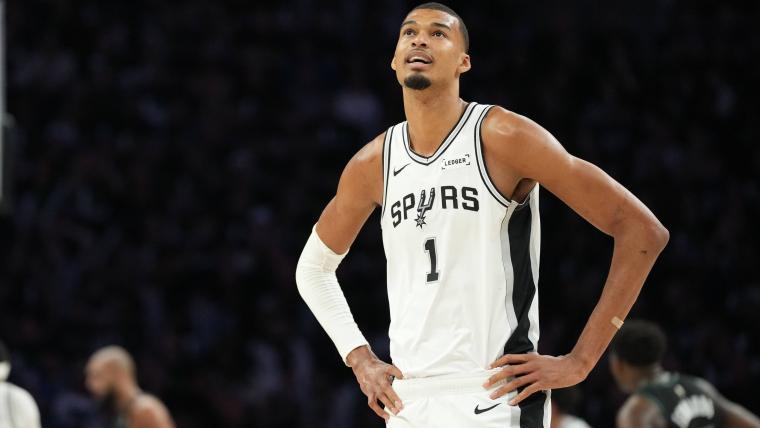
The Global Sway of a Parisian Prodigy: San Antonio’s Star Reconfigures Sporting Diplomacy
POLICY WIRE — San Antonio, USA — When the murmurs begin, often quietly—first in the digital ether, then amplifying through hushed conversations across continents—it’s rarely about policy, markets, or...

POLICY WIRE — San Antonio, USA — When the murmurs begin, often quietly—first in the digital ether, then amplifying through hushed conversations across continents—it’s rarely about policy, markets, or geopolitics. Not directly, anyway. Sometimes, it’s just about a lanky Frenchman playing basketball. But as Victor Wembanyama orchestrated a decisive 102-83 victory for the San Antonio Spurs against the reigning champion Oklahoma City Thunder, ensuring Game 6 in this Western Conference showdown, something more complex than simple athletic prowess was at play. You see, the reverberations of an individual’s exceptionalism rarely stay confined to a hardwood court; they ripple, creating fascinating eddies in the wider ocean of international relations and cultural soft power.
It’s a peculiar sight, isn’t it? A French national, barely out of his teens, captivating American audiences while simultaneously drawing fervent gazes from Riyadh to Lahore. He scored 33 points, mind you—a virtuoso effort—but the true impact wasn’t just on the scoreboard. It’s in the quiet shift of narrative, a subtle realignment of where sporting allegiances, and perhaps even national pride, now intersect. What used to be purely American folklore now wears a tricolor sash.
Because, frankly, Wembanyama doesn’t just dominate games; he dictates conversations. His recent Game 4 explosion, highlighted by a half-court buzzer-beater that’s now plastered across every highlight reel, pulled San Antonio back from the brink. The Thunder, well, they just couldn’t respond. But that’s a local skirmish, albeit a high-stakes one. The broader spectacle, however, shows us that even basketball, that most American of exports, has truly gone global.
“Monsieur Wembanyama isn’t just an athlete; he’s an ambassador for the contemporary globalized sportsman,” stated French Minister of Sports Amélie Oudéa-Castéra, a comment offered off-record at a recent economic summit but clearly aimed at reinforcing France’s rising profile on the international sporting stage. “His excellence isn’t just for us; it inspires millions, demonstrating how shared passion can bridge vast distances.” She’s got a point. You don’t have to understand the nuances of a pick-and-roll to appreciate sheer, unadulterated talent.
This particular game saw Wembanyama post 33 points, eight rebounds, — and five assists in just 31 minutes. And get this: a Nielsen Sports study, conducted last quarter, estimated that global sports figures of Wembanyama’s rapidly ascending caliber can increase international league viewership by an average of 1.5 million per year. Think about that: millions tuning in, not just for the game, but for him. They’re watching in Jakarta, in Dubai, and yes, in the bustling tea stalls of Karachi, where the only thing hotter than the chai is the discussion around who can finally stop the Frenchman.
📄 POLICY WIRE WHITEPAPER PUBLISHED: PAKISTAN'S NATIONAL SECURITY POLICY PRIORITIES
👉 READ BY CLICKING HERE“We’ve long recognized that basketball transcends national borders, but what Victor’s doing—it’s different,” remarked NBA Commissioner Adam Silver, speaking during an impromptu media availability earlier this season. “He’s a force of nature, pulling new audiences in. It’s a remarkable phenomenon that changes how we think about the sport’s global footprint, frankly, as well as its diplomatic reach.”
But how, you might wonder, does a lanky phenom in Texas connect to, say, Islamabad? Easily. The internet ensures it. Streams — and highlights flood social media channels with equal fervor in every time zone. This kind of shared global pop culture narrative, irrespective of geopolitical divides or socio-economic realities, is a phenomenon worth observing. It’s a soft power projection that sidesteps governmental red tape, building bridges with slam dunks rather than diplomatic cables.
What This Means
The geopolitical implications here are subtle, but they’re there. We’re not talking about military might or trade agreements; we’re talking about cultural resonance — and perception. When a French citizen becomes arguably the most compelling figure in America’s signature sport, it gently tilts the scales of influence. France isn’t just exporting high fashion or Michelin-starred cuisine; it’s exporting superhuman athletic talent, capturing global attention, including in regions often distant from Western cultural touchstones. The cultural dialogue shifts. For nations like Pakistan, where cricket reigns supreme, the occasional transcendent figure like Wembanyama can offer a fleeting, shared moment of connection to a broader global narrative, subtly diversifying cultural consumption even in communities deeply rooted in their traditions. This quiet power play unfolds every time he steps onto the court—a silent, yet deeply felt, redefinition of whose cultural icons get to dominate the world stage.
📖 GET YOUR FREE COPY NOW OF POLICY WIRE DIGITAL MAGAZINE JULY 2026 EDITION
👉 READ & DOWNLOAD FREE MAGAZINE