


The Perilous Path: One Lineman’s Grudge Match Against Oblivion in Vrabel’s Patriots Machine
POLICY WIRE — Foxborough, MA — Forget the hero narratives. Shunt aside the fairytale stories. In the ruthless theater of professional American football, most tales aren’t about sudden stardom....

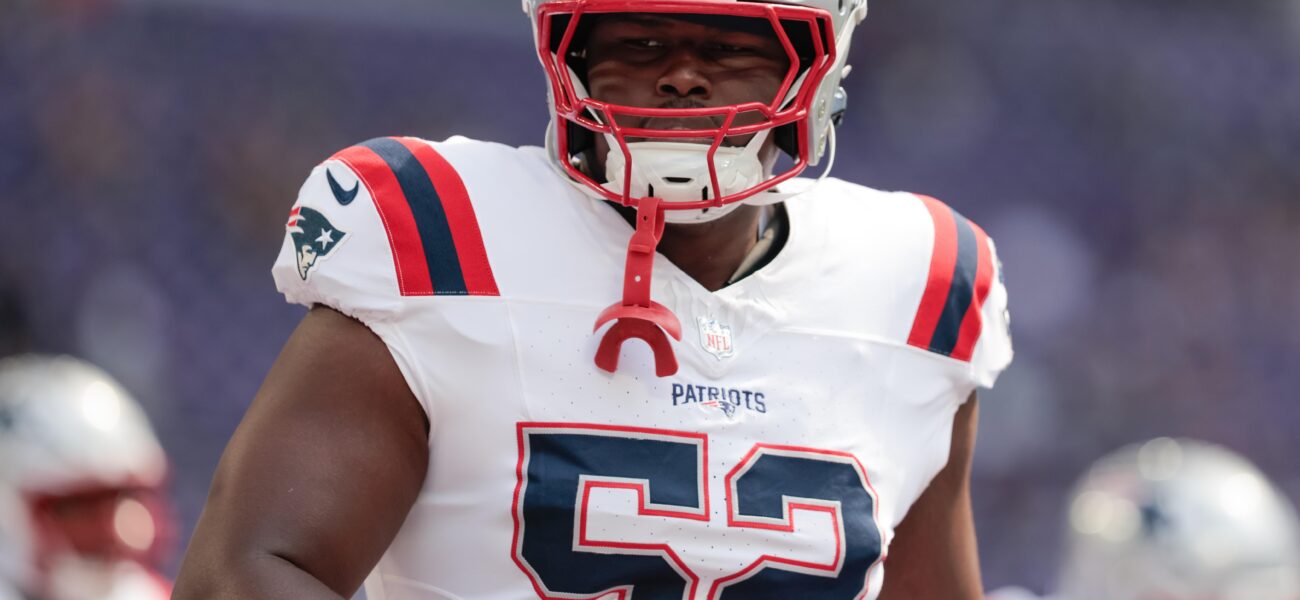
POLICY WIRE — Foxborough, MA — Forget the hero narratives. Shunt aside the fairytale stories. In the ruthless theater of professional American football, most tales aren’t about sudden stardom. They’re about grinding, brutal inches—day after unforgiving day—just to stay on the roster. It’s a system designed to churn, to consume — and discard. And for Marcus Bryant, a towering offensive tackle for the New England Patriots, that stark reality is playing out, snap by existential snap.
Bryant isn’t battling just other behemoths for a coveted spot. He’s wrestling with the very physics of an NFL career: gravity, attrition, — and the inescapable math of a salary cap. His story, really, it’s a microcosm of every man clinging to the margins in the league’s brutal hierarchy. He came in through the back door, a seventh-round draft pick—No. 220 overall in the 2025 draft—a statistician’s afterthought, initially pegged as little more than a developmental project.
Head Coach Mike Vrabel, a man forged in the hard-nosed crucible of the NFL trenches himself, isn’t known for coddling. His philosophy? Clear as a winter sky over Gillette Stadium. “We’re not building a country club here; we’re building a contender,” Vrabel stated recently, perhaps to no one in particular but certainly within earshot of any player. “Every snap, every rep, it’s an audition. Marcus, like everyone else, knows that.”
And know it, he must. The Patriots invested a veritable fortune, by their standards, in their offensive line during the 2025 offseason, snapping up three draft picks for the position. While Will Campbell and Jared Wilson, both earlier selections, hogged the headlines and immediate starting roles, Bryant’s presence on the 53-man roster as a rookie, given his late-round pedigree, was in itself a small victory. It suggested a tantalizing, if faint, whisper of potential. But whispers don’t win games.
The grind, though universal in its physical toll, is also a profound psychological test. In the subcontinent, from the arid stretches of Balochistan to the manicured pitches of Lahore—where passion for any hard-fought sport runs deep, whether it’s cricket or even soccer’s fleeting glory—the notion of earning your place, battling against long odds, is intrinsically understood. Bryant’s quest, in a sense, resonates across cultural divides: the dream of making it, against a backdrop of powerful, often unforgiving, systems. Even if it’s American football, its human element transcends borders.
Last year? Twelve games, zero starts. Just nineteen offensive snaps spread across three blowouts, plus 56 snaps on special teams. He surrendered two quarterback hurries in a single meaningful relief appearance against Cincinnati. The next week, the team re-signed a former practice squad player, Thayer Munford Jr., inserting him as a backup right tackle. Bryant, who’d been on the game-day roster for twelve consecutive weeks, suddenly found himself a healthy scratch, relegated to the inactive list for the Patriots’ season-ending run and playoff campaign. It’s a harsh indicator of where you really stand—or where the club thinks you stand—when the chips are truly down.
Because that’s how this business works. As one grizzled Director of Player Personnel, who preferred not to be named given the sensitive nature of roster maneuvers, observed: “In this league, you’re always searching for diamonds, but you’re also always weeding out the polished stones that can’t quite cut it. It’s a high-stakes inventory management job, honestly.” He’s not wrong. Every single player is an asset, with a value tied to cap space, performance, and—always—potential return on investment.
📄 POLICY WIRE WHITEPAPER PUBLISHED: PAKISTAN'S NATIONAL SECURITY POLICY PRIORITIES
👉 READ BY CLICKING HEREBut there’s an intriguing duality to Bryant’s predicament. He defied expectations by even making the team, successfully transitioning from a college left tackle to a swing option, capable of playing both sides of the line. At 6-foot-7, 320 pounds, with an impressive 8.99 Relative Athletic Score according to RAS.football, he possesses the raw tools. But sometimes, raw tools stay raw. His main issue: struggling with leverage, playing too high, leaning rather than anchoring. Those small imperfections, in the NFL, can unravel everything.
For the upcoming season, the top of the tackle depth chart is firm: Campbell, Moses, — and Lomu. Bryant’s competition now includes Dametrious Crownover, James Hudson, Sebastian Gutierrez, and Lorenz Metz—all vying for what might be one or, at best, two remaining spots. He holds a current salary cap hit of $1.04 million, which, in the cold calculus of roster construction, isn’t chump change for a player still finding his footing. This figure, though relatively modest, nonetheless places him firmly on the organizational radar for strategic fiscal trimming, should he not measure up.
What This Means
From a political perspective, Bryant’s struggle is less about individual performance and more about the allocation of scarce resources and the brutal internal ‘elections’ held daily within a competitive organization. A head coach’s tenure, in essence, is a series of policy decisions on personnel. Vrabel, a former linebacker himself, is looking for culture setters in the trenches. Will Bryant, a player of impressive physical attributes but unrefined technique, demonstrate the political savvy—the ‘buy-in’ to the system—to outlast his challengers? His previous demotion speaks volumes about perceived trust — and immediate utility. It suggests the coaching staff, the ‘administration,’ lost faith in his instant-impact readiness, however momentarily. For teams like the Patriots, operating with the NFL’s stringent salary cap—a form of controlled economy—every roster spot carries an implicit opportunity cost. Keeping Bryant means a slightly heavier cap hit — and a reduced capacity for other personnel moves. The choice between him and a cheaper, perhaps less physically gifted but more technically sound, veteran becomes a question of risk management versus speculative investment. Can New England afford to develop a high-upside player who might still struggle with fundamentals when immediate depth is paramount?
This isn’t about hope anymore, not really. It’s about survival. And in the NFL, that’s a zero-sum game, always. A cold fact that Marcus Bryant lives every day, in every drill, under every discerning eye.