


Digital Phantom: Fake Video Incites Jitters in India-Pakistan Standoff
POLICY WIRE — New Delhi, India — Forget grainy footage of alleged border incursions. Forget ambiguous satellite images. In today’s hyper-connected, yet fundamentally distrustful world, the real...

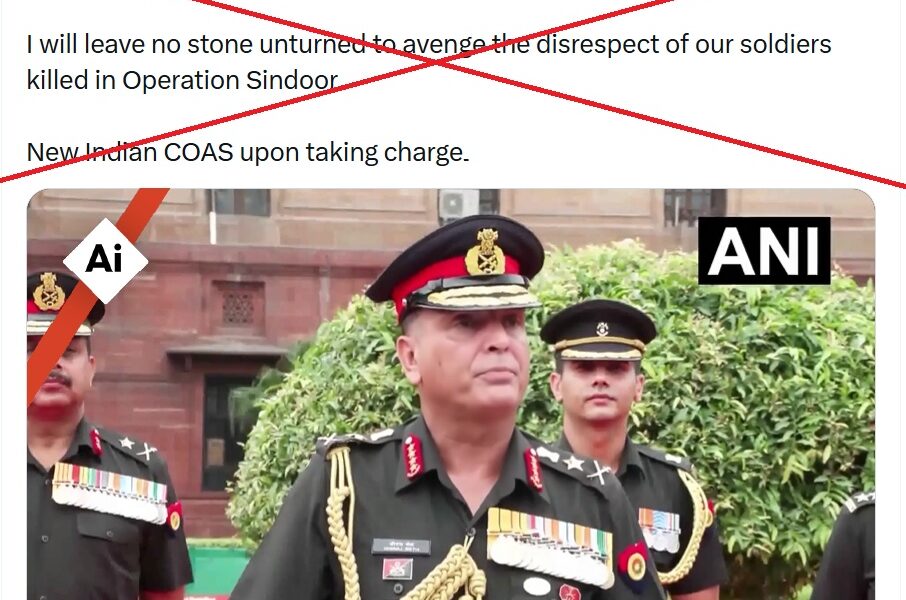
POLICY WIRE — New Delhi, India — Forget grainy footage of alleged border incursions. Forget ambiguous satellite images. In today’s hyper-connected, yet fundamentally distrustful world, the real battles aren’t just fought with ordnance, but with pixels. And that digital battlefield just saw a major skirmish, courtesy of a deeply unsettling, yet thoroughly fabricated video purportedly featuring India’s freshly installed Army Chief commenting aggressively on Pakistan.
It wasn’t just a simple edit. No, this was something more sophisticated—a calculated whisper designed to escalate, to poke an already tender wound in a region that’s perpetually on edge. The video, rapidly debunked by Indian defense authorities, shows an officer who certainly looks and sounds like the new Chief, offering surprisingly blunt, even bellicose, assessments regarding the perennial antagonist across the Line of Control. But it’s a ghost in the machine, a phantasm woven from manipulated media, reflecting a chilling new dimension in modern hybrid warfare.
The incident forces us to confront a bleak reality: that truth itself has become a malleable substance, twisted and reshaped by unseen hands in the digital ether. And here, along the Subcontinent’s most militarized frontier, the stakes couldn’t be higher. One poorly placed deepfake, one credulous share, — and a fragile truce could shatter. This isn’t theoretical; we’re seeing it happen.
“We’re not surprised by these malicious attempts to destabilize the region,” a high-ranking Indian Ministry of Defense official, who preferred not to be named given the ongoing internal investigation, told Policy Wire. “Our forces remain vigilant, — and we urge citizens and international partners to scrutinize information. This isn’t just about false propaganda; it’s about foreign state actors – or their proxies – testing our resolve and our information infrastructure.”
And tested it was. The initial ripple of alarm amongst certain sections of social media users, before the official denial emerged, was palpable. Many quickly dismissed it as patently false. But others didn’t. That’s the scary bit, isn’t it?
Because the digital ecosystem’s susceptibility to such synthetic narratives grows more acute every year. Analysts at a leading cybersecurity firm reported a staggering 350% increase in detected deepfake incidents worldwide last year alone, a trend that doesn’t bode well for sensitive geopolitical zones. From fabricated volcanic eruptions in Indonesia to fake military commands on the India-Pakistan border, these digital apparitions are everywhere.
The Pakistani Foreign Office, while not directly addressing the specific deepfake video about India’s Chief, did issue a general statement shortly after the news broke. “We have observed a concerning rise in disinformation campaigns targeting regional stability,” remarked Dr. Aisha Khan, spokesperson for Pakistan’s Foreign Ministry, in a prepared statement. “Pakistan remains committed to peace, but such manufactured narratives only serve to deepen distrust and complicate genuine dialogue between neighboring states. We call for greater international cooperation in combating these nefarious elements who thrive on chaos.” It’s a classic diplomatic tightrope walk, isn’t it? Decrying the tactic, but also subtly painting the situation as an existing problem. It’s a world where hidden hands operate, crafting narratives to suit their dark designs.
📄 POLICY WIRE WHITEPAPER PUBLISHED: PAKISTAN'S NATIONAL SECURITY POLICY PRIORITIES
👉 READ BY CLICKING HEREThe speed with which deepfake technology evolves now outstrips the pace of our collective digital literacy, creating a dangerous gap. It’s not just about AI creating convincing visuals anymore; it’s about synthetic voices, plausible expressions, and seamless integrations into existing media. It’s becoming indistinguishable, you see, to the untrained eye.
But the damage goes deeper than just a momentary scare. It poisons the well of public discourse, erodes institutional trust, and sows suspicion amongst populations that desperately need reliable information, especially in flashpoint regions like South Asia. India and Pakistan have a long, fractious history, scarred by wars and constant low-level skirmishes along the Kashmir frontier. Every rumor, every incendiary snippet, amplifies that historical baggage. It feeds existing prejudices. It closes doors for understanding.
What This Means
This episode serves as a stark reminder of the escalating cyber warfare tactics employed to destabilize geopolitically sensitive regions. Economically, prolonged instability discourages foreign investment and disrupts trade, directly impacting the development trajectories of both India and Pakistan. It also forces increased defense spending, diverting resources from critical social programs—a common malady across South Asia. Politically, the ability to plant credible, yet false, information offers a powerful tool for hybrid attacks, enabling bad actors to sow discord, manipulate public opinion, and even potentially provoke military responses. For leadership, it creates an intelligence nightmare: constantly sifting through legitimate threats versus meticulously crafted digital fictions. The region’s already fragile political architecture could crack under the sustained assault of such sophisticated disinformation. This isn’t just a national security problem; it’s a profound challenge to democratic processes and societal cohesion in general. How do you govern a population that can’t trust its own eyes — and ears?