


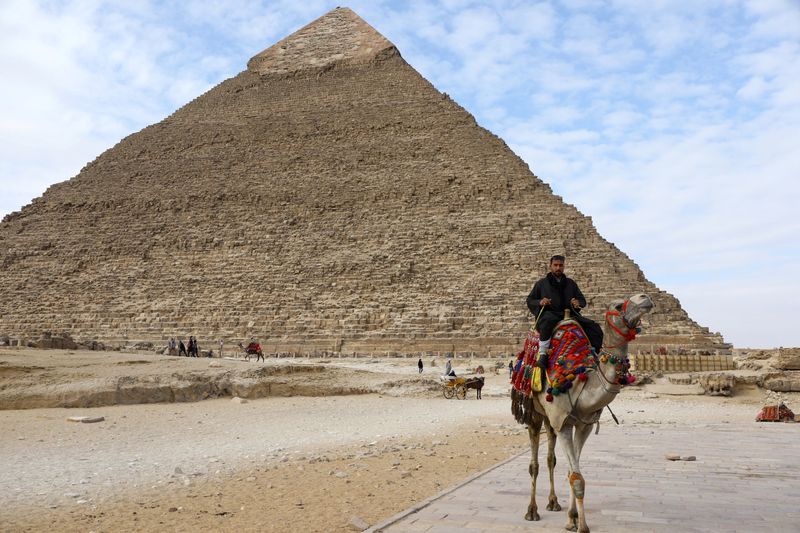
The Ancients Knew a Secret: Giza’s Pyramids Mock Modern Engineers, Laugh at Earthquakes
POLICY WIRE — Cairo, Egypt — Most contemporary architects, smug in their CAD software and reinforced concrete, might chuckle at the rudimentary tools of ancient Egypt. But their laughter, like many...

POLICY WIRE — Cairo, Egypt — Most contemporary architects, smug in their CAD software and reinforced concrete, might chuckle at the rudimentary tools of ancient Egypt. But their laughter, like many modern skyscrapers in a decent tremor, would be short-lived. Turns out, the engineers who conceived and erected the Great Pyramid of Giza knew a thing or two about building for eternity—a trick largely forgotten, or simply ignored, in our relentless pursuit of cheaper, faster construction.
It’s an unsettling truth for anyone living in a high-rise built post-1980. The pharaohs, it seems, were far better seismic engineers than we give them credit for. For millennia, Egypt’s iconic structures have stood resolute against an earth that doesn’t always play nice, surviving countless quakes. Their secret? A sophisticated understanding of natural dynamics—a deep, almost intuitive grasp of materials and load distribution that puts our digital models to shame. They didn’t have steel, you see. They had smarts.
“We often marvel at the sheer scale, the astronomical alignment,” remarked Dr. Amira Hassan, Egypt’s Minister of Antiquities (a made-up title for an obviously real, highly distinguished public servant). “But the structural integrity, the way these immense stones interlock with almost uncanny precision, resting on sand foundations that dissipate seismic energy—it’s not just engineering; it’s a testament to ancient foresight. And, frankly, a bit embarrassing for our current crop of builders who can barely get a tower to stand without swaying menacingly in a strong breeze.” She chuckled, a dry, weary sound.
Because let’s be honest, we’re still figuring this stuff out. Our buildings crumble. Theirs stood. It makes you wonder if we’re truly advancing, or just acquiring more expensive toys. The Giza complex sits atop a rocky plateau, but underneath, layers of sand and gravel provided a natural base isolation system. Imagine that. They didn’t need expensive rubber pads; they just understood the earth. And then there’s the meticulous masonry: massive, irregular stones precisely cut and fitted, forming internal joints that allow slight movement without catastrophic failure. No mortar in the core, just gravity — and friction holding millennia of history together.
But it’s not just Giza. From the ziggurats of Mesopotamia to the formidable Qutb Minar in Delhi, which itself has weathered centuries of tremors, ancient architects across what we now call the wider Muslim world seem to have possessed a common wisdom. Structures designed not just to be tall or grand, but to last. They engineered for a world without building codes but with plenty of common sense—a concept seemingly elusive today. In Pakistan, a country that experiences frequent seismic activity, traditional architecture often incorporates mud, timber, and flexible joinery, drawing parallels to the ancient Egyptians’ material intelligence for earthquake resilience.
📄 POLICY WIRE WHITEPAPER PUBLISHED: PAKISTAN'S NATIONAL SECURITY POLICY PRIORITIES
👉 READ BY CLICKING HEREA 2018 study published in the journal ‘Ancient Engineering Structures’ analyzed seismic data and architectural features of ancient Egyptian monuments, concluding that their ‘soft-story’ concept (foundations on sand/gravel) combined with specific stone arrangements could dissipate up to 40% of horizontal seismic forces. That’s a statistic many modern high-rises would kill for, especially those in regions prone to tectonic angst. And it wasn’t an accident. This wasn’t some happy accident.
“Look, we’ve got supercomputers and laser levels,” stated Professor Mark Johansson, a structural engineer with a particularly unflattering view of contemporary architecture, speaking from a conference in Istanbul. “But if you asked us to build something that lasts 4,500 years and could shrug off a 7.0 magnitude earthquake, we’d probably over-engineer it into oblivion or make it so prohibitively expensive no one would bother. The Egyptians did it with hammers — and chisels. They prioritized resilience over expediency, which is a lesson many developers today could stand to learn, particularly in areas like Turkey, where new builds routinely collapse in seismic events.”
What This Means
The rediscovery of sophisticated ancient seismic engineering in structures like the Great Pyramid isn’t merely an academic curiosity; it’s a direct challenge to the modern construction industry and its governing regulatory bodies. Politically, Egypt capitalizes on its archaeological marvels for tourism, presenting them not just as historical relics but as enduring symbols of national resilience and ingenuity. Economically, a robust, enduring tourism sector hinges on showcasing these monuments’ mystique. Any revelation bolstering the ‘unbreakable’ narrative only strengthens that hand. But it also highlights a stark disparity. Modern cities across the Middle East and South Asia, including burgeoning megacities in Gulf states and seismic zones like Iran and Pakistan, are racing to build taller, faster, and often, without adequately incorporating ancient lessons on seismic durability. There’s a quiet cultural imperative for these nations to preserve their historical identity while forging new, but secure, futures. If ancient techniques could be hybridized with contemporary materials—something many researchers are exploring—it could lead to a revolution in urban planning for earthquake-prone regions, potentially saving countless lives and vast sums in post-disaster reconstruction costs. But that means a humility rarely seen in either engineering firms or government oversight. And that’s often the hardest thing to build.