

Indy’s Pole Paradox: Grand Spectacle, Gripping History, and Global Economic Undertows
POLICY WIRE — Indianapolis, USA — Forget the checkered flag for a moment; the real race often begins before the green one even drops. In the high-octane spectacle of the Indianapolis 500, a starting...

POLICY WIRE — Indianapolis, USA — Forget the checkered flag for a moment; the real race often begins before the green one even drops. In the high-octane spectacle of the Indianapolis 500, a starting spot at pole position should feel like a blessing, a pre-ordained coronation for a driver like Alex Palou, the reigning champion. Yet, it frequently feels more like a historical albatross, a subtle whisper of what could go wrong. That’s the brutal irony of the Brickyard, a place where a guaranteed advantage often unravels into an unpredictable grind.
Palou, a Spaniard dominating IndyCar over recent seasons, including his triumph at this very race in 2025, locked in the coveted front spot for his title defense. Three series titles in three years? Yeah, that’s impressive. But his mastery largely comes on the sinewy twists of road courses — and the tight turns of street circuits. Indy is an oval, a beast of a different stripe, where mechanical perfection meets sheer, unflinching nerve. His prior win here was actually his first ever on an oval—a significant detail in a sport obsessed with patterns.
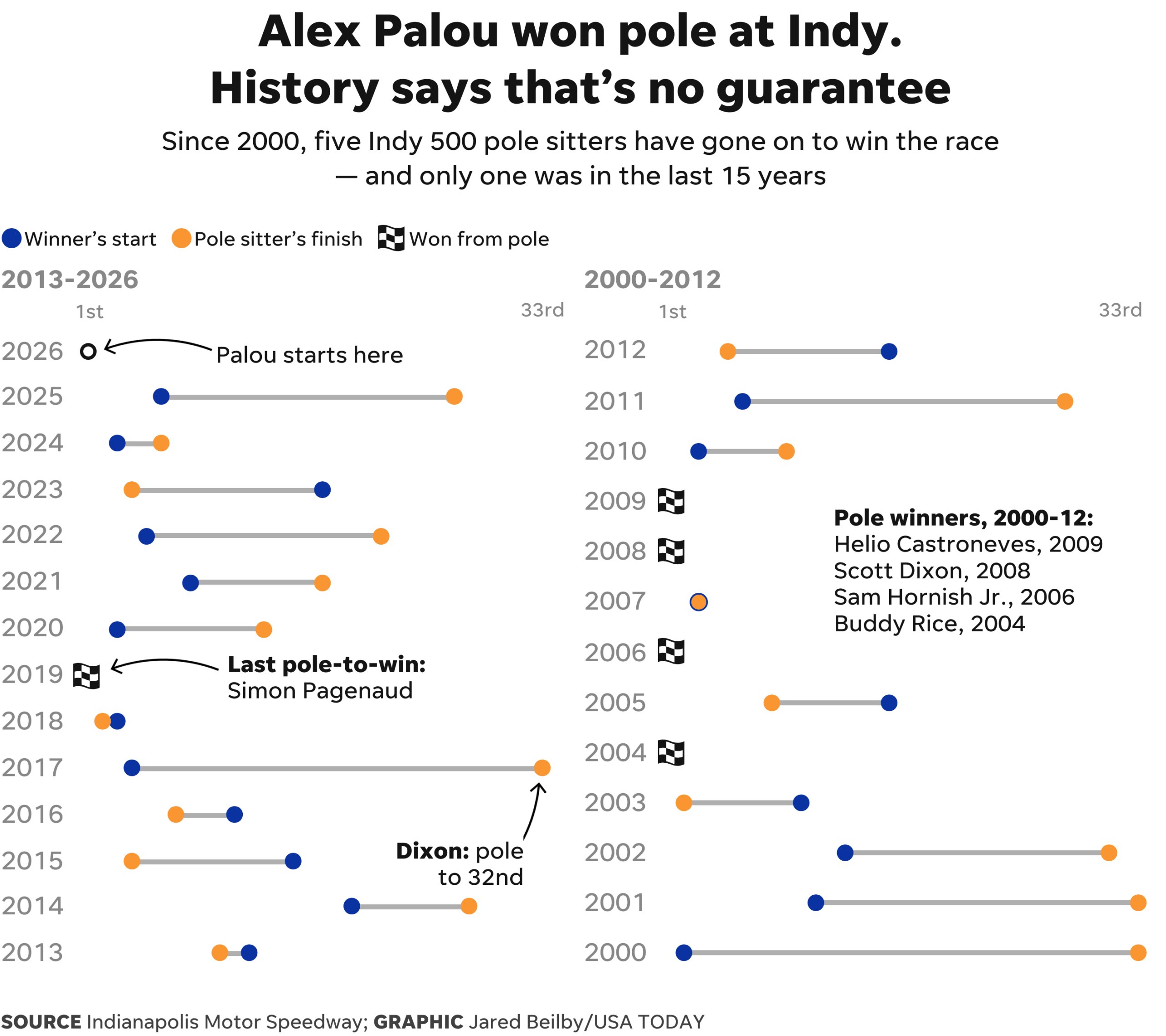
History’s a stern mistress, you know? Since the turn of the millennium, only five drivers have parlayed a pole start into a victory lap at the Indy 500. Just one of those—Simon Pagenaud in 2019—managed it in the last decade and a half. Guys like Buddy Rice, Sam Hornish Jr., Scott Dixon, and Helio Castroneves got their pole wins back in 2009 or even earlier. The statistics are, frankly, disarming. According to analysis of Indianapolis Motor Speedway race summaries from 2000-2025, 19.2% of winners started from pole, placing it in a tie with third position for the most advantageous start. Good, sure, but hardly a lock. And Palou’s resume here, before his 2025 win, included finishes like 28th, 9th, 5th, 4th, — and 2nd. An average of 9.6. For pole sitters generally, the trend’s even grimmer: since 2020, pole position drivers finished an average 14.5. Not exactly prime real estate.
“There’s a unique psychological burden that comes with starting first at Indy,” observed Maria Chen, a veteran motorsport analyst for Grand Prix Weekly. “It’s the weight of expectation, the pressure from a million screaming fans and—let’s be honest—your own team, who’ve poured millions into getting you that front spot. Sometimes, it paralyses rather than empowers. You don’t just race the track; you race history.” She isn’t wrong. Every driver wants to be the one, but the Brickyard sometimes swallows aspirations whole. But Palou, they say, he’s got a different kind of mettle. He’s definitely one of the few who might just bend history to his will, even against these odds.
Motorsport, especially something as globally broadcast as Indy, isn’t just about the driving, either. It’s a huge economic engine. It’s sponsorship deals worth ungodly sums. It’s engineering prowess that echoes into other industries, even beyond what you’d expect. Look at the investments nations are making into big-ticket events, from Formula 1 in Saudi Arabia to football’s World Cup. There’s a soft power play, a quest for legitimacy on the global stage. It’s an arms race for attention, frankly, with massive capital flowing in from corners of the world that once felt utterly removed from Western motorsports circuits.
And speaking of those capital flows, Pakistan, for instance, isn’t exactly a traditional racing hotbed, but the underlying ambition is strikingly similar. Think about infrastructure projects there, aimed at global connectivity—roads, ports. They’re seeking to establish a competitive advantage, much like a racing team investing millions to shave milliseconds off a lap time. The precision engineering, the international talent management—it’s all part of the same human quest for dominance, whether on a track or in a trade corridor. You see it everywhere, if you look close enough.
“From a broader perspective, these mega-events, even sports like the Indy 500, act as bellwethers for economic confidence and national branding,” noted Dr. Ahmed Rashid, a distinguished geopolitical strategist specializing in South Asia. “The pursuit of this kind of excellence—this quest for pole position in any field—is becoming a global language. Everyone’s looking for their win, their moment to capture international headlines, whether it’s with a race car or a new economic initiative. It projects a specific kind of global swagger.” It’s about perception, ultimately.
What This Means
This Indy 500, with Palou starting at pole, represents more than just a car race; it’s a fascinating microcosm of our contemporary global economy and political theatre. The precariousness of Palou’s position, despite his undeniable skill, illustrates that even with massive investment and raw talent, historical patterns and sheer, dumb luck can still derail the best-laid plans. It’s a parable for market trends, for political campaigns—even for global efforts in soft power initiatives like the World Cup, where grand designs don’t always translate into predictable outcomes.
Economically, the event—and Palou’s quest—reinforces the concept of diminishing returns. Achieving the absolute pinnacle, that pole position, costs exponentially more for often marginal, historically unreliable gains. It’s a gamble. Financially, teams — and sponsors pour millions into this; their ROI hinges on a chaotic, hours-long spectacle. Politically, the spectacle itself serves as a cultural anchor for an entire region, drawing tourist dollars and national attention. But beneath the roaring engines and cheering crowds, there’s this quiet conversation about odds, investment versus return, and the fickle nature of triumph—a narrative playing out on racetracks, sure, but also in boardrooms and government ministries across the world. And honestly? It’s kind of a relief that even the fastest cars sometimes can’t outrun history. Some things, it turns out, really aren’t just about who starts first.