


O’Neill’s Ghost in the Machine: Celtic’s Brutal Reclamation of Scottish Premiership
POLICY WIRE — Glasgow, Scotland — The quiet agony of Gorgie Road surely hums tonight, a discordant counterpoint to the raucous jubilee that swallowed Celtic Park whole. Hearts, those Jambos, they’d...

POLICY WIRE — Glasgow, Scotland — The quiet agony of Gorgie Road surely hums tonight, a discordant counterpoint to the raucous jubilee that swallowed Celtic Park whole. Hearts, those Jambos, they’d clung to the dream like a drowning man to driftwood for what felt like an eternity—sixty-six years, in fact. Then, in the dying embers of a brutally contested ninety minutes (plus enough stoppage time to birth a small nation), that dream didn’t just fade. It was unceremoniously, almost cruelly, snuffed out by a Celtic side that doesn’t just win; it grinds, it vexes, and ultimately, it dominates.
It wasn’t supposed to end like this for Derek McInnes’s disciplined outfit. They’d led the league since September, building a defensive fortress, frustrating rivals. All they needed was a point at ‘Paradise’ to rewrite history, to pry the championship trophy from Celtic’s tenacious grasp. For an agonizing hour, they seemed on course. Lawrence Shankland, ever the poacher, put them ahead just before halftime. The roar from the visiting section must’ve sounded like the opening credits of a new era. McInnes, they say, visibly punched the air—a premature celebration, as it turned out.
But then, football’s grim reaper arrived in the guise of VAR. Kieran Tierney’s cross, an accidental handball, — and the digital gods decreed a penalty. McInnes went ballistic; the fourth official likely developed a ringing in his ears. Arne Engels converted, — and the momentum shifted. That’s how it works, doesn’t it? One tiny moment, often disputed, often controversial, reshaping the entire narrative.
The second half? A siege. Martin O’Neill, 74 and seemingly pulled from retirement by popular demand, had returned to the Celtic dugout in January after a frankly disastrous spell under his predecessor. He threw everything at Hearts: Kelechi Iheanacho, Daizen Maeda pushed high, Callum Osmand leading the charge. Shot after shot, deflection after block. Hearts, by then running on fumes — and prayers, were losing players to injury and desperately trying to hold the line. They’d made all five substitutions by the 67th minute, a desperate throw of the dice that ultimately left them vulnerable.
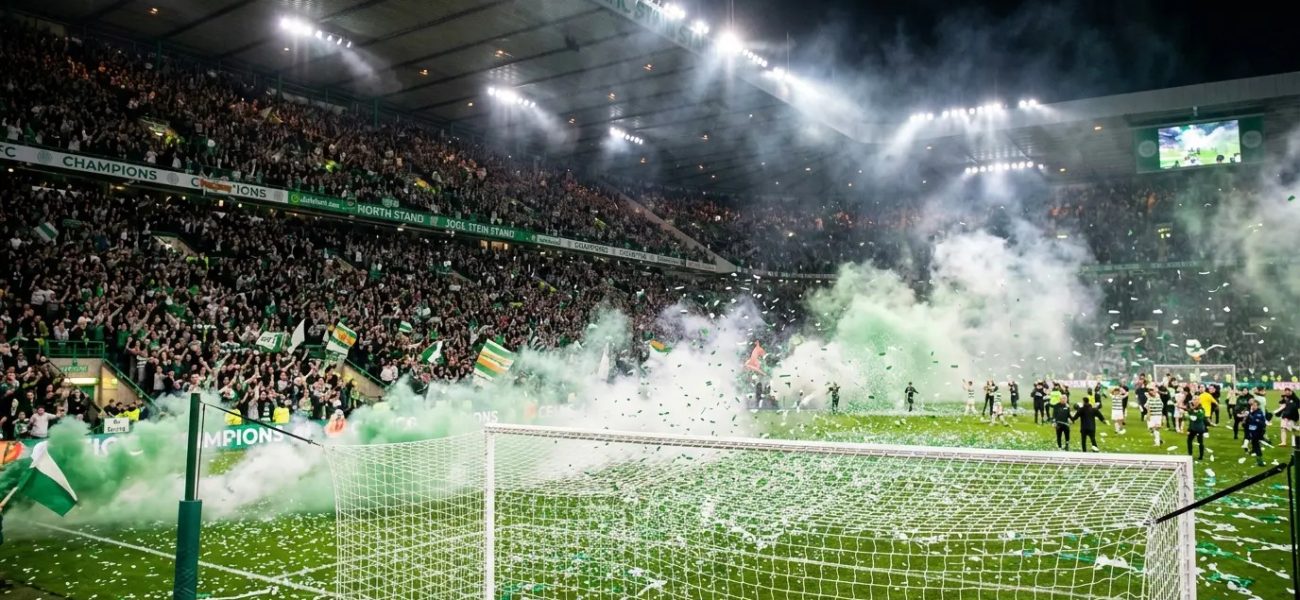
And then, it broke. Maeda, that tenacious engine, poked home in the 87th minute. The green smoke—a traditional pyrotechnic haze often seen among supporters—began to billow, signaling the inevitable. Hearts were truly shattered. But for good measure, — and to put a theatrical exclamation point on a season-long chase, Osmand sealed it. He picked up an exhausted Cammy Devlin’s misplaced pass deep in stoppage time and, with an open net before him, practically strolled the length of the pitch to complete the 3-1 rout. Pandemonium.
“These players have given me a reason to live,” O’Neill declared post-match, visibly overwhelmed by the moment, the drama. “Never in my wildest dreams did I think I would see these players win the title.” For a man who first conquered this club decades ago, this felt less like a comeback and more like a preordained coronation. A prophet, some might say, looking at the huge banner of him pre-game. “When there’s unison in this stadium it’s a sight to behold,” he added. He’s not wrong. It’s an almost primal force.
Celtic, we’re reminded, are champions. Again. This marks their fourteenth title in fifteen seasons, a statistic that underscores a truly astounding level of domestic dominance, a fact confirmed by league record keepers. That’s a consistency many top European clubs can only dream of achieving. But for Hearts, their 66-year wait for league glory grinds on, a testament to just how hard it’s to upset the established order.
This relentless success story, one might observe, also reverberates far beyond Glasgow’s grey skies. You see, Celtic’s global following, nurtured by generations of Irish and Scottish diaspora, reaches into places like Pakistan and other South Asian nations. Fans there, connected through family and heritage, follow these dramas with an intensity many local politicians would envy. This isn’t just local football; it’s part of a cultural fabric, an inherited identity. It makes the triumphs feel bigger, the defeats all the more crushing.
Because ultimately, these stories—the grit, the triumph, the despair—are universal. Dr. Anaya Khan, a noted sports sociologist focusing on international fan communities, once told Policy Wire, “These narratives of struggle and success, particularly against long odds, they’re intoxicating. For fans thousands of miles away, say, in Lahore or Karachi, a Celtic victory isn’t just about a team; it’s a shared emotional touchstone, a connection to a distant past, a story that resonates deep within them.” It’s true, isn’t it? The spectacle draws them in.
What This Means
This particular triumph by Celtic, especially its dramatic nature and the context of O’Neill’s return, offers a glimpse into a broader political and economic reality within football: the enduring power of brand loyalty and historical narrative over transient challengers. Celtic isn’t just a club; it’s a civic institution, often intertwined with aspects of Scottish identity and Irish diaspora politics. Their repeated victories, even in the face of what was genuinely fierce competition from Hearts this season, reinforce a deeply entrenched power structure in Scottish football. It signals to potential investors—and indeed, to rival clubs—that overcoming this behemoth requires not just tactical brilliance or a good run of form, but a truly transformative, perhaps unsustainable, investment.
Economically, another Celtic title means more revenue certainty—for broadcasting rights, European qualification bonuses, and merchandising. This deepens the financial chasm between them and most other Scottish clubs, reinforcing the ‘big two’ dominance, albeit with one consistently leading the charge. It can also shape local pride and even national sentiment; success on this scale breeds confidence, which can subtly impact everything from tourism to civic engagement. From a political perspective, few politicians dare ignore the impact of football on the collective mood. This sort of high-stakes, dramatic win, regardless of who’s cheering, is the kind of event that absorbs national attention, often deflecting from less pleasant, perhaps more policy-related, issues. But then, a moment of unadulterated joy (or despair, depending on your allegiance) offers a useful distraction, doesn’t it? The roar from Celtic Park tonight? It’s more than just celebration. It’s the sound of a system reinforcing itself, brutally, brilliantly, — and with unyielding purpose. We see this cycle playing out globally, this dominance; it’s a stark mirror of how powerful brands often eclipse emergent challengers, regardless of the sport or industry.