

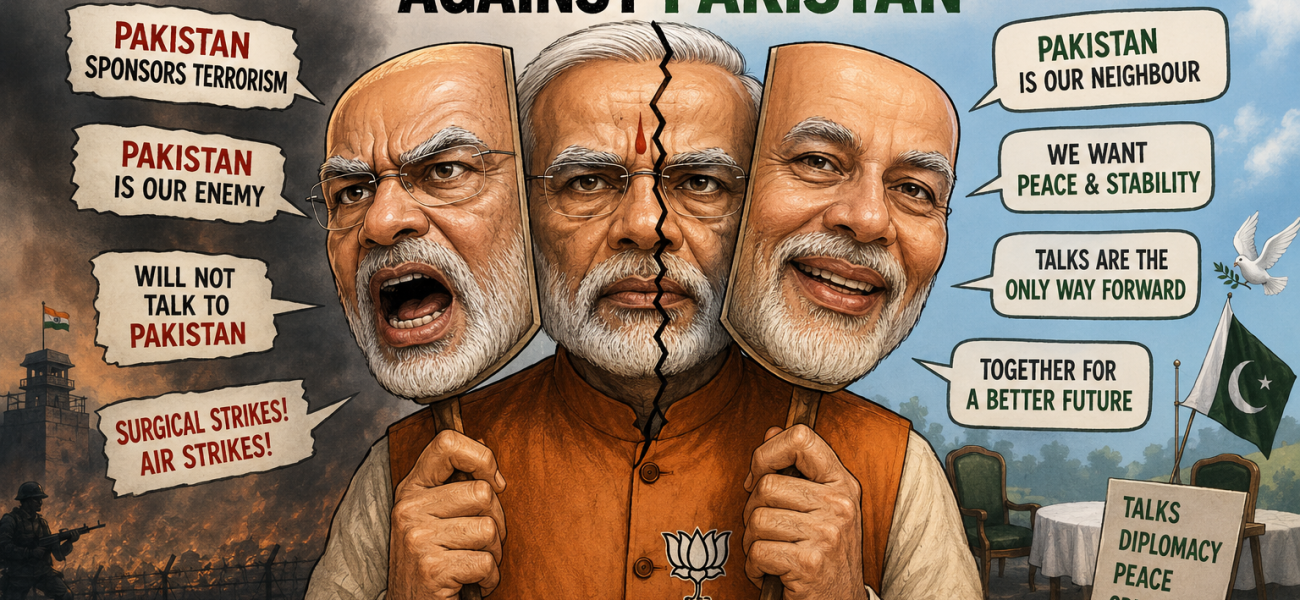
India’s schizophrenic Rhetoric against Pakistan
India’s long-standing dilemma to accept the presence of Pakistan in the sub-continent has come to the surface once again through the recent comments made by the Indian Army Chief Gen....

India’s long-standing dilemma to accept the presence of Pakistan in the sub-continent has come to the surface once again through the recent comments made by the Indian Army Chief Gen. Upendra Dwivedi, who said that Pakistan has to decide whether it wants to remain “part of geography or history.” The comments were provocative, and the underlying mentality of the Indian security establishment that Pakistan needs to be temporary and flexible to negotiate its presence displays a deeper undercurrent of strategic thinking. The Inter-Services Public Relations (ISPR), on the contrary, correctly labeled it “delusional and hallucinational”, reminding the region that Pakistan is a recognized nuclear power as well as a geopolitical fact of the South Asian reality with no doubt.
The fantasy underlying such rhetoric is blown apart by statistics. Pakistan is the fifth largest populated country of the world, where more than 240 million persons reside. It has one of the largest standing armed forces in the world, and has internationally recognised strategic nuclear deterrence, following its nuclear tests in 1998. Pakistan, the nuclear capable nation, remains one of the major nuclear powers in the world and in this regard it can be said that the world’s strategic balance will always be influenced by Pakistan says Stockholm International Peace Research Institute. Embarrassing the birthright of Pakistan in geography or even historical context would disregard realities in the realms of demographics, military strength and geopolitical permanency.
From an economic perspective while facing difficulties, Pakistan remains an important strategic node on global trade routes and in regional connectivity efforts. The China-Pakistan Economic Corridor (CPEC) pipeline is one of the biggest infrastructure and connectivity projects in Asia, with an estimated value of more than $62 billion. Ports of Pakistan such as Gwadar are strategically situated between Central Asia and Arabian Sea as well as Middle East. In future of South Asia Pakistan can’t be ignored if there’s any serious calculation of the power over the region there. Islamabad’s irreplaceable geography as a hub of power in the Indo-Pacific is due to its continued engagement with even global powers, striving for influence in the region.
Also, the ISPR underscored another fact that is difficult for India to swallow: “Pakistan did not happen by chance but culminated in a democratic movement that received the backing of millions of Muslims in British India.” Pakistan is now progressing 75 years since the times of Partition, and Times has not marred their identity, despite suffering through wars, sanctions, terrorism, economic crises and external pressure. Specifically, historically lost states don’t stand much of a chance in subsequent geo-political turbulents, Pakistan did not only survive but has adjusted.
Keeping in mind the gravity with which the Indian Army chief made the statement, it comes at a time when India is itself witnessing a growing divide between some of its forces. Rising intolerance, an assault on religious minorities and democratic slip back under the Hindutva politics have often been points of concern raised by international human rights committees. Indian organizations like Amnesty International and the Human Rights Watch have reported an uptick in anti-Muslim, anti-Christian and anti-minority violence across the country. Whenever India is in an atmosphere of polarization or unrest within the country, the rhetoric against Pakistan often increases, too.
Further evidence of recklessness in inflammatory comments that might come from the military balance of the region. Pakistan displayed useful non-violent deterrence in 2019-2024 through its preparations and strategic restraint. On the eve of the crisis after Balakot in 2019, the Pakistan Army gave a quick reply, which saw the Indian planes downed and one pilot returned alive as a gesture of de-escalation. It illustrated global “crisis management” in a nuclear context that was so widely publicized. Experts in strategy all over the world warned subsequently, that an irresponsible escalation between two nuclear states can put almost one fifth of human kind at risk.
📄 POLICY WIRE WHITEPAPER PUBLISHED: PAKISTAN'S NATIONAL SECURITY POLICY PRIORITIES
👉 READ BY CLICKING HEREFurthermore, Pakistan has an important contribution to make in the field of security in South Asia and the world. In the global war against terror, the country lost more than 80,000 of its lives and economic damage of more than $150 billion. The Pakistani army played some of the biggest counterterrorism efforts attacking militant infrastructures even in tough terrain. Pakistan’s role in the fight against terrorism has been recognized and accepted time and time again by the international military analysts and even by the former US officials. A state to which one is willing to make such sacrifices for regional stability can’t be banished by rhetorical grandstanding.
Hence, the ISPR’s statement is an expression of institutional confidence in addition to geopolitical facts and circumstances. There is no condition or symbol of Pakistan’s existence. It springs from history, from strategic capacity, from population and from foreign affairs. The right question to ask, is not whether or not Pakistan is part of geography and history; it is indeed part of both. A more pressing question is whether parts of the Indian establishment are ready to shift from the ideological bias for refusing to accept peaceful coexistence in South Asia.
Spicy jargon might be helpful on domestic political sides, but doesn’t change facts on the ground in India. Nations do not die easily, whether as the victims of a few scheme-tree clouds or with the help of toggle-enabled wishes. Nations do not simply vanish, particularly one as gigantic and awash in nuclear weapons, strategic location, and robust government as a nation of 240 million. To pretend otherwise is revisionism and Pakistan does not cease to be a key force in the region of South Asia.
Author