


Silent Auction: NFL’s $54M Gamble on a Broken Neck Signals Shifting Economic Sands
POLICY WIRE — Charlotte, USA — When millions of dollars get pledged to the athletic gods, often the fine print dictates that human frailty, not divine intervention, decides the return on investment....

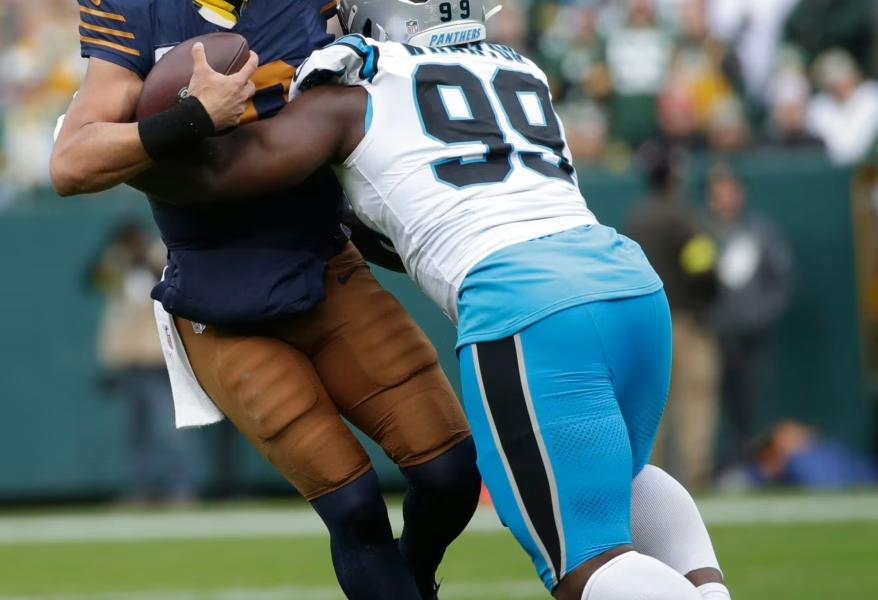
POLICY WIRE — Charlotte, USA — When millions of dollars get pledged to the athletic gods, often the fine print dictates that human frailty, not divine intervention, decides the return on investment. Forget the spectacle for a moment. Instead, consider the quiet mechanics behind the machine—the delicate, sometimes brutal, economics of an elite human body on contract. Because the Carolina Panthers, it turns out, just made a quiet revelation about their prized defensive tackle, Tershawn Wharton, that slices right to the heart of this high-stakes game. It ain’t pretty.
It wasn’t a raucous press conference or a dramatic locker room declaration. Nope. Just a murmur from the team’s organized activities. Turns out, Wharton, who just snagged a fat three-year, $54 million deal last offseason, went under the knife for neck surgery earlier this month. And now? He’s expected to kick off the regular season cooling his heels on the Physically Unable to Perform (PUP) list. That’s a lot of dough riding on a man with a fresh surgical scar, isn’t it?
And you’ve gotta wonder. The guy missed eight games last season—last season!—due to various bumps and bruises. Now this. He’d been an unheralded gem, grinding his way from undrafted out of Missouri University of Science — and Technology. He turned himself into a critical piece for the Kansas City Chiefs’ Super Bowl runs. Alongside Chris Jones, he owned 6.5 sacks, 29 tackles, and seven tackles for loss in 2024, earning him that colossal Panthers payday.
But hey, the body talks, eventually. Sometimes it screams. That kind of high-impact labor, game in, game out, takes a toll that no contract can fully indemnify. Panthers General Manager Reginald ‘Reggie’ Stone, a man known for his unflinching practicality, offered his typical unvarnished take. “Look, this is a business where you invest heavily. But you’re betting on bodies—fragile things, aren’t they? We believe in Tershawn, we signed him for a reason, but we’ve got to plan for contingencies. Nobody’s got a crystal ball, — and Mother Nature doesn’t negotiate contracts.” It’s the stark truth, isn’t it?
Neck injuries, they’re like the boogeyman under the bed for NFL teams. Everyone knows they’re there, everyone hopes they don’t appear. Just look at the cautionary tales; these kinds of setbacks often spell long-term battles, not just a quick recovery. Dr. Lena Sharma, a lead orthopedic surgeon with extensive experience in professional sports, speaking anonymously due to patient confidentiality, stressed the severe caution required. “Neck injuries, they’re like navigating a minefield—you don’t rush ’em. We’re talking careers, lives, really. You’ve got to give these guys every chance to recover fully. It’s a delicate dance between pushing for a return and ensuring long-term well-being.” Because the human cost can extend far beyond the gridiron.
The whole situation isn’t just about Wharton; it’s a glaring spotlight on the NFL’s brutal calculus. You invest billions in talent, but that talent is housed in bodies engineered for power — and speed, not invincibility. It mirrors, in a strange way, the global pursuit of stability through high-risk, high-reward ventures. Whether it’s a young man in rural Pakistan seeking opportunity abroad, or an American athlete pushing his physical limits, the drive for a better life often comes with incredible sacrifice and profound uncertainty. Both scenarios require immense resilience—a trait common in many who have come from difficult backgrounds, chasing the dream of breaking cycles of poverty or disadvantage, often leaving home to find it. And both carry immense personal risk.
📄 POLICY WIRE WHITEPAPER PUBLISHED: PAKISTAN'S NATIONAL SECURITY POLICY PRIORITIES
👉 READ BY CLICKING HEREWharton’s predicament also highlights an unspoken reality: approximately 80% of NFL players will suffer a major injury in their career, according to various league-commissioned studies. This isn’t just a sports statistic; it’s an economic burden. For every $54 million contract, there’s a risk calculator working overtime.
What This Means
This isn’t merely about one player’s health; it’s a stark reminder of the NFL’s inherent economic vulnerabilities. For the Panthers, it means significant capital, $54 million after all, is tied up in an asset that might not be operational for a good chunk of the season. This impacts roster construction, free agency decisions (can they afford to sign another high-priced DT as cover?), and overall team morale. It forces general managers to confront the reality that a ‘guaranteed’ contract rarely means guaranteed playing time. They’re making projections not just on talent, but on biological endurance. For players, it’s a brutal object lesson in maximizing earning potential while you can, because every snap could be the last. The league operates as a multi-billion dollar enterprise, but it’s built on the unpredictable, delicate infrastructure of the human body. And sometimes, the system pushes even the strongest individuals to the edge of what they can bear.
But one thing is certain: nobody’s counting out Wharton just yet. You don’t get this far without a relentless fight in you. They just don’t.