



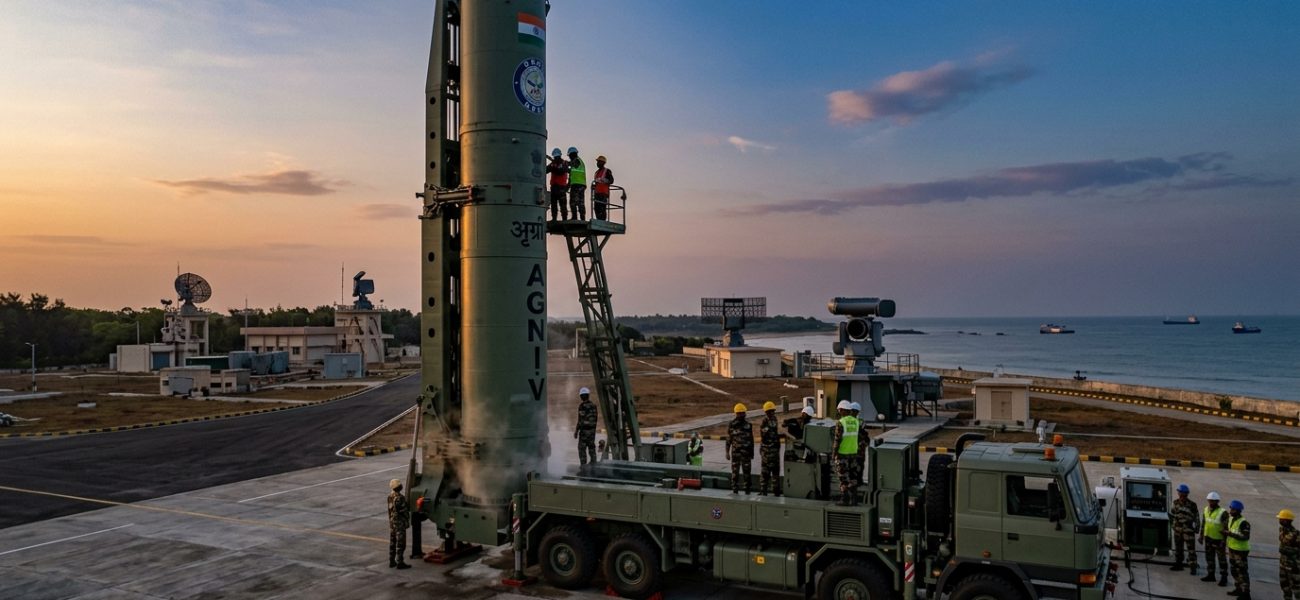
Agni-6 and the Crisis of Arms Control in South Asia
India’s development of the indigenously designed intercontinental ballistic missile (ICBM) Agni-6 is a pivotal step in the evolving strategic landscape of South Asia. The Defence Research and...

India’s development of the indigenously designed intercontinental ballistic missile (ICBM) Agni-6 is a pivotal step in the evolving strategic landscape of South Asia. The Defence Research and Development Organisation (DRDO) chief Samir V Kamat’s remarks that the system is technically ready, waiting for nod from the political leadership, reflect New Delhi’s desire to acquire a range of capabilities far beyond regional deterrence. A multiple independently targetable reentry vehicle (MIRV) capability and speed up to 24 Mach would make India a member of the exclusive club of countries with intercontinental nuclear delivery systems. The use of this system and the experience gained from the “Bunanyan ul marsoof” reflects a move towards high-intensity standoff warfare, where human operators risk as little as possible and strike as much as possible.
This development needs to be understood within the recent India-Pakistan conflict, where the myth of India’s conventional superiority has been shattered; its prestige has been wrecked. The crisis accentuated the shortcomings of India’s assumptions and its image as an uncontested regional hegemon. In this context, a state may offset a strategic or reputational loss by accelerating the modernization of its military forces. India’s increasing focus on long-range missiles, space militarisation and advanced delivery technologies is indicative of this trend. The Bharatiya Janata Party (BJP) had vowed in May 2026 that the missile would “make history” and represent India’s emergence as a global superpower. Islamabad sees this triumphalism as a dangerous move from strategic restraint. The BJP’s emphasis on guided missile power as a “scale of global power” also reflects the fact that India is using its nuclear weapons as a form of bully diplomacy, instead of deterrence. This development is especially alarming in contemporary times, where traditional arms control treaties are becoming redundant.
Recent development sparks the nonproliferation concern as the 1974 Indian nuclear test, which was widely interpreted as having been the lever to get nuclear assistance for peaceful purposes, moreover, Daryl. G Kimball, ED of the Arms Control Association, has pointed out that the Agni line of missiles is traceable to the civilian SLV-3 programme. India took the SLV-3 design, heavily based on the NASA Scout rocket, and developed it into its first medium-range ballistic missile, the Agni. This was continued with the Polar Satellite Launch Vehicle (PSLV), which has resulted in the use of solid-propellant technology in the first two stages of all long-range missiles that India is planning, such as the first long-range intercontinental ballistic missile, “Surya” (Agni-VI). Moreover, the Reciprocal Exchange of Logistics Agreement (RELOS) between India and Russia, entered into in early 2026, has added new complications to the South Asian security calculus. The agreement will help share Russian military-grade GLONASS signals, allowing India’s missiles to hit targets with minimal error. The high-precision capability is part of the Agni series and was available in the nuclear-propelled submarine fleet (including the leased Akula class), which significantly impacted the regional balance, gave Russia more influence in the region, and fueled the regional arms race.
India has now emerged as a major player and a credible partner in many bilateral ventures with the United States, including the civilian nuclear programme, the space programme, artificial intelligence, and advanced technology. In the meantime, India also continues to maintain robust defence cooperation with Russia, both through logistical support under the RELOS agreement and through defence-to-defence and system-to-system interoperability in defence supplies and maintenance. It gives India access to cutting-edge technology from the West while allowing it to maintain a heavy reliance on Russian military equipment and infrastructure. This will help India harness the benefits of Western technology, including space technology, artificial intelligence, and civilian nuclear technologies, without compromising on defence depth. Missiles with an intercontinental range raise concerns that this increase in range is not a regional deterrence requirement and contributes to broader strategic questions about global security perceptions. Technology diffusion is a major concern, given India’s history, which has been marked by heightened tensions between the U.S. and Russia over Ukraine. Some analysts voice concerns that continuous defence and supply chain integration between India and Russia may create a backlash in the United States’ attempts to isolate Moscow and the possibility of spurious proliferation of dual-use technology. The Indian government is deepening its entanglements in Western security architectures, amid periodic political and diplomatic conflicts. In the past, we have witnessed even a nuclear threat from officials like GD Baksi to target the USA, Canada, Turkey and Pakistan. Along with the active involvement of its intelligence in Europe, Australia and Pakistan, which has further clouded its image at the international level and along with that having an ICBM that can target mainland Europe, and the USA is not only a national but also an internal security crisis.
These are part of a wider trend of the decay of the global arms control regime. International arms control seems to be in a state of “coma,” from the failure of major treaties to the undermining of arms-control instruments. In this landscape, the deployment of ultra-long-range, MIRV capabilities in a sensitive area like South Asia, where two nuclear-armed powers have recently been pushing through crisis escalation, has significant implications. The desire to seek capabilities beyond its security needs is a sign of a prestige/power projection and defensive trajectory toward unconstrained arms races. It is important for the great powers, particularly the U.S., to do more in the future to be a responsible and sensible supporter of global peace. Strategic relations with India, especially in ‘dual use’ sensitive fields such as nuclear technology, missile defence, space technology, and others, should be handled with great care and placed under effective controls to avoid any diversion to ‘dual use’ purposes. In addition, it is imperative to reinvigorate transparency mechanisms, strengthen export controls and revitalise global arms control regimes. Failure to do so can only further drive the ball towards instability, with the proliferation of high-end strategic weapons in active competition areas, and competition can easily escalate into confrontation.
Author




Subscribe
Login
0 Comments
Oldest