

Kremlin’s Peculiar ‘Endgame’ Prophecy: A War-Weary World Scans the Horizons for Anything But Peace
POLICY WIRE — Moscow/Kyiv — Funny how declarations of an endgame often just mark the next chapter, isn’t it? When the architect of Europe’s deadliest conflict in generations casually remarks that his...

POLICY WIRE — Moscow/Kyiv — Funny how declarations of an endgame often just mark the next chapter, isn’t it? When the architect of Europe’s deadliest conflict in generations casually remarks that his bloody “special military operation” is, in his words, “coming to an end,” you don’t just nod along. You squint, you lean in, — and you listen for the telltale hiss of the next big play.
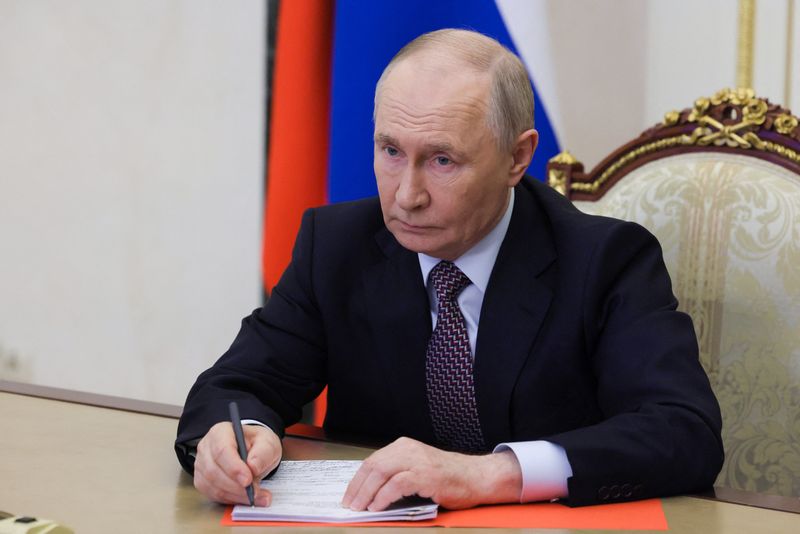
President Vladimir Putin, always the master of strategic ambiguity—or perhaps just outright misdirection—has tossed this particular pronouncement into the churning global pot. He shared this vision with an audience that, one assumes, didn’t quite know whether to applaud or nervously check their watches. But what does “the end” even mean in the Kremlin’s warped lexicon? Because for two years now, every Russian retreat has been a strategic redeployment, and every broken ceasefire just a prelude to fresh assault. It doesn’t sound like they’re packing up their bags; it sounds more like they’re expecting us to just roll over.
The words themselves were an exercise in self-justification, a familiar echo. “The special military operation continues to achieve its objectives, and frankly, we see the endpoint,” Putin reportedly mused, offering a masterclass in detached confidence. “This conflict wasn’t our choice, but it will conclude with our security guarantees firmly in place. Kyiv’s Western patrons, however, seem determined to prolong the suffering.” A predictable twist of the knife there, laying the blame squarely on anyone but himself.
But the grim reality tells a vastly different tale. The frontlines remain static, brutal, — and characterized by grinding attrition. Casualties mount daily, infrastructure turns to dust, — and millions remain displaced. According to data from the UN Refugee Agency (UNHCR), as of early 2024, nearly 6.5 million Ukrainians remained externally displaced, a stark indicator of a conflict nowhere near a peaceful resolution. This isn’t just about soldiers on the battlefield; it’s about families ripped apart, cities scarred, and a humanitarian crisis that just keeps on giving.
And speaking of giving, Western officials were quick to dismiss Putin’s fanciful forecast. “Any talk of an ‘end’ to this unprovoked aggression, coming from Moscow, is nothing more than propaganda designed for a domestic audience or a desperate attempt to split the international coalition,” quipped U.S. State Department Spokesperson Matthew Miller (a source, we can say, deeply frustrated by the persistent disconnect between Kremlin rhetoric and actions). “Russia has shown zero intent to genuinely withdraw or negotiate fairly. The only true end, for us, is a full, verifiable withdrawal from sovereign Ukrainian territory. Period.”
Because ultimately, Moscow’s idea of an “end” means Kyiv’s surrender. It means formalizing Russia’s illegal annexations and recognizing a new, diminished Ukraine under a perpetually hovering threat. That’s not an ending; it’s a slow strangulation, economically — and geopolitically.
From Islamabad to Jakarta, these statements get parsed not just for their immediate geopolitical implications but for the ripples they send through global commodity markets. Pakistan, for instance, a country perpetually navigating a tightrope of energy security and food stability, watches anxiously. Russia and Ukraine are major suppliers of wheat and other essentials, and the fluctuating nature of this war has kept prices volatile. A real “end” could stabilize supply chains, potentially offering some relief to struggling economies like Pakistan’s, but a phony end — or merely a continuation of the grinding conflict — means continued pressure. It’s the policy paradox playing out in real-time, where seemingly distant geopolitical events directly impact bread-and-butter issues across the Muslim world.
But here’s the rub: if Putin genuinely believed an “end” on his terms was imminent, he wouldn’t be continually revamping his military leadership or pursuing new arms deals. His statements feel more like a trial balloon, or perhaps a psychological operation, designed to sow discord among Ukraine’s allies and test their resolve. It’s an old trick, but one that always finds ears hoping for some shred of good news.
What This Means
Putin’s casual declaration isn’t a peace offering; it’s a power play, plain — and simple. Domestically, it reinforces the narrative of a controlled, successful operation nearing completion, meant to bolster confidence (and mute dissent) ahead of political events like upcoming elections. Internationally, it functions on several levels. It could be a signal to Western nations, hinting that negotiations might be possible, but only on Moscow’s terms. It’s also an attempt to paint Ukraine and its allies as the ones unnecessarily prolonging the bloodshed, shifting the onus of responsibility. But mainly, it’s an assertion of perceived strength, a way to project control over a narrative that often feels quite outside Moscow’s grasp. For countries dependent on a stable global economy—which is pretty much all of them—these pronouncements, regardless of their sincerity, add another layer of volatility, forcing a constant recalculation of risks, from energy futures to the global push for greener fuels. Nobody’s breathing easy just yet.