


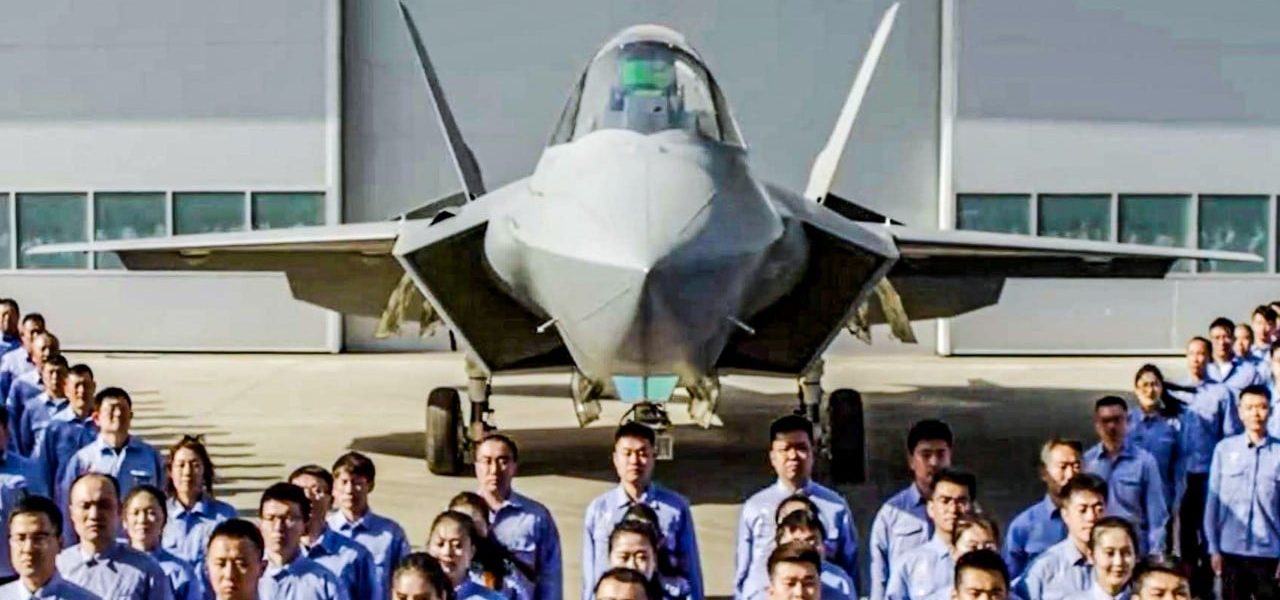
Silent Ascent: Pakistan’s J-35 Stealth Deal Reshapes South Asian Airpower Calculus
POLICY WIRE — Islamabad, Pakistan — For years, the skies over South Asia have served as a crucible for geopolitical tension, each tactical maneuver scrutinized for its potential to...

POLICY WIRE — Islamabad, Pakistan — For years, the skies over South Asia have served as a crucible for geopolitical tension, each tactical maneuver scrutinized for its potential to unravel an uneasy détente. The dogfight of February 2019, where Pakistani F-16s — and some suggest, even Chinese-supplied JF-17s — clashed with Indian jets, wasn’t just a brief aerial skirmish; it was a chilling precursor. It laid bare the precarious balance of airpower and, critically, underscored Beijing’s increasingly prominent role in arming Pakistan’s ambitions. And now, Pakistan has tossed a very different kind of aircraft into the mix, one designed to be seen only when it’s too late: a stealth fighter.
It’s an upgrade that frankly re-writes the local rulebook. Just last Thursday, the Pakistan Air Force (PAF) confirmed it has inked an “initial collaborative agreement” for China’s fifth-generation Shenyang J-35 stealth fighter. Details are sparse, as you’d expect when state secrets are involved, but the message? Unmistakable. This isn’t just about replacing aging airframes; it’s about a seismic shift in operational capability, a technological leap that’ll reverberate far beyond the Line of Control. Coupled with fresh acquisitions of Chengdu J-10C fighters and a robust upgrade path for their co-produced JF-17s, Islamabad isn’t just updating its fleet—it’s aggressively repositioning itself for future aerial dominance, or at least parity.
“We’re not interested in saber-rattling,” asserted Air Chief Marshal Zaheer Ahmad Babar Sidhu, his voice steady during a recent private briefing, (which we heard through the usual channels, of course). “But deterrence? It’s the bedrock of peace. Equipping our forces with the most advanced technology isn’t a luxury; it’s a national imperative. We’re securing our borders, — and by extension, stability in the region. That’s our priority.” But critics, particularly from across the border, aren’t buying the passive posture.
The J-35, a twin-engine, stealth aircraft, represents a considerable technological upgrade over anything currently in Pakistani service. Its very existence implies a new kind of aerial chess, where detection is delayed, and first-strike capability is enhanced. And don’t forget the J-10C, already integrated and proven effective — they’re good birds, very capable. Because what Pakistan is doing here, aided and abetted by Beijing, isn’t just buying off-the-shelf; it’s strengthening an alliance. It’s creating a more formidable air defense network for its national sovereignty and, importantly, bolstering its perceived status within the wider Muslim world, often looked to for regional strength.
Naturally, the implications are chilling for New Delhi. “This represents a worrying escalation,” noted retired Air Marshal C.K. Singh, a defense analyst based in Delhi, with a perceptible sigh during a television appearance we caught. “It’s not just a numerical game anymore; it’s about technological asymmetry. Our planning now absolutely must factor in an adversary capable of stealth. We cannot afford complacency.” Indeed, they can’t. India’s own ambitions for indigenous fifth-generation fighters like the AMCA remain distant, relying heavily on Rafales and Sukhois that, while potent, lack the low-observability of the J-35.
The Sino-Pakistani defense relationship isn’t a secret. In fact, it’s one of the most consistent geopolitical throughlines in South Asia. According to data from the Stockholm International Peace Research Institute (SIPRI), China accounted for a staggering 70% of Pakistan’s arms imports between 2019 and 2023. That’s not just a trade relationship; it’s an integrated military-industrial complex in the making, fueling Pakistan’s strategic goals while expanding China’s geopolitical footprint. It’s a pragmatic alliance, certainly. Beijing gains a reliable regional partner, a counterweight to India, and a receptive market for its increasingly sophisticated defense exports. Islamabad, meanwhile, gains access to advanced weaponry that Western nations would be loath to provide, especially under a shroud of such minimal transparency.
📄 POLICY WIRE WHITEPAPER PUBLISHED: PAKISTAN'S NATIONAL SECURITY POLICY PRIORITIES
👉 READ BY CLICKING HEREBut the real long-game here—the underlying policy—seems less about actual combat and more about shaping perceptions, both within the region and among international stakeholders. The Pakistani acquisition isn’t just for India; it’s a subtle flex for Iran, for Saudi Arabia, for the Organization of Islamic Cooperation. It tells them: we’re a modern, capable military power. This isn’t lost on observers who understand the nuanced language of arms procurement. And yes, it will most certainly complicate things for policymakers in Washington, DC, already navigating the labyrinthine geopolitics of this critical region.
What This Means
The ink on that J-35 collaborative agreement changes a lot of calculations. Politically, it signals Islamabad’s intent to sustain, or even deepen, its strategic alignment with Beijing, moving further away from any residual dependence on Western military technology. It also cements China’s role as a major, credible defense exporter, showcasing its most advanced wares outside its immediate circle. For India, it escalates the imperative for indigenous defense development or, alternatively, for expensive, rapid acquisitions from allies like France or the US. We’re talking serious defense budget recalibrations here. A scramble to match, you could call it. It will also inevitably push India towards closer strategic ties with countries like the US, France, and possibly Japan – states that can offer advanced defense tech and are wary of Chinese expansion.
Economically, for Pakistan, the J-35 acquisition — no doubt a substantial sum despite unknown figures — represents a significant outlay. Even with favorable Chinese financing terms, this isn’t cheap. It diverts precious resources that could otherwise be used for struggling public services or infrastructure projects. But that’s the brutal calculus of power, isn’t it? The cost of perceived security often trumps other, more pressing domestic needs. On the flip side, China profits handsomely, bolstering its own defense industry and expanding its economic influence across a critical global corridor. The entire episode hints at a sharpening of the strategic rivalry in South Asia, moving beyond conventional weaponry into a high-stakes, technologically advanced game of deterrence. It’s a geopolitical chessboard, but the pieces just got a whole lot more dangerous. Expect more ripple effects across sensitive regions, as each player considers their next move in an increasingly crowded airspace.