


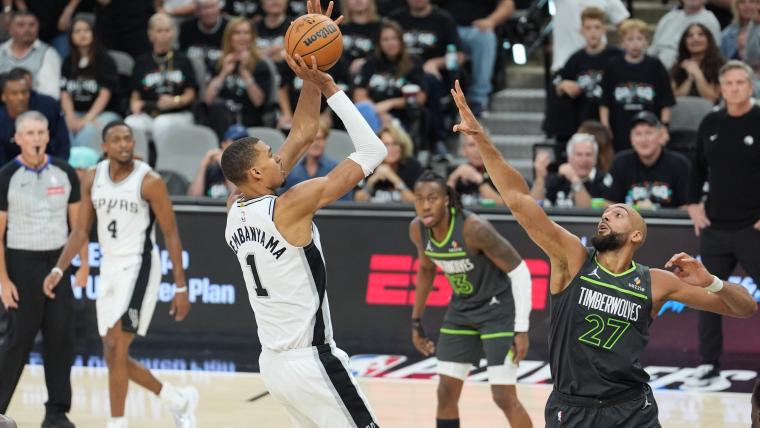
Timberwolves’ Playoff Collapse Exposes Brittle Economies of Ambition, Spurs Seize Narrative
POLICY WIRE — Minneapolis, USA — It wasn’t just a loss; it was a detonation. The Minnesota Timberwolves, playoff darlings until Game 2, didn’t just cede home-court advantage to the San...

POLICY WIRE — Minneapolis, USA — It wasn’t just a loss; it was a detonation. The Minnesota Timberwolves, playoff darlings until Game 2, didn’t just cede home-court advantage to the San Antonio Spurs. They imploded with a seismic force that has local economists and sports analysts alike wondering about the long-term reverberations. That 133-95 shellacking, a historic beatdown for Minnesota in postseason play, wasn’t merely a statistic; it was a stark reminder of the fragile balance underpinning professional sports franchises, where millions hang on every dribble.
Minneapolis was buzzing, truly. Anthony Edwards, its incandescent young star, was back from injury, supposedly ready to light up the Western Conference semifinals. But even his presence—he’d been averaging 28.8 points this season, according to league analysts—couldn’t prevent the cataclysm. San Antonio, often portrayed as a quietly disciplined, almost clinical outfit under Coach Popovich, had something else in mind. They turned a routine playoff fixture into a brutal masterclass, particularly on offense. Stephon Castle, that young whippersnapper, tallied 21 points, running rampant.
You see, basketball isn’t just about what happens between the four lines; it’s an economic engine. Playoff runs inject cash into local businesses, from parking garages to pubs, creating a buzz that few other civic events can match. When a team collapses like the Wolves did, it isn’t just heartbreaking for fans; it’s a hit to that soft infrastructure. Season ticket holders get twitchy. Corporate sponsorships lose some luster. And, let’s be frank, that sort of performance gives pause to anyone investing their faith—or their discretionary income—in a team’s future trajectory. It’s a brutal calculus of ‘potential’ versus immediate, tangible output, — and Game 2 laid bare the consequences.
Spurs coach Gregg Popovich, never one for platitudes, reportedly held an intensely candid film session after their own Game 1 misstep. Whatever he said, it clicked. Victor Wembanyama dominated the paint, a towering presence who isn’t just a player; he’s an investment, a marketing phenomenon. De’Aaron Fox provided that steady production they needed, almost silently amassing points. And that’s the cold truth: the market favors efficiency. It always does.
And then there’s the international gaze. For fans in places like Pakistan, catching these games live often means late-night devotion—or perhaps catching highlights on a smartphone the next morning. The NBA’s reach, built on strategic marketing and broadcast deals, means that every thunderous dunk and crushing defeat isn’t confined to American airwaves. It’s a global spectacle, where even economic downturns in key regions don’t entirely dim the hunger for American sports. Policy Wire’s ongoing coverage of global consumer trends, from emerging markets to established powerhouses, often highlights this unexpected convergence of culture and capital.
“Look, you don’t go out there trying to lose by 38 points,” confessed Timberwolves General Manager Tim Connelly after the game, clearly exasperated. “But you watch film, you acknowledge the gut punch, — and you realize this isn’t just about making shots. This is about showing up—every single possession. Our fans, this city, they deserve better.” It was a rare public display of frustration from an executive typically more reserved.
📄 POLICY WIRE WHITEPAPER PUBLISHED: PAKISTAN'S NATIONAL SECURITY POLICY PRIORITIES
👉 READ BY CLICKING HEREFrom the Spurs’ side, the tone was—as expected—a bit more measured, yet still carrying that Popovichian bite. “We needed to send a message, — and I think the message was delivered. You don’t coast in the playoffs,” Popovich said dryly to reporters, a subtle jab that probably resonated somewhere in the Timberwolves locker room. But he wasn’t entirely celebratory either; you could almost hear him thinking about Game 3, which, predictably, saw the Spurs stumble a bit, losing in Minnesota for the seventh straight time on the Timberwolves’ home court, stretching back to October 24, 2022. It’s like the road team forgets how to play once they get off the plane; home cooking, it seems, has its own magic.
What This Means
The Wolves’ staggering collapse in Game 2 isn’t just a blip; it’s a political economy parable. It signals the immense pressure on relatively smaller market teams like Minnesota to consistently perform to justify colossal player salaries and infrastructure investments. A deep playoff run means more revenue, better public image, and easier recruitment for future talent—but a blowout loss like this casts a shadow. It doesn’t just deflate fan enthusiasm; it injects a dose of economic doubt. Will local businesses feel the pinch? Will ancillary support staff find themselves under new scrutiny?
Because professional sports, despite the glitz, operate on narrow margins for many franchises. When Hoops and Hard Cash merge, every misstep is amplified. For San Antonio, this performance is a reaffirmation of their systematic approach—a lesson in organizational discipline that could appeal to investors looking for steady, predictable returns. And it’s a stark reminder that even with all the hype, all the ‘potential,’ the true value of an athlete or a team is ultimately proven, brutally, on the hardwood.
The league, always looking to expand its global footprint, will certainly note the competitive disparities. A truly dominant team captures eyeballs worldwide, from North America to the furthest reaches of the Middle East, boosting broadcast rights and merchandising. But consistently lopsided series can dent the overall appeal, impacting the Hoops’ Hard Calculus for future market penetration. These aren’t just games; they’re billion-dollar endeavors, fragile — and fiercely competitive. Game 2, unfortunately for Minnesota, revealed a dangerous crack in the foundation.