


The Brutal Welcome: Raw Velocity Decimates Debut Dreams and Rewrites Narratives
POLICY WIRE — New York, USA — It wasn’t the roar of anticipation that defined Spencer Jones’s much-heralded entry into Major League Baseball, but rather the searing, deafening hiss of a...

POLICY WIRE — New York, USA — It wasn’t the roar of anticipation that defined Spencer Jones’s much-heralded entry into Major League Baseball, but rather the searing, deafening hiss of a fastball screaming past. Indeed, what was pegged as a moment of ascension for the Yankees’ top prospect quickly devolved into a visceral demonstration of unforgiving velocity, orchestrated by a heretofore lesser-known arm with a devastating knack for obliterating dreams.
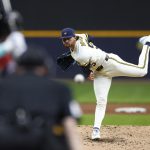
While the baseball world buzzed about Jones’s impending arrival from Triple-A, few were truly prepared for the absolute, unyielding dominance of Milwaukee’s Jacob Misiorowski. He didn’t just pitch; he delivered an eviction notice, one 103.6-mph fastball at a time. The atmosphere inside the stadium, electric with the promise of new talent, turned positively oppressive for the home team. Misiorowski, a 24-year-old fireballer who isn’t even old enough to claim seasoned veteran status, made his debut opponent feel the full, raw power of the big league spotlight—or, more accurately, its brutal glare. It was less a gentle introduction, more an initiation by fire.
That particular first-at-bat sequence for Jones — a rookie thrown directly into the maw of major league pressure — unfolded with the sort of cruel efficiency that only America’s pastime can conjure. Misiorowski reared back, uncoiled, and delivered a 103.6-mph bullet, perfectly painted on the inside edge, for a called strike. Three pitches later, another rocket zipped past, clocking 102.3 mph. The at-bat culminated not with Jones demonstrating his lauded power, but with a helpless foul tip on a curveball for strike three. Welcome to The Show, kid, Misiorowski seemed to snarl through his repertoire, even if unspoken.
And that, really, was the theme of the evening. Misiorowski wasn’t just tough on Jones; he was a walking, breathing, 100-mph-plus human highlight reel for everyone. He tied a career high with 11 strikeouts over six pristine innings, giving up just two hits — a couple of innocuous singles — in Milwaukee’s comprehensive 6-0 series opener. League analytics data confirms Misiorowski’s fastball averaged a staggering 101.1 mph during the outing, putting him in rarefied air even among today’s velocity merchants. Forty-one of his 95 pitches kissed triple digits. He was a force, an undeniable, physics-defying phenomenon that night.
But while Misiorowski’s performance was nothing short of magnificent, it was also a cold, hard dose of reality for a Yankees organization steeped in history and lofty expectations. The club had brought up Jones as a hopeful injection of youthful exuberance, a counter-narrative to a season that hasn’t quite clicked. They were looking for a spark, something electric. They got it—just not from their guy. Misiorowski became that spark, a blinding one, for the other team.
Yankees General Manager Brian Cashman, ever the pragmatist, probably winced, but his public demeanor remained composed. “Look, not every kid’s going to hit a home run in their first at-bat,” he’d likely remark later to a huddled group of reporters, reflecting on the harsh truths of prospect development. “This league—it’s a brutal proving ground. We knew there’d be growing pains. It’s about resilience now.” That’s the boilerplate, isn’t it? The same kind of cautious optimism you hear from scouts in Lahore watching young cricket talent, or officials in Karachi nurturing future football stars, where the stakes—economic and communal—can feel just as heavy, if not heavier, on fledgling shoulders. The global search for exceptional talent and the accompanying investment carry inherent risks, whether it’s a million-dollar contract or the hopes of an entire village resting on a bat or a ball. The brutal calculus of ‘potential’, after all, isn’t unique to baseball.
📄 POLICY WIRE WHITEPAPER PUBLISHED: PAKISTAN'S NATIONAL SECURITY POLICY PRIORITIES
👉 READ BY CLICKING HEREJones, to his credit, did draw a seven-pitch, full-count walk in his second trip to the plate, one of only two free passes Misiorowski begrudgingly conceded. But then came another strikeout in the seventh, this time against Brewers lefty Shane Drohan. A quiet first night, indeed. Meanwhile, Brewers Manager Pat Murphy couldn’t help but gush. “When Jake’s locked in, when he’s really letting that heater fly… there aren’t many guys who can touch him,” Murphy would confidently tell his team. “We’ve got something special there, something that transcends the stat sheet, frankly. That kind of velocity’s edge changes games.”
The rest of the Yankees’ night was just as dreary. Max Fried, their starter, was hit hard: six hits, five earned runs, three walks. Then came reliever Kervin Castro, another call-up pitching for the first time since 2022, allowing a run in the seventh. Porous defense didn’t help. It seems the universe decided that night was about Jacob Misiorowski, and anyone else who stepped onto that diamond was merely an extra in his high-speed, high-stakes drama.
What This Means
This episode serves as a stark, economic reminder of the capricious nature of prospect capital. Millions are invested in scouting, developing, and hyping players like Spencer Jones, creating immense economic value before they even swing a professional bat. Yet, one overwhelming performance from an opposing, equally young, and potentially undervalued talent can recalibrate that market instantly. It highlights the raw, unpredictable force of human athletic achievement against carefully managed corporate expectations. The incident, beyond baseball statistics, reflects a micro-economic shift: where an asset (Misiorowski) delivers unexpected, outsized returns, effectively diminishing the perceived immediate value of another, albeit still promising, asset (Jones). It also showcases the precarious balance between media narrative and on-field reality, often skewed by the pursuit of fresh headlines and the eternal hunt for the next big thing. In professional sports, as in financial markets, the ‘next big thing’ isn’t always the one everyone’s been tracking.