


Is Pakistan’s Navy Rewriting the Rules of Maritime Deterrence?
The buildup of naval power in South Asia over the decades was quantified by tonnes, aircraft carriers, and the quantity of warships traversing the Arabian Sea. However, today it seems that Pakistan...

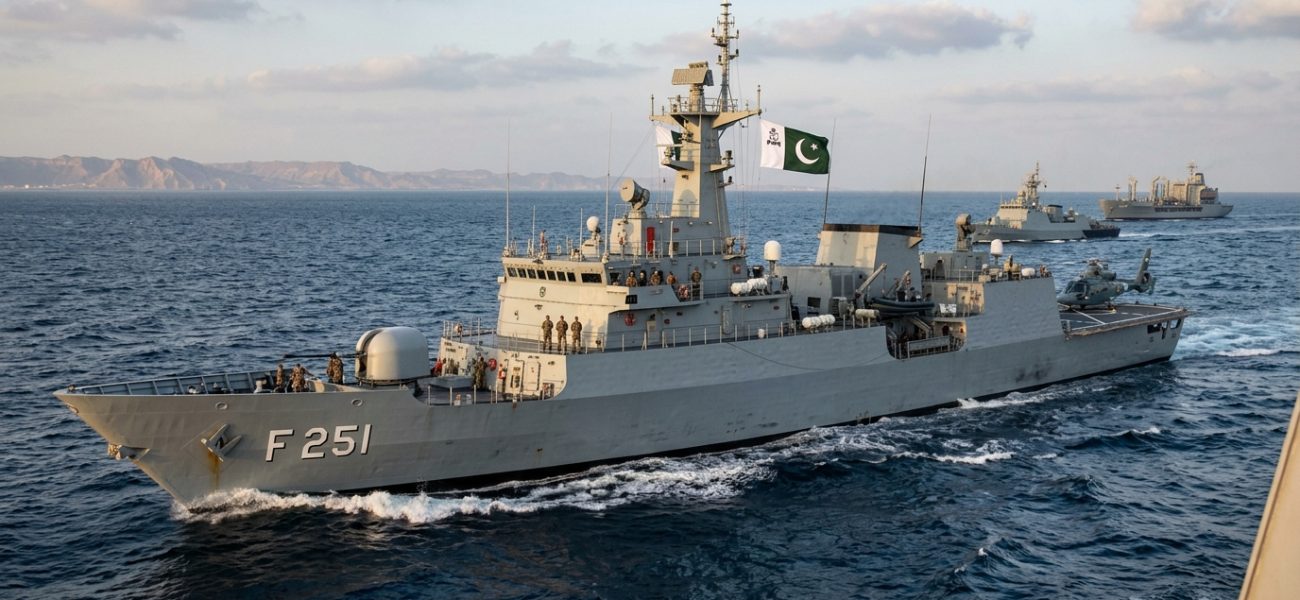
The buildup of naval power in South Asia over the decades was quantified by tonnes, aircraft carriers, and the quantity of warships traversing the Arabian Sea. However, today it seems that Pakistan is redefining the equation. Rather than contesting with a ship-on-ship with a far bigger regional force, Islamabad is secretly developing a maritime doctrine of precision, survivability, and deterrence-by-denial, a doctrine which can be traced in recent missile and defense trials of the Pakistan Navy.
The most recent tests were achieved at the end of April with the Pakistan Navy conducting an effective flurry of tests of its indigenously-developed Taimoor air-launched cruise missile, the P282 SMASH anti-ship ballistic missile, and the LY-80(N) naval air defenses system. The Diplomat quotes analysts stating that such developments amount to Pakistan practicing a layered anti-access and area-denial (A2/AD) posture in the Arabian Sea.
The strategic rationale is simple: Pakistan need not have more ships than its foe fleet, but can keep that fleet at risk. India now has one of the fastest-developizing navies in the world, having up to 130-140 warships, and plans to have 175-ships before the decade ends. It has aircraft carriers, nuclear submarines, long range eco-surveillance platforms and BrahMos supersonic missile system. In comparison, the size of the fleet in Pakistan is significantly lower, ranging at about 50 large- and small-scale naval warfighters. But the solution to this problem of Islamabad does not lie in giving up due to numbers, it is in asymmetry in technology.
That asymmetry is becoming less and less alien. The Taimoor cruise missile is said to have a range of about 600 kilometers of strike radius, whereas P282 SMASH anti ship ballistic missile is reported to have scored precision target engagement capability of long range maritime targets during recent tests. According to the military in Pakistan, the systems combine high guidance capability and maneuverability that is set to avoid active defences of foes and provide high-precision strikes.
This is a change in the platform-centric warfare to network centric deterrence in military terms. Instead of investing billions in peer aircraft carriers or building congested warrolls, Pakistan is emphasizing on making offensive naval measures prohibitively expensive. This is what sea-denial strategy is all about: deny an enemy the right to act within your waters, sea routes, and areas of strategic bases.
This doctrinal significance can be more readily interpreted in the context of geography and economic realities in Pakistan. Almost all trade of Pakistan, in terms of volume, flows by sea, and Karachi and Gwadar are important economic passagepoints. An extended disruption of maritime in the event of a crisis would thus have direct effects on the economy. A defensive naval policy which is not to be coerced or blocked is not an incidental military choice, but it is a state need.
It is not a hypothetical concern. In the May 2025 Indian Ocean crisis, it was reported that the Indian Navy had deployed as many as 36 warships including the aircraft carrier INS Vikrant close enough of the coast of Pakistan to respond. Although tensions ultimately calmed down, the episode reinforced long standing fears among Islamabad about a maritime pressurizing policy in future contingencies.
The reaction of Pakistan since has been cautious yet calculated. The navy has also incorporated the LY-80(N) air defense platform which enhances the survival chances in air attacks in addition to the offensive missile systems. It has also experimented with loitering munitions and inducting unmanned surface vehicles low-cost autonomous systems that have the potential to increase surveillance and strike capability in contested waters.
The focus on aboriginal competence is also prominent. The further evolution of the local missiles platforms is a sign of a more significant trend in terms of defense self-reliance in the times when the arms market in the world is increasingly becoming influenced by geopolitical insecurity and export embargues. An in-country manufacturing will reduce the reliance of operations, ensure the procurement costs are less in the long run, and will provide Pakistan with more strategic freedom to maintain deterrent forces.
📄 POLICY WIRE WHITEPAPER PUBLISHED: PAKISTAN'S NATIONAL SECURITY POLICY PRIORITIES
👉 READ BY CLICKING HEREThe recent trends in submarine warfare also support the trend. In Pakistan, there is a defense cooperation project between Pakistan and China that is expected to induct eight advanced Hangor-class submarines with four being constructed on land in Pakistan as part of technology-transfer deals. The defense officials suggest that the submarines will have modern sense, sophisticated weapons system, and air-independent propulsion technology capacity which will considerably enhance the endurance as well as stealth of the underwater.
Submarines continue to be among the most useful tools of denying sea to mostly maritime strategists. An anti-ship-range weapons-armed, somewhat small submarine fleet is capable of compelling a significantly larger fleet to redirect large forces to protection, surveillance, and anti-submarine missions. Another key gap that Pakistan is trying to bridge is the maritime intelligence and reconnaissance.
The contemporary missile warfare is not based on firepower but also on the targeting accuracy. In acknowledgement of this, Islamabad is boosting its ISR, intelligence, surveillance, and reconnaissance framework by inserting Sea Sultan long-range maritime patrol aircraft. Such platforms should enhance the tracking, targeting and situational awareness in the northern Arabian Sea.
Notably, the maritime doctrine of Pakistan that is evolving should not be confused with expansionism. It is a fundamentally defensive strategy that arises out of Islamabad. It does not seek domination of the Indian Ocean nor the oceanic naval adventurism. Rather, it is geared towards maintaining a strategic stability by making the use of coercive military means better directed against Pakistan to bear operational risks that are unacceptable. That distinction matters.
Regional competition notwithstanding, the Pakistan Navy has, time and time again, portrayed itself as a stabilizing presence at sea. Recently, Pakistani navy officials helped an Indian commercial ship, which was stuck at the Arabian Sea, due to a technical complication, by offering food, medical services and technical assistance to the crew this week. These measures highlight one of the neglected facts: it is possible to have professional maritime behavior and convincing punishment.
The naval balance in South Asia is hence moving into new areas of precision missile, autonomous systems, surveillance networks, and undersea deterrence, whereby the number of ships at anchor may have a lesser impact than precision missiles, automated systems, surveillance networks and undersea deterrence. The largest navy in the world may never be demanded by Pakistan. But it is increasingly having its way in making an instrument that would be of a rather more practical kind, of making sure that no enemy can turn against it with comparative ease.
Author