


Gridiron Gamble: Washington’s Costly Bid for a Pass-First Future
POLICY WIRE — Ashburn, Virginia — In Washington D.C., where policy gridlock is an art form and short-term memory a political virtue, another kind of capital-based institution regularly subjects its...

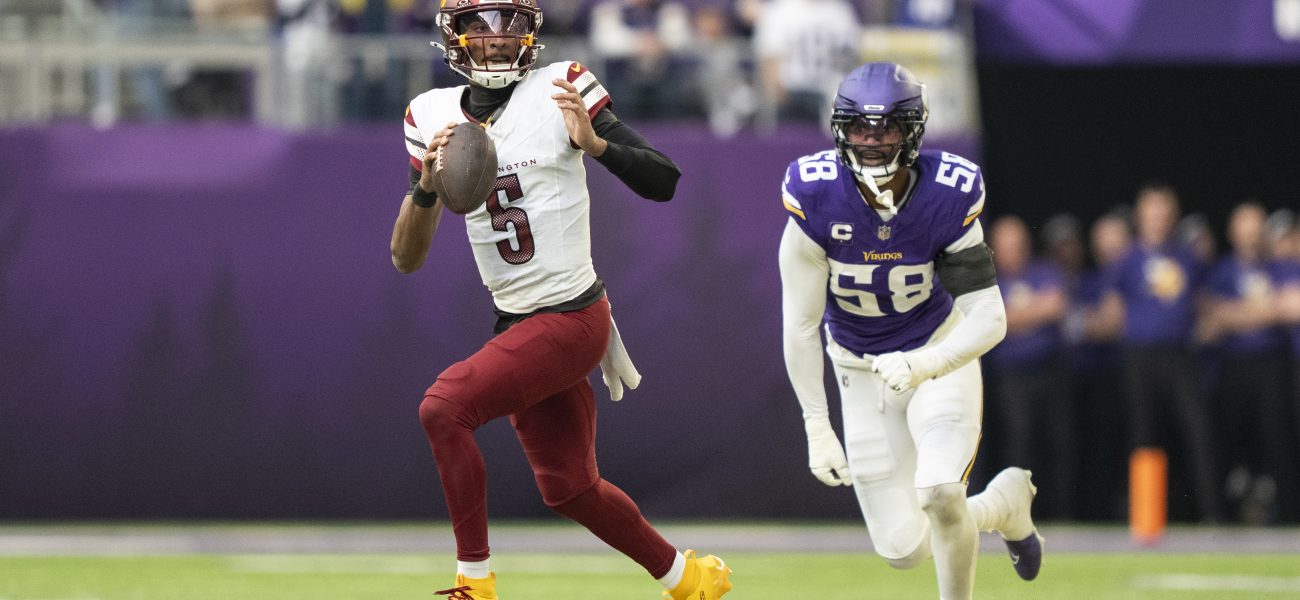
POLICY WIRE — Ashburn, Virginia — In Washington D.C., where policy gridlock is an art form and short-term memory a political virtue, another kind of capital-based institution regularly subjects its constituency to cycles of high-stakes hope and profound disappointment. I’m talking, of course, about the Commanders, specifically their ongoing saga to sculpt Jayden Daniels, a talent laden with both promise and recent scars, into a franchise quarterback who throws the darn ball.
It’s a long, often brutal march for any signal-caller who steps onto the Commanders’ turf. And Daniels, the 2024 second overall pick, certainly flashed the goods as a rookie. He amassed 891 rushing yards — and six touchdowns, alongside 3,568 passing yards, 25 scores, and nine picks. That’s an awful lot of doing for a newcomer. But the football gods—or perhaps, simply physics—had other plans in 2025. A dislocated elbow, a sprained left knee, — and a bum hamstring knocked him around, limiting him to a mere seven starts. Because, well, that’s just how it usually goes.
Now, heading into his third professional season, the strategic directive from the Commanders’ brass is crystal clear: Daniels needs to evolve into a pocket passer, one who looks to exploit the whole field rather than simply escaping it on foot. The franchise isn’t exactly looking for another human highlight reel running for first downs when a downfield strike might yield so much more. This isn’t just about preserving Daniels’ body, you see, but maximizing his arm. But that shift, everyone knows, doesn’t happen in a vacuum. It requires an ecosystem, players who understand nuance, players who can turn a broken play into a passing opportunity.
“We’re not building a track team out there,” Head Coach Dan Quinn quipped, leaning back in his chair during a March presser (where I suspect the coffee was as bland as most D.C. pronouncements). “Jayden’s got a cannon, — and we’re damn sure going to let him air it out. Extend the play? Absolutely. But extend it to make a *pass*, not just another footrace.” It’s a delicate dance, coaxing a dual-threat phenom away from his natural inclinations.
Enter Antonio Williams. The Commanders scooped up the Clemson wide receiver in the third round of the 2026 NFL Draft. He’s not a marquee splash, not a headline grabber from the top shelf. But within the meticulous calculus of team building, Washington’s front office believes Williams is exactly the kind of unglamorous-but-necessary asset required to redefine Daniels’ comfort zone, especially when plays break down. They’re betting the kid’s precise route-running can give Daniels the outlet he craves without always resorting to a scramble. After all, when Daniels dropped from 209.9 passing yards per game and a 100.1 passer rating in his rookie year to 180.3 and 88.1 after the injuries, a lot of that came down to losing receiving options and the general havoc his body was in. You just can’t produce when you’re consistently battered.
📄 POLICY WIRE WHITEPAPER PUBLISHED: PAKISTAN'S NATIONAL SECURITY POLICY PRIORITIES
👉 READ BY CLICKING HERE“He’s not just some raw talent we’re trying to mold into a position,” General Manager Adam Peters declared with a conviction that wouldn’t feel out of place in a Senate subcommittee hearing on defense spending. “This kid—Williams, I mean—he’s got the route-running finesse that allows Daniels, or any quarterback for that matter, to feel confident when things break down. He catches it, gets yards. It’s that simple, but believe me, simple is bloody hard to find in this league.” Peters specifically highlighted Williams’ film from 2024, before a hamstring injury slowed his 2025 college season, calling him a “great athlete, really fast” and, most critically, an “NFL route runner” who understands coverages.
This organizational pivot follows an internal regime change. Out is Kliff Kingsbury, Daniels’ original offensive coordinator, who departed after the 2025 season over philosophical differences. In is David Blough, promoted from within, signaling a push for consistency in messaging—a strategy not unlike a geopolitical administration appointing an experienced envoy to manage sensitive relations, hoping institutional memory can smooth a turbulent transition. Blough, a former NFL quarterback himself, is tasked with instilling more under-center principles and pushing Daniels to scan and connect with his targets, like veteran Terry McLaurin, the enduring anchor of the receiving corps, but now also with the newly minted Antonio Williams working the slot.
The Commanders, famously, ended last season ranked 22nd in total offense and scoring, a precipitous fall from 7th and 5th in 2024. And while their run game has consistently been a strength (ranking 4th in total rushing yards last year, per official NFL statistics), the passing game stagnated. That kind of imbalance doesn’t cut it in today’s league. For a team owned by Josh Harris, whose multifaceted investments span sports, finance, and various global ventures, ensuring the on-field product performs is hardly just a hobby; it’s an extension of a sprawling economic enterprise. Much like international investors from regions like South Asia often seek out stable, well-managed assets regardless of sector, Harris and his partners demand performance, which ultimately translates to higher valuations and robust fan engagement. The choices made on this gridiron—whether they involve a specific route concept or a personnel shift—are effectively corporate decisions, impacting brand, revenue, and future acquisition potential. This is big business, dressed up as a game.
What This Means
This isn’t merely about finding a new receiving option; it’s a calculated, high-stakes wager on redefining their most critical asset, Jayden Daniels. If Williams can genuinely ease Daniels’ transition to a pass-first mentality, offering reliable targets when chaos reigns, it’s a massive win. Economically, a successful Daniels translates into sustained fan interest, jersey sales, higher broadcast revenue projections, and—frankly—a much more attractive asset for current ownership. A struggling, injury-prone quarterback is a liability that depreciates quickly. Politically, within the insular world of the NFL, it solidifies the current coaching staff’s vision and justifies the considerable investment in their top draft pick. Conversely, if Daniels falters again, either due to continued injuries or a failure to adapt, it casts a long shadow over the entire front office. Every player acquired, every coach hired, is a policy decision designed to navigate the turbulent waters of professional sports. And they’re banking on a relatively anonymous third-rounder to help steady that ship, hoping he provides the quiet reliability Daniels—and by extension, the Commanders’ future—desperately needs. It’s a pragmatic move, echoing a corporate strategy: identify the specific weak point, inject targeted talent, and hope for systemic stability. And as any political pundit can tell you, hope isn’t a strategy, but sometimes, it’s all you’ve got.