


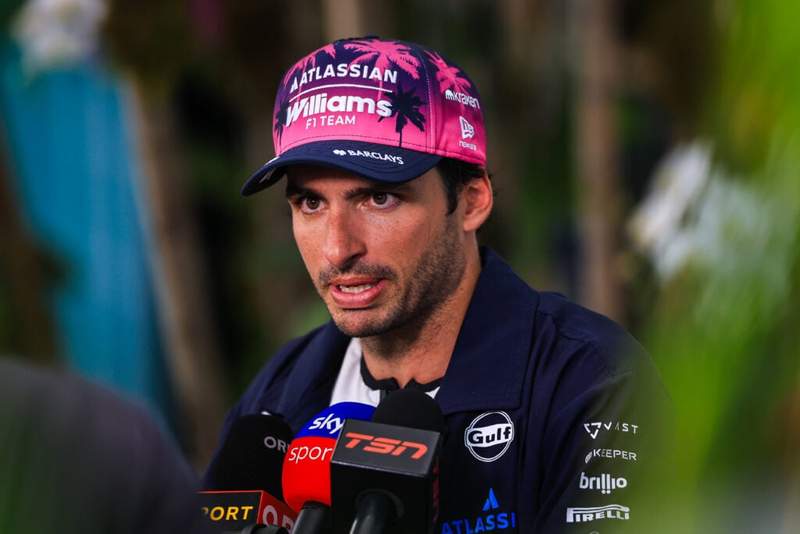
Sainz’s Siren Call: F1 Drivers Urged to Pivot from Critique to Collaboration on 2026 Rules
POLICY WIRE — Monaco, Principality — In the high-octane world of Formula 1, where split-second decisions dictate fortunes and careers hang by a thread of carbon fiber, the very act of public dissent...

POLICY WIRE — Monaco, Principality — In the high-octane world of Formula 1, where split-second decisions dictate fortunes and careers hang by a thread of carbon fiber, the very act of public dissent often feels like a strategic misstep. Still, drivers, those gladiators of the asphalt, perpetually find themselves caught between the unvarnished truth of the cockpit and the carefully curated narratives of their multi-million-dollar teams. So, when Ferrari’s Carlos Sainz, fresh off another robust performance, suggested his peers temper their public critiques of the impending 2026 technical regulations, it wasn’t merely a call for decorum; it was a subtle, yet profound, challenge to the sport’s entrenched culture of complaint.
It’s a peculiar dynamic, isn’t it? The very individuals who push these machines to their absolute limits are also the most vocal—and perhaps, the most qualified—critics of the rules governing their domain. But Sainz, who’s shown a knack for navigating both overtakes and political currents, believes the moment for grievances has passed. Instead, he’s advocating for a more constructive, collaborative pathway, particularly as the sport barrels towards a consequential regulatory overhaul that has already sparked considerable debate.
The updated 2026 rules, designed ostensibly to improve racing and reduce the performance gap, debuted in a preliminary sense at the recent Miami Grand Prix. Reactions from the paddock were, predictably, a mixed bag. McLaren’s Lando Norris, a driver often lauded for his candor, conceded some positive advancements. Yet, he pointed to lingering, fundamental issues with the intricate hybridisation systems that remain central to F1’s future powertrain philosophy. His teammate, Oscar Piastri, meanwhile, articulated a more fundamental unease, questioning the inherent logic behind certain changes, describing them as almost arbitrarily imposed.
And that’s the rub, isn’t it? For every nuanced observation, there’s an undercurrent of frustration. But Sainz, who secured another top-ten finish, opined that time is a necessary ingredient for evaluation. “Look, overtaking is overtaking. That’s true,” Sainz asserted to ESPN following the Miami race, acknowledging the core objective of the new rules. “But it depends more on what you do with the engine strategy and engine map than what you do as a driver.” It’s a candid admission, laying bare the complexities beneath the surface spectacle. “So I think these regulations still have potential for improvement. But I think it’s time to stop criticising and keep pushing for changes in the right direction.” It’s a sentiment that, while perhaps unpalatable to some, underscores a pragmatic approach to governance in a sport perpetually balancing innovation with competition.
The call for quiet comes at an interesting juncture. McLaren, in a rather telling move, reportedly instructed Norris to dial back his public observations—a curious directive considering his commentary hadn’t been overtly inflammatory of late. This sort of top-down management of driver narratives isn’t new, but it highlights the delicate tightrope teams walk between transparency and maintaining a unified front. Sainz’s appeal, therefore, might just signal a broader readiness among a segment of the driver cohort to transition from adversarial posturing to more hands-on engagement with regulatory bodies like the FIA and Formula 1 management.
📄 POLICY WIRE WHITEPAPER PUBLISHED: PAKISTAN'S NATIONAL SECURITY POLICY PRIORITIES
👉 READ BY CLICKING HERE“Formula 1 thrives on innovation, but also on a unified vision,” asserted Stefano Domenicali, CEO of Formula 1, in a statement obtained by Policy Wire, addressing the broader regulatory challenges. “Our partners, our teams, and critically, our growing global fanbase — including millions across the South Asian subcontinent — expect a degree of predictability, even amidst the most ambitious technical evolution. It’s imperative we collaborate to safeguard the sport’s integrity and its soaring popularity.” Indeed, F1 reported a global TV audience of 1.59 billion in 2023, according to official figures, a significant portion emanating from rapidly growing markets in Asia, where regulatory stability can directly influence investment appetite and fan engagement.
What This Means
At its core, Sainz’s intervention reflects a deeper, ongoing struggle within Formula 1: the tension between engineering ambition, competitive parity, and commercial viability. Regulatory shifts aren’t merely technical adjustments; they’re economic interventions. Unrest and public criticism from key stakeholders—the drivers—can destabilize sponsor confidence, detract from the sport’s carefully cultivated image, and potentially deter new market entries or expansions. The financial models that underpin the sport are incredibly sensitive to perceived instability. From an economic perspective, consistent regulatory frameworks, even if imperfect, allow teams and sponsors to plan with greater certainty, fostering investment. For emerging markets, particularly those in the Middle East and parts of South Asia, which are increasingly critical to F1’s global sporting ambitions, stability is paramount. Political leaders and investors in places like Saudi Arabia, Qatar, or potentially Pakistan—should F1 ever gaze in that direction—are keenly watching not just lap times, but the underlying health and political cohesion of the series. Internal strife, even if over engine maps, can signal broader governance challenges, making F1 a less attractive long-term proposition. The drivers, wittingly or not, wield significant influence over this perception, making Sainz’s diplomatic appeal a potentially pivotal moment in steering F1 towards a more unified future.