
Starmer’s Gambit: A Ukrainian Loan, A Brexit Olive Branch?
POLICY WIRE — London, UK — The chasm, it seemed, was beginning to narrow. Not through grand treaties or dramatic reversals, but through the grim exigencies of war. Keir Starmer, leader of Britain’s...

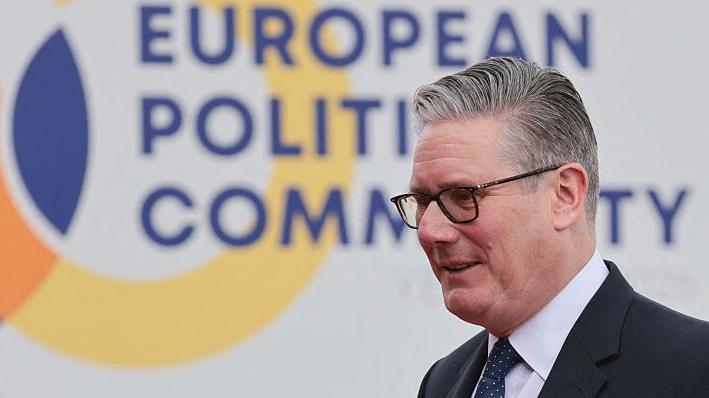
POLICY WIRE — London, UK — The chasm, it seemed, was beginning to narrow. Not through grand treaties or dramatic reversals, but through the grim exigencies of war. Keir Starmer, leader of Britain’s Labour Party, recently posited a rather pointed idea: the UK should join the European Union’s expansive loan scheme for Ukraine. It’s not just about Kyiv’s survival, he’s contending, but about mending the frayed sutures of a post-Brexit relationship that’s long been, shall we say, chilly.
At its core, this proposal isn’t merely an act of benevolence toward a besieged nation. It’s a shrewd political maneuver, a calculated overture suggesting that Britain, under a prospective Labour government, could chart a course of pragmatic cooperation with its European neighbors without, ostensibly, re-litigating the divorce. For those watching the perpetually fraught dynamic between London and Brussels, this isn’t simply aid; it’s a carefully chosen symbol, a tentative olive branch offered on a battlefield.
“Britain’s place is not on the sidelines of European stability; it’s at the heart of finding pragmatic solutions to the gravest challenges of our era,” Starmer asserted, his voice carrying the weight of a leader-in-waiting, during a recent foreign policy address. “Participating in the EU’s macro-financial assistance mechanism for Ukraine demonstrates a commitment to collective security, and crucially, signals a renewed willingness to work hand-in-glove with our closest partners.”
Still, the current Conservative government, perpetually wary of anything that smells remotely of ‘rejoining,’ has shot back with expected caution. A senior official within the Foreign, Commonwealth and Development Office, speaking anonymously but reflecting Whitehall’s established position, opined that while the UK’s commitment to Ukraine remained “unwavering,” its aid would continue through “independent, bilateral channels.” There’s an understandable fear, you see, that joining an EU scheme could be perceived as blurring the hard-won lines of sovereignty – a notion that still carries considerable political currency within the ruling party’s ranks. But one must ask: at what cost?
Indeed, the financial commitment is not insignificant. The European Union has pledged a substantial €18 billion (around £15.4 billion) in macro-financial assistance for Ukraine for 2023 alone, a figure designed to stabilize its economy amidst the relentless Russian onslaught, according to data from the European Commission. This isn’t just humanitarian relief; it’s keeping the lights on, literally and figuratively, for a nation under existential threat. And while the UK has been a major bilateral donor, its absence from this particular joint financial muscle-flexing has been duly noted on the continent.
But the ramifications stretch beyond Europe’s borders. The sustained financial and military drain on Western treasuries for Ukraine often means less bandwidth – or indeed, less inclination – for other global crises. Consider Pakistan, for instance, a nation grappling with its own precarious economic situation, compounded by devastating climate events and persistent security challenges. While Ukraine rightfully demands immediate attention, the interconnectedness of global finance means that significant commitments in one theatre can subtly, but inevitably, recalibrate priorities and resource allocation elsewhere. For nations like Pakistan, navigating a complex geopolitical landscape, the stability of global financial architectures – and the unity of major Western powers – isn’t a theoretical concern; it’s a tangible factor influencing their own quest for stability and development. It’s all part of the grand, messy tapestry of international relations, isn’t it?
📄 POLICY WIRE WHITEPAPER PUBLISHED: PAKISTAN'S NATIONAL SECURITY POLICY PRIORITIES
👉 READ BY CLICKING HEREAnd let’s not forget the symbolic heft. A unified financial front, especially one involving the UK — and EU, could send a potent message to Moscow. It suggests a long-term commitment that transcends immediate political cycles, underpinning Ukraine’s resilience for the duration. It also represents a stark contrast to past episodes where Western unity sometimes faltered, leaving adversaries (and indeed, allies like Ukraine) in an unenviable lurch. The geopolitical stakes couldn’t be higher.
What This Means
Starmer’s proposition, while pragmatic, serves multiple strategic ends. Politically, it allows Labour to brand itself as the party of sober, constructive international engagement, particularly after years of often acrimonious post-Brexit squabbles. It’s a clear differentiation from the current government, which often prioritizes perceived sovereignty over deeper integration, even where mutual benefit is evident. Economically, joining the loan scheme could offer Britain a seat at a consequential European table, influencing the terms and conditions of aid, and perhaps leveraging its financial expertise. This isn’t about writing a blank cheque; it’s about investing in a shared future.
it lays groundwork for a potential reset of UK-EU relations. Should Labour come to power, such a move could pave the way for broader collaboration on issues from security to climate change, areas where disentanglement has proven more complex and costly than initially advertised. It won’t erase Brexit, no. But it could certainly soften its edges, establishing pathways for cooperation where none currently exist. It hints at a future where Britain, having charted its own course, nonetheless recognizes the imperative of working closely with its European neighbours to confront global challenges. For Europe, facing an uneasy reckoning of its own regarding self-reliance, a more cooperative Britain would be a welcome, if long-awaited, development. This isn’t just about Ukraine; it’s about redefining Britain’s place in a volatile world.