


The Cost of Compassion: A Humpback’s Release and the Quandary of Conservation Policy
POLICY WIRE — Coastal Metropolis, Global Ocean — Not every high-stakes policy debate unfolds in gilded halls or beneath the clamor of legislative sessions. Sometimes, it’s played...

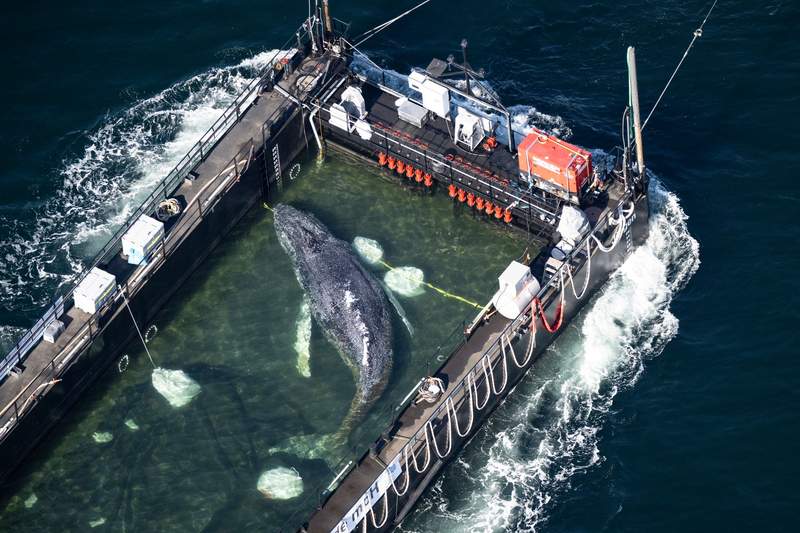
POLICY WIRE — Coastal Metropolis, Global Ocean — Not every high-stakes policy debate unfolds in gilded halls or beneath the clamor of legislative sessions. Sometimes, it’s played out in the tranquil, yet perilous, shallow waters where a single, displaced humpback whale—dubbed Timmy by his human custodians—has become an unlikely fulcrum for a profound conservation quandary. The impending release of this 40-ton leviathan back into deeper, more suitable oceanic expanses isn’t just a feel-good story; it’s a stark, expensive lesson in where our societal compassion, and finite resources, truly lie.
For months, Timmy, an adolescent male, has been an immense undertaking. His accidental stranding in a comparatively constricted bay prompted an intervention of staggering proportions: round-the-clock monitoring, intricate feeding protocols, and the continuous strategizing of marine biologists, veterinarians, and logistical teams. And it’s costing a fortune, a figure quietly footed by a mélange of public funds and private donations, though no exact public ledger exists — a typical opacity in these kinds of endeavors.
Dr. Elara Vance, lead marine biologist at the Ocean Stewardship Institute, didn’t mince words. “Every life is precious, of course,” she shot back during a recent virtual press briefing, “but the scale of intervention for Timmy underscores a systemic challenge — the ocean’s health can’t be fixed one animal at a time, not when we’re facing such colossal threats.” Her observation cut through the romanticism, isn’t it? It pointed to a broader, more inconvenient truth about the political economy of environmental protection.
Still, the emotional pull of an individual animal in peril is undeniable, often eclipsing less charismatic, yet perhaps more existentially dire, ecological crises. Imagine the headlines if the same resources — millions, by some estimates — were poured into, say, mitigating ghost fishing gear or cleaning up microplastic pollution in the open ocean. These are the less glamorous battles, the ones fought against an invisible enemy, not a majestic, relatable behemoth.
And that’s where the policy dilemma crystallizes. Governments — and NGOs grapple with the allocation of limited budgets. Do you invest in the visible, singular rescue that galvanizes public support, or the systemic, often unseen, efforts that prevent countless future casualties? It’s a choice that reflects deeper societal values and, often, a pragmatic understanding of public relations.
Consider the contrast: while developed nations pour immense resources into the individual care of animals like Timmy, many coastal states in the Muslim world, from the Arabian Sea to the Indonesian archipelago, face overwhelming marine degradation with comparatively paltry means. Pakistan, for instance, grapples with rampant plastic pollution, industrial discharge, and overfishing in its extensive coastline. They’ve established marine protected areas and launched initiatives to combat pollution, yes, but often without the specialized, multi-million-dollar rapid response capabilities seen in the West for a single animal. Their conservation calculus must accommodate not just ecological preservation, but also the immediate economic realities of millions dependent on the sea for sustenance. It’s a vastly different kind of perilous calculus.
📄 POLICY WIRE WHITEPAPER PUBLISHED: PAKISTAN'S NATIONAL SECURITY POLICY PRIORITIES
👉 READ BY CLICKING HEREBehind the headlines of Timmy’s successful relocation lies an ocean drowning in human refuse. Global plastic production, for instance, is projected to nearly triple by 2060, reaching 1 billion tonnes annually, according to a 2022 report by the Organisation for Economic Co-operation and Development (OECD). This isn’t just unsightly; it’s a direct threat to whales, seabirds, and marine ecosystems on a scale that individual rescues can never truly address.
Undersecretary Mark Jenkins from the Department of Fisheries — and Oceans admitted the complexity. “Allocating these resources is a continuous negotiation, a delicate balance between public expectation and scientific necessity,” he conveyed in a rather clipped tone. “We’re certainly learning valuable lessons here about community engagement and the sheer scale of modern marine logistics.” He wouldn’t elaborate on the precise financial outlay, naturally.
What This Means
Timmy’s odyssey, culminating in a hopefully successful return to the deep, isn’t merely an environmental feel-good story; it’s a potent illustration of policy’s inherent tensions. Economically, the immense cost of such a rescue — while publicly popular — raises questions about opportunity cost. Could these funds, funneled into broader ocean health initiatives, yield greater overall ecological benefits? Politically, these high-profile animal rescues serve as powerful emotional touchstones, allowing governments and organizations to demonstrate immediate, tangible action on environmental issues, which resonates strongly with a public often disengaged from more abstract policy debates about climate change or biodiversity loss. It’s an exercise in balancing the optics of compassion with the hard, cold realities of budgetary constraints and systemic neglect. And, as we’ve seen with the silent famine of global humanitarian funding, resources are always a zero-sum game.
At its core, the Timmy narrative forces us to confront a fundamental question: Is our conservation policy optimized for saving charismatic individuals or for preserving the ecosystems that sustain all life, even those creatures far less appealing than a majestic humpback? The answer, like Timmy’s future, remains very much in flux.