


Beneath the Desert Sky: Albuquerque’s Bridge Milestone Echoes a National Infrastructure Reckoning
POLICY WIRE — ALBUQUERQUE, N.M. — It wasn’t the fanfare of a ribbon-cutting, nor the thunderous roar of a rocket launch. Instead, the New Mexico Department of Transportation (NMDOT) recently...

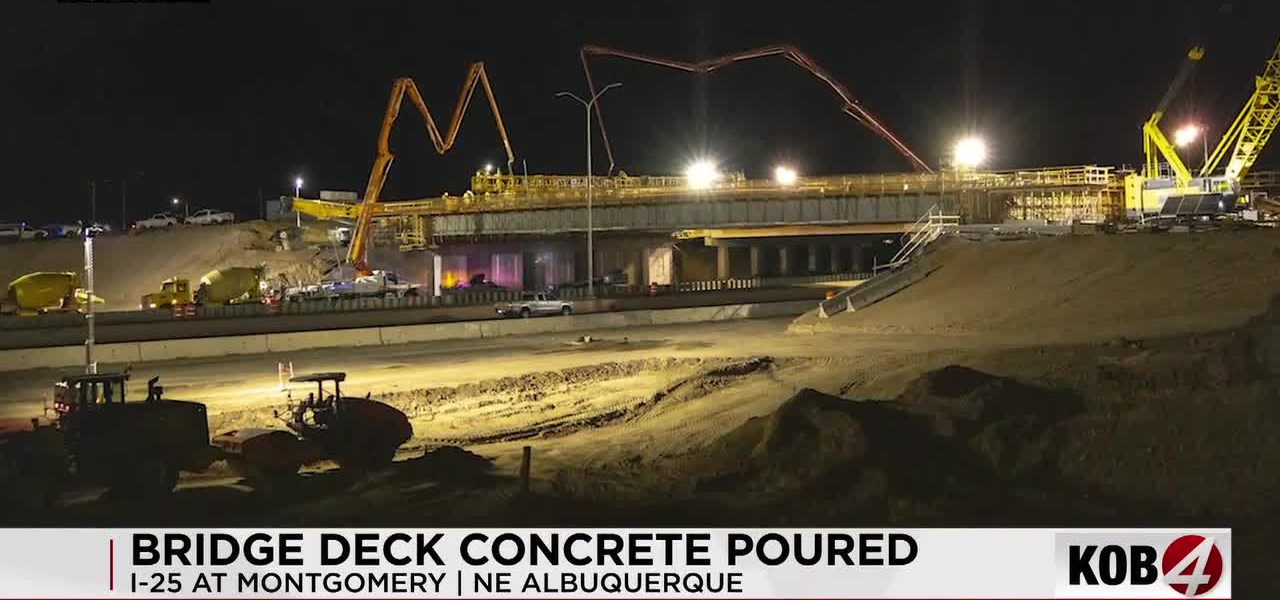
POLICY WIRE — ALBUQUERQUE, N.M. — It wasn’t the fanfare of a ribbon-cutting, nor the thunderous roar of a rocket launch. Instead, the New Mexico Department of Transportation (NMDOT) recently heralded a quieter, yet arguably more consequential, triumph: the completion of the concrete deck pour for the eastbound Montgomery Boulevard bridge over I-25. This seemingly mundane achievement in the high desert city of Albuquerque, however, belies a much larger narrative about the nation’s creaking infrastructure, its enduring economic arteries, and the silent, relentless grind of progress against decay.
For weeks, the rhythmic drone of machinery has been a fixture for commuters navigating the bustling interstate—a temporary inconvenience for what state officials contend is a permanent necessity. But its culmination marks a pivotal step in a years-long endeavor to modernize a critical urban interchange. This particular pour, requiring the coordinated might of two specialized concrete pump trucks, now forms the foundational stratum for future vehicle traffic, promising smoother, safer passage across what’s become a veritable chokepoint.
“This isn’t just about pouring concrete; it’s about connecting communities, fostering economic vitality, and ensuring New Mexico remains a place where commerce moves freely and safely,” shot back New Mexico Governor Michelle Lujan Grisham, her office having previously underscored the project’s importance for regional growth. “We’re investing in our future, brick by laborious brick, and this milestone proves that commitment isn’t just rhetoric—it’s tangible progress.”
Behind the headlines of grand federal infrastructure bills, these local projects represent the granular reality of that investment. They’re the sinews — and bones of a complex national organism, often out of sight, yet absolutely vital. The completion allows crews to pivot now to the intricate dance of constructing on- and off-ramps, along with the adjacent frontage roads—a labyrinthine effort demanding precision and patience from both engineers and the motoring public.
And it’s a patient public that America sorely needs. The American Society of Civil Engineers’ 2021 Infrastructure Report Card, a sobering read for anyone concerned with national resilience, starkly noted that roughly 7% of the nation’s bridges—some 43,578 structures—remain structurally deficient. The Montgomery Boulevard project, though relatively small in the grand scheme, epitomizes the painstaking work required to incrementally whittle away at that daunting deficit.
Still, the methodical execution observed here in Albuquerque stands in stark contrast to the infrastructure woes that plague many developing nations, where political will often falters and critical projects languish, sometimes with devastating consequences. Consider the ongoing challenges in Pakistan, for instance, where infrastructure development struggles against a backdrop of economic instability and regional tensions. While Albuquerque’s bridge workers contend with desert heat and traffic management, their counterparts in Karachi or Lahore might face far greater uncertainties, from funding shortages to geopolitical disruptions affecting material supply chains. It’s a stark reminder that even the concrete in our bridges isn’t immune to global ripples, making every successful pour a quiet victory for stability. Indeed, the very components used in such construction projects often travel a winding path across continents, a testament to an interconnected world.
📄 POLICY WIRE WHITEPAPER PUBLISHED: PAKISTAN'S NATIONAL SECURITY POLICY PRIORITIES
👉 READ BY CLICKING HEREU.S. Secretary of Transportation Pete Buttigieg, speaking broadly on such state-level initiatives, emphasized the collaborative imperative. “From Albuquerque to Appalachia, America’s infrastructure deficit has been a bipartisan concern for far too long,” he articulated during a recent policy brief. “Projects like the Montgomery Boulevard bridge, though seemingly local, are the granular components of a nationwide endeavor—a testament to our commitment to modernizing the arteries of this country, often with federal assistance that proves indispensable.”
It’s not just about moving cars; it’s about the commerce they carry, the jobs they connect people to, and the emergency services that rely on swift passage. Every new bridge deck laid, every widened lane, subtly recalibrates a local economy, injecting efficiency into its veins and, perhaps more significantly, bolstering public confidence in the state’s capacity to deliver on essential services. So, while the Montgomery Boulevard project won’t capture international headlines quite like, say, the struggle for Balochistan’s resources, its completion is a tangible, albeit less dramatic, marker of societal progress.
What This Means
This construction milestone, far from a mere engineering footnote, offers a microcosm of America’s ongoing infrastructure policy battle. Economically, it promises reduced commuter times and enhanced logistical flows for businesses in a crucial regional hub, translating directly into economic efficiencies that compound over time. Politically, such projects, while sometimes delayed and frustrating for constituents (who hasn’t cursed a traffic cone?), are vital proof points for state and federal administrations seeking to demonstrate their competence and commitment to long-term public good. They also underscore the intricate dance between federal funding—often tied to broader legislative packages—and state-level execution. It’s a delicate equilibrium, where local needs meet national policy ambitions. The ability to complete these projects on schedule, or at least with demonstrable progress, becomes a quiet yet potent political asset, reassuring voters that their tax dollars are, in fact, laying down new foundations, rather than merely patching old cracks. It’s a pragmatic, unglamorous form of nation-building, but it’s building nonetheless.