


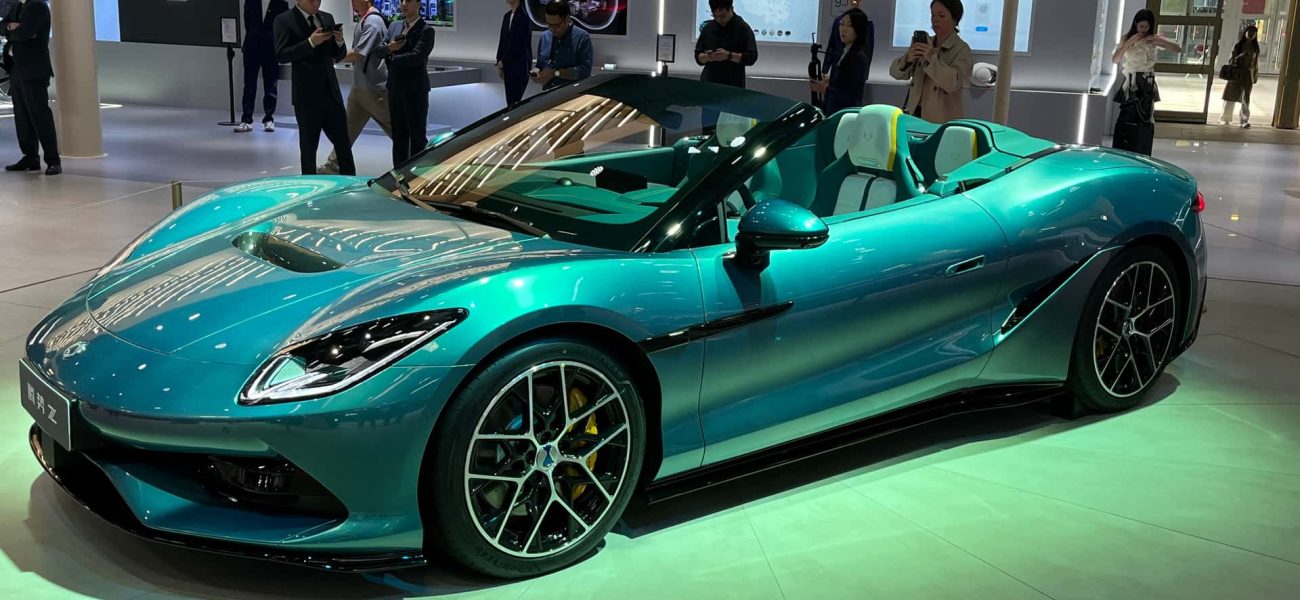
Shenzhen’s 1,000-Horsepower Gauntlet: BYD’s Denza Z Delineates a New Global Automotive Order
POLICY WIRE — BEIJING, CHINA — The roaring silence of a 1,000-horsepower electric roadster, the Denza Z, emerging from BYD’s Shenzhen laboratories isn’t merely an engineering feat;...

POLICY WIRE — BEIJING, CHINA — The roaring silence of a 1,000-horsepower electric roadster, the Denza Z, emerging from BYD’s Shenzhen laboratories isn’t merely an engineering feat; it’s a stark, undeniable declaration. It’s a precisely engineered gauntlet thrown at the feet of legacy automakers and a testament to China’s accelerating dominance in a sector once the exclusive domain of American and European titans. This isn’t just about speed or luxury; it’s about industrial policy, geopolitical leverage, and the relentless recalibration of global economic power.
For too long, the West harbored a comforting — and frankly, quite naive — assumption: Chinese innovation, particularly in high-performance segments, would always trail. But the Denza Z, a concept car that’s now a tangible, neck-snapping reality, shatters that illusion with the force of its prodigious electric motor. It doesn’t just match rivals; it pushes boundaries, offering supercar aesthetics and hypercar performance without the customary stratospheric price tag. And it’s doing so with a blend of cutting-edge battery technology and sophisticated design that suggests a maturity few outside China predicted.
At its core, this vehicle—developed by Denza, a joint venture that once included Mercedes-Benz but is now predominantly BYD’s — underscores a much broader, more consequential narrative. It illustrates a manufacturing might that isn’t just about volume anymore, but about vertical integration, technological prowess, and a strategic vision for market capture. They’re not just assembling cars; they’re designing and manufacturing everything from the battery cells to the intricate software. This integrated approach grants them unparalleled cost efficiencies — and speed to market, leaving competitors gasping.
“We’re not simply building vehicles; we’re crafting the future of global mobility,” asserted Chen Gang, a senior policy advisor to China’s Ministry of Industry and Information Technology, during a recent economic forum. “Our innovation knows no arbitrary bounds, and the world is finally recognizing the depth of our technological ambition.” It’s a confidence that feels earned, particularly when examining market statistics. According to reports from Canalys, BYD indeed surpassed Tesla in Q4 2023, delivering over 526,000 battery electric vehicles globally, compared to Tesla’s 484,500 – a statistical pivot that shifted the global EV crown. That’s not just a lead; it’s a seismic shift.
Still, the implications stretch far beyond direct sales competition. The Denza Z, like so many of its Chinese brethren, represents a strategic pivot for nations grappling with energy security and environmental mandates. Countries like Pakistan, for instance, are increasingly looking to China for affordable and technologically advanced EV solutions as they strive to reduce crippling fuel import bills and curb urban pollution. The prospect of high-performance, cost-effective EVs like the Denza Z — or its more utilitarian cousins — entering these markets could fundamentally reshape local automotive industries, fostering new dependencies while simultaneously offering pathways to modernization. It’s a complex dance, isn’t it?
Western policymakers, long accustomed to dictating the terms of industrial development, are finding themselves on the back foot. “For years, we dismissed Chinese innovation as merely imitative,” lamented Dr. Eleanor Vance, a geopolitical economist at the European Policy Institute, in a recent interview. “Now, it’s abundantly clear they’re setting benchmarks across the spectrum, from battery chemistry to autonomous driving. That’s not just an automotive challenge; it’s a reckoning for established industrial powers and a potent symbol of shifting global influence.” The economic ripples from such a paradigm shift can’t be overstated.
📄 POLICY WIRE WHITEPAPER PUBLISHED: PAKISTAN'S NATIONAL SECURITY POLICY PRIORITIES
👉 READ BY CLICKING HEREBehind the headlines of blistering acceleration — and sleek design lies a fierce geopolitical contest. China’s EV manufacturers, often backed by substantial state investment and strategic foresight, are not just competing on price; they’re competing on technology, scale, and global reach. Their rapid expansion into Southeast Asia, Latin America, and increasingly, parts of the Middle East and Africa, isn’t just good business; it’s an extension of Beijing’s soft power and economic diplomacy. And it’s proving incredibly effective, especially as nations search for alternatives to what they perceive as Western technological hegemony.
It’s not just about the destination; it’s also about the journey. The swiftness with which BYD and its peers have developed these advanced vehicles, navigating stringent regulatory environments and consumer expectations, speaks volumes about China’s industrial resilience and its capacity for rapid iteration. They’ve learned, they’ve adapted, — and now, they’re leading.
What This Means
The arrival of vehicles like BYD’s Denza Z signifies more than just another competitor in the luxury EV space; it delineates a profound shift in global industrial leadership with significant geopolitical ramifications. Economically, it heralds intense pressure on legacy automakers in Europe, Japan, and the U.S., forcing them to accelerate their own EV development, often at higher costs. We’re seeing a direct challenge to the profitability and market share of companies like Porsche, Tesla, and Ferrari – brands that once felt untouchable in performance luxury. This competition could trigger trade tensions, with Western nations potentially implementing tariffs or other protective measures against Chinese imports, creating a volatile environment for global commerce.
Politically, China’s ascendance in advanced manufacturing bolsters its credibility as a technological superpower. It grants Beijing greater leverage in international negotiations and strengthens its Belt and Road Initiative by offering tangible, high-tech products alongside infrastructure. For developing nations, particularly those within the Muslim world and South Asia, access to affordable, cutting-edge Chinese EVs presents a tantalizing prospect for sustainable development and economic growth, potentially fostering deeper ties with Beijing. This, in turn, could diminish the influence of traditional Western allies and their economic models, reshaping regional alliances. The sheer scale and speed of this transformation — from industrial underdog to global frontrunner — suggests a future where Beijing increasingly dictates the terms of technological progress and economic engagement. It’s a transformative period, don’t you think? And it isn’t going to slow down.