


Eagles’ Quarterback Gambit: The Unconventional Pursuit of Cole Payton and the NFL’s Talent Calculus
POLICY WIRE — Philadelphia, USA — It’s a curious addiction, this obsession with signal-callers. Even with a Super Bowl MVP firmly entrenched and a veteran safety net already secured, the Philadelphia...

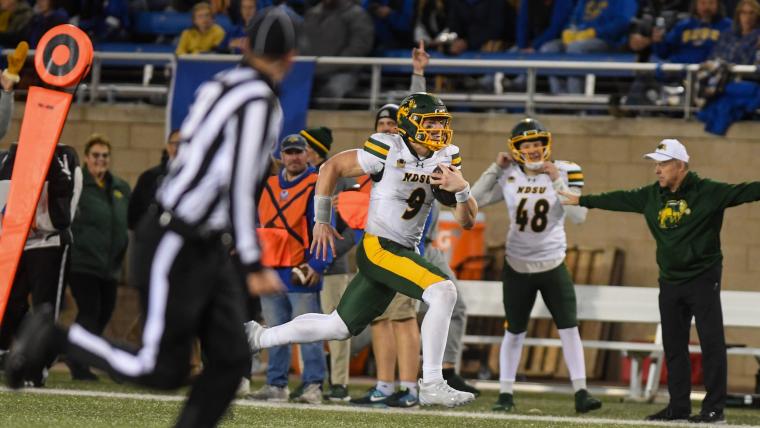
POLICY WIRE — Philadelphia, USA — It’s a curious addiction, this obsession with signal-callers. Even with a Super Bowl MVP firmly entrenched and a veteran safety net already secured, the Philadelphia Eagles — under the notoriously acquisitive gaze of General Manager Howie Roseman — couldn’t resist. They just had to draft another quarterback. And not just any quarterback, but Cole Payton, a left-handed, dual-threat marvel from the Football Championship Subdivision (FCS), a league few casual fans track.
This isn’t about immediate need; it’s about an organizational philosophy, a relentless pursuit of what Roseman terms a “quarterback factory,” even if it risks a logjam worthy of a rush-hour motorway. Payton, selected in the fifth round of the 2026 NFL Draft, represents the latest, most intriguing cog in this ever-expanding machinery. He’s not a polished passer, not yet, but a raw, explosive athlete — a speculative stock pick in a market obsessed with certainty.
Payton hails from North Dakota State, a veritable powerhouse in the FCS, soon to ascend to the Football Bowl Subdivision (FBS) in the Mountain West. But don’t mistake NDSU’s dominance for NFL readiness. Payton spent most of his tenure as a backup, blossoming only in his final year as a starter. Still, his collegiate numbers for a singular starting season were impressive against FCS defenses: 2,719 passing yards and 16 touchdowns, alongside a staggering 777 rushing yards and 13 scores in 2025. Over his career, Payton amassed 1,919 rushing yards, a stark indicator of his primary NFL upside, according to The Sporting News.
Many a scout, no doubt, has penciled him in with that ubiquitous comparison: Taysom Hill. You know, the Saints’ Swiss Army knife, a player whose positional versatility often overshadows his actual quarterbacking prowess. Payton, standing at 6-foot-3 and 233 pounds, possesses a similar physical profile, a formidable runner capable of extending plays, if not consistently picking apart defenses from the pocket. “He’s a curiosity, a raw, explosive athletic specimen who could redefine a gadget role or simply fade,” one veteran scout, who preferred anonymity given the volatile nature of draft assessments, mused. “It’s a calculated gamble, pure — and simple, and frankly, those are the ones that keep GMs up at night.”
And so, the Eagles’ quarterback room swells. Jalen Hurts remains the unquestioned incumbent, a Super Bowl performer whose contract reflects his stature. Behind him, the veteran Andy Dalton, acquired earlier from the Carolina Panthers, offers a dependable, if unspectacular, relief option. Then there’s Tanner McKee, a homegrown talent the Eagles have consistently lauded, whose arm talent has occasionally flashed. Payton’s arrival pushes McKee even further down the depth chart, intensifying speculation about a potential trade for the former BYU standout.
“Our philosophy isn’t just about finding starters; it’s about perpetually stress-testing the ceiling of our positional groups,” Roseman himself once posited to reporters, a slight smile playing on his lips. “Quarterbacks, especially, are a scarce commodity; you can’t have enough talent in that room.” This mantra explains the seeming gluttony, the continuous investment in a position that often sees teams scramble for even middling talent.
But it’s also a high-stakes poker game. Last year, the Eagles drafted Kyle McCord in the sixth round, only to waive him before the regular season even began. That’s the brutal calculus of the NFL: every draft pick is a lottery ticket, — and most don’t pay out. Payton’s immediate future isn’t as a starter, or even a primary backup. It’s likely as a project, a specialized weapon for trick plays, a dynamic runner whose passing game needs considerable refinement.
📄 POLICY WIRE WHITEPAPER PUBLISHED: PAKISTAN'S NATIONAL SECURITY POLICY PRIORITIES
👉 READ BY CLICKING HERENew offensive coordinator Sean Mannion will be tasked with molding this raw clay. Can Payton translate his FCS athleticism to NFL success? Will he be another Hill, or just another name on the roster churn? It’s a question that hangs heavy over every mid-round selection, a testament to the league’s ceaseless appetite for potential.
What This Means
This latest Eagles move isn’t just about a football team; it’s a microcosm of the brutal, globalized calculus of talent acquisition that permeates industries worldwide. Philadelphia’s relentless pursuit of quarterbacks, even from unconventional pipelines like the FCS, reflects a strategic imperative: mitigate risk by stockpiling potential, no matter how raw. In a world where one star player (or one key innovator) can redefine an organization’s fortunes, the investment in multiple, sometimes redundant, assets becomes a calculated hedge.
For regions like South Asia, where sporting infrastructure often lags behind developed nations, this NFL draft strategy offers a peculiar parallel. The search for Payton — a diamond in the FCS rough — mirrors the global quest for untapped human capital, whether it’s software engineers from Lahore or cricket prodigies from Karachi, struggling against systemic limitations to break into global-tier competitions. The premium placed on sheer athleticism and potential over immediate polish, as seen with Payton, speaks to a willingness to invest in development, hoping to unlock transformative value. But it also underscores the stark reality: for every Payton who gets a shot, countless others with similar raw gifts remain undiscovered, their potential unfulfilled, simply because the scouting networks or developmental pathways don’t reach them. The NFL’s luxury of choice — drafting four quarterbacks for a single roster — is a privilege many global talent pools simply don’t possess.
At its core, this move signals a further blurring of positional lines in the NFL, a recognition that specialized athletes with unique skill sets can disrupt traditional offensive schemes. Whether Payton ultimately succeeds or becomes just another footnote in the Eagles’ relentless roster churn, his selection is a vivid reminder: in the perpetual arms race of professional sports, potential is king, and teams are willing to look under every rock to find it.