


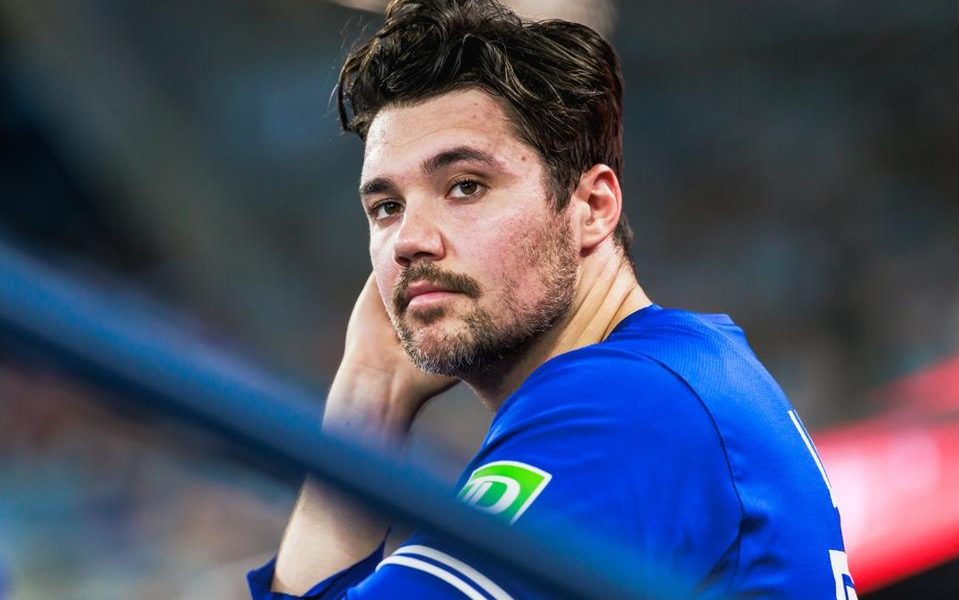
Digital Fury’s Toll: Blue Jays Pitcher’s Agony Unmasks Global Fan Toxicity
POLICY WIRE — Toronto, Canada — The echoes of a single, ill-fated pitch can reverberate far beyond the stadium — into the deepest recesses of an athlete’s mind, and, in the digital age, across...

POLICY WIRE — Toronto, Canada — The echoes of a single, ill-fated pitch can reverberate far beyond the stadium — into the deepest recesses of an athlete’s mind, and, in the digital age, across the vast, often venomous, expanse of the internet. Brendon Little, a Toronto Blue Jays hurler, found this out in the most brutal fashion imaginable. His narrative isn’t just about a fastball gone awry or a season derailed; it’s a stark, harrowing exposé of modern fandom’s most corrosive tendencies and the immense psychological burden shouldered by those who dare to perform in the public eye.
It wasn’t a contentious trade or a locker-room scandal that brought the deluge upon Little, but rather a solitary swing of the bat during the 2025 World Series. A pivotal Game 3, a walk-off home run conceded to Freddie Freeman in the 18th inning — a moment of athletic fallibility that, for many, would be a career lowlight, certainly. But for Little, it became a personal crucible. He retreated from the mound, carrying not just the weight of defeat, but also the nascent seeds of a public crucifixion.
Behind the headlines of team slumps and pitching rotations, Little recounted an off-season plagued by a relentless, chilling torrent of death threats. “The last pitch Little threw in 2025 landed in the Dodger Stadium seats,” veteran baseball writer Mike Wilner chronicled for the Toronto Sun. “He had to sit on that all winter while the death threats kept rolling in.” Hundreds, Wilner specified, flooding inboxes and social media feeds, transforming a professional setback into an existential threat. And that’s the insidious twist: what once might have been boos from the stands now metastasizes into direct, personal menace delivered directly to one’s digital doorstep.
So, it’s hardly surprising that when the 2026 season commenced, Little’s performance was, to put it mildly, abysmal. His earned run average (ERA) ballooned to an almost inconceivable 24.55 in five Major League outings — a stark contrast to his respectable 3.03 ERA from the previous regular season. The psychological torment, it seemed, had translated directly to the physical realm. “It wears on you,” Little confessed, describing the continuous offseason death threats. “You start putting more pressure on yourself to go out — and pitch well. Start doubting things that you’d never even thought about. That’s something that was new to me.” It wasn’t just physical mechanics; it was the mind, an invisible opponent far more formidable than any batter.
This isn’t an isolated incident, mind you. Across the globe, from the manicured lawns of Wimbledon to the dust-laden pitches of Lahore, athletes frequently find themselves targets of hyper-aggressive fan bases. One might recall the intense scrutiny and vitriol often directed at cricket stars in South Asia — where a single dropped catch or a poor batting display in a high-stakes match, like a World Cup encounter, can unleash a maelstrom of abuse, effigy burnings, and even threats against players’ families. It’s a passion that, when curdled, becomes toxic. Indeed, surveys indicate a significant majority of professional athletes grapple with some form of online harassment; a 2021 study by the Australian Institute of Sport found that 35% of elite athletes reported experiencing online harassment, a figure that’s likely conservative when accounting for unreported instances and the sheer volume of low-level abuse.
Toronto Blue Jays Manager John Schneider, observing the broader pattern, understands the precarious position of his players. “The intensity of modern sports, amplified by social media, demands an unprecedented level of mental resilience,” Schneider remarked recently. “We’re not just coaching skills; we’re supporting human beings through immense pressure, and it’s incumbent upon us, as organizations, to provide robust mental health frameworks that address these very real, very ugly realities.” This sentiment underscores a growing recognition within professional sports that the battlefield isn’t just the field itself, but the digital ether that surrounds it.
📄 POLICY WIRE WHITEPAPER PUBLISHED: PAKISTAN'S NATIONAL SECURITY POLICY PRIORITIES
👉 READ BY CLICKING HERELittle, thankfully, found a lifeline. He wisely disengaged from social media — a digital detox, if you will — and embraced a demotion to Triple-A, a move that would typically feel like a professional demotion but proved to be a psychological ascent. Down in the minors, away from the glaring lights and the digital mobs, his form returned; he boasts a 1.29 ERA over seven games. “The mental break’s probably been the biggest thing,” he acknowledged, a telling insight into the restorative power of distance. “Just come down here — and have fun with teammates again. Focus on doing what I feel like I can do rather than, ‘Better put up a zero or else I get crucified for the next two outings.'” That raw admission — the fear of crucifixion — speaks volumes.
What This Means
At its core, Brendon Little’s ordeal isn’t merely a baseball story; it’s a profound commentary on the societal undercurrents of the digital age. The ease of anonymity online has emboldened a segment of the populace to transform fervent fandom into outright malice, wielding keyboards as weapons against public figures. This phenomenon carries significant implications, not only for the athletes themselves — whose mental well-being and careers hang in the balance — but for the broader economy of sports and entertainment. Leagues and franchises must increasingly allocate resources to mental health initiatives, essentially offsetting the psychological costs imposed by an unpoliced online environment. From a policy perspective, this incident highlights the perennial debate surrounding content moderation, free speech, and the responsibility of social media platforms. Where does passionate criticism end, — and criminal harassment begin? Governments and tech giants, often slow to react, face mounting pressure to navigate this ethical and regulatory quagmire. Indeed, the very notion of public discourse is being reshaped, with direct parallels seen in political spheres where online harassment silences voices or drives radicalization. The ease with which an individual can be targeted, regardless of geography or cultural context (think of the intense scrutiny faced by artists or politicians in emerging Middle Eastern nations or the vigilante justice narratives in India), underscores a global crisis of digital civility.
Still, Little’s story offers a sliver of hope. It’s a testament to resilience, certainly, but also a stark reminder that the human element — the fragile psyche beneath the jersey — is the most consequential component of any grand spectacle. Professional sports organizations, typically focused on performance metrics, are now forced to confront a more nebulous, yet utterly vital, metric: the mental fortitude of their stars against an invisible, often cruel, digital tide. It’s a new frontier in athlete welfare, — and one they can no longer afford to ignore.